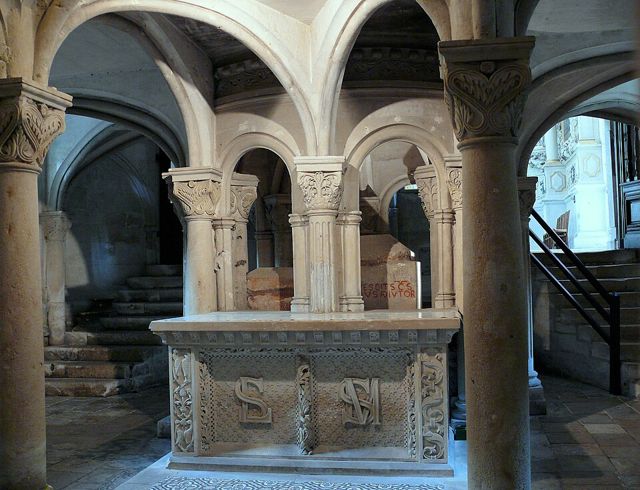
St. Vigilius

Vigilius was born around 353.

Read the essentials →
June 26 · Bishop, Martyr

St. Vigilius

St. Vigilius

Vigilius was born around 353.

Traditional feast

June 26
1914 / pre-1969 calendar, per Baring-Gould (1897)

Current feast

June 26
Secondary source · Wikipedia

Represents

Bishop
Martyr

Their story

Adapted in modern English from the Catholic Encyclopedia (1913) · original text below

Vigilius was born around 353. His mother Maxentia and his brothers Claudian and Magorian are also counted among the saints. As a boy he came with his parents to Trent, and he studied at Athens, where he became known for holiness and learning and seems to have befriended St John Chrysostom. In 380 he returned from Rome to Trent, and the people chose him as their bishop by acclamation. St Ambrose showed a fatherly care for him and urged him to oppose marriages with pagans.

He worked hard to convert the Arians (followers of Arius's teaching that the Son is a created being, not fully God) of Trent and the many idol-worshippers of his diocese. He also preached around Brescia and Verona and set up some thirty parishes there, putting his missionary companions in charge of them. Among these were Sts Sisinnius, Martyrius and Alexander from Cappadocia, who were martyred after a short apostolate, and Vigilius wrote an account of their martyrdom.

With his brothers and a priest named Julian he then went west of Trent into the Rendena Valley to preach to the worshippers of Saturn. There he offered Mass and threw the statue of Saturn into the River Sarca, and the enraged pagans stoned him to death on 26 June 405. His body was brought back to Trent and buried in the church he had built. Benedict XIV called him the first martyr canonized (officially declared a saint by the pope) by a pope. He is the patron of Trent and the Tyrol.

Early life

The book says little or nothing about early life. This is how the account begins.

Thin entry · the 1897 book gives only 26 words. We have not filled the gap with invented detail.

…venerated, and in their rage, the idolaters stoned him to death. His body was removed to Trent, and in the 15th century was translated to Milan.

What they represent

How they teach us to live

Drawn from themes in the original account

Keep their day. Remember them on June 26 with a short prayer, and ask for their help.

From the Catholic Encyclopedia

1913 · 480 words

Bishop of Trent, martyr, patron of Trent and of Tyrol, b. c. 353; d. 26 June, 405; feast 26 June. The name of his father was not known (Acta SS., June, VII, 143), though given by some as Theodosius [name of Roman emperors; Theodosius I (379–395) made Christianity the state religion]. His mother Maxentia (Acta SS., Apr., III, 781) and his brothers Claudian (Acta SS., March, I, 426) and Magorian (Acta SS., March, II, 398) are numbered among the saints. At an early age he came with his parents to Trent (possibly he was born there), and pursued his studies at Athens, becoming noted for his sanctity and learning; here he seems to have formed a friendship with St. John Chrysostom. He went to Rome and thence in 380 returned to Trent, where the people by acclamation chose him their bishop. He was consecrated by Valerian [Roman emperor 253–260, who persecuted bishops and clergy], Bishop of Aquileia, or possibly by St. Ambrose of Milan who donated the episcopal insignia and showed a paternal solicitude for Vigilius; he urged him (Ep. 29 in P.L., XVI, 982) to strongly oppose marriages with heathens. Vigilius laboured strenuously to convert the Arians [followers of Arius, who taught that the Son is a created being, not fully God] in the city of Trent and the many idolaters throughout the diocese. He preached the Gospel in the districts of Brescia and Verona, beyond the confines of his diocese, and there erected some thirty parishes placing his missionary companions as pastors and bishops. Among these were Sts. Sisinnius, Martyrius, and Alexander (Acta SS., May, VII, 37), natives of Cappadocia [a region of central Turkey], whom Vigilius had brought from Milan, and who after a short apostolate were martyred; parts of the relics [the bodily remains of a saint, or objects they used, kept with honor] were sent to Milan and others to Constantinople.

Accompanied by his brothers and a priest named Julian, Vigilius then went west of Trent to the Rendena Valley to teach the Gospel to the worshippers of Saturn. At a place, which is now the parish of Rendena, he offered the Holy Sacrifice of the Mass and threw the statue of Saturn into the River Sarka. Enraged at this the idolaters stoned him to death. The body was brought back to Trent and buried in the church built by Vigilius. The acts of his life and martyrdom were immediately sent to Rome. Innocent I gave them to the Emperor Honorius as a protection on one of his military expeditions. He seems to have made a formal canonization, for Benedict XIV ("De canonizat. SS.", Prato, 1839, I, ch. iv, no. 12) calls Vigilius the first martyr canonized by a pope. Eugippius, the successor of Vigilius in the See of Trent, enlarged the cathedral and dedicated it to St. Vigilius. In 1386 the right hand was separated from the body and put into a precious reliquary. Many churches in Tyrol bear the name of the saint. He is the author of the work, "De Martyrio SS. Sisinnii, Martyrii et Alexandri", in P.L., XIII, 549.

BARDENHEWER, Patrology, tr. SHAHAN (St. Louis, 1908), 444; KRÖSS, Austria Sancta, I (Vienna, 1910), 8.
Read more

The full original · 26 words

Read Baring-Gould’s full account

Baring-Gould’s sources: Roman Martyrology. Floras of Lyons in his additions to Bede’s Martyrology, Usuardus, Ac. Authority: — A late recension of the ancient Acts, trustworthy, but not of great antiquity in its present form.] S. Vigilius, a native of Trent, of honourable family, was educated at Athens. On his return to Trent, at the age of twenty, he was elected bishop, in the room of Abundantius, just deceased. Though considerably under the canonical age, he was consecrated by the bishop of Aquileia, outside the walls of the city. He founded in Trent the church of SS. Gervase and Protasius, and received from S. Ambrose of Milan some relics of those saints to place in it Vigilius preached diligendy in all parts of his mountainous diocese, and fell a victim to his zeal in the remote Alpine valley of Redena, at Mortaso, overhung by the icy spires of the Card-alto. There he broke down an altar to Saturn, whom the mountaineers vS. Maxentius.

…venerated, and in their rage, the idolaters stoned him to death. His body was removed to Trent, and in the 15th century was translated to Milan.

Feast days

Feast: June 26

Nine days · Free

Pray the novena
with us.

One short email a day for nine days. The day's prayer, a line from St. Vigilius's story, and a nudge to keep going.

Also on June 26
Sts. John and Paul

Sts. John and Paul

June 26 · Martyrs
St. Maxentius

St. Maxentius

June 26 · Abbot
C

St. Corbican

June 26 · Feast
← All 1726 saints in the library
Sources & notes

Feast-day sources

Story sources

Sources

Credits

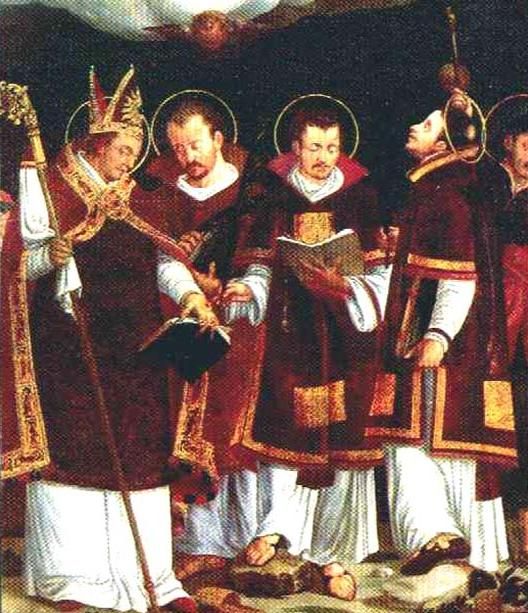
Image: Vigilius and companions-Naurizio.JPG · Paolo Naurizio · Public domain, via Wikimedia Commons

From Sabine Baring-Gould, The Lives of the Saints, new edition in 16 vols. (London: John C. Nimmo, 1897–98); text from the Internet Archive scan (OCR, lightly cleaned; errors possible). Public domain.

Image: Paolo Naurizio, Wikimedia Commons (Public domain)

From “Catholic Encyclopedia (1913)/St. Vigilius,” The Catholic Encyclopedia (New York: Robert Appleton Company, 1907–1914), via Wikisource. Public domain. Matched by name and feast date; text unedited except for our bracketed notes in grey.

From Sabine Baring-Gould, The Lives of the Saints, new edition in 16 vols. (London: John C. Nimmo, 1897–98); text from the Internet Archive scan (OCR, lightly cleaned; errors possible). Public domain in the United States. Reproduced unedited, except for short bracketed notes in grey that we added to explain names and terms (“S.” is the old abbreviation for Saint). Some history and judgments reflect 19th-century scholarship.