Baring-Gould’s sources: English Martyrology. Authorities:—Life of Goscelin, the monk (fl. 1100), and mention in Bede, John of Brompton, Florence of Worcester, Hyden, Langherne, Simeon of Durham.
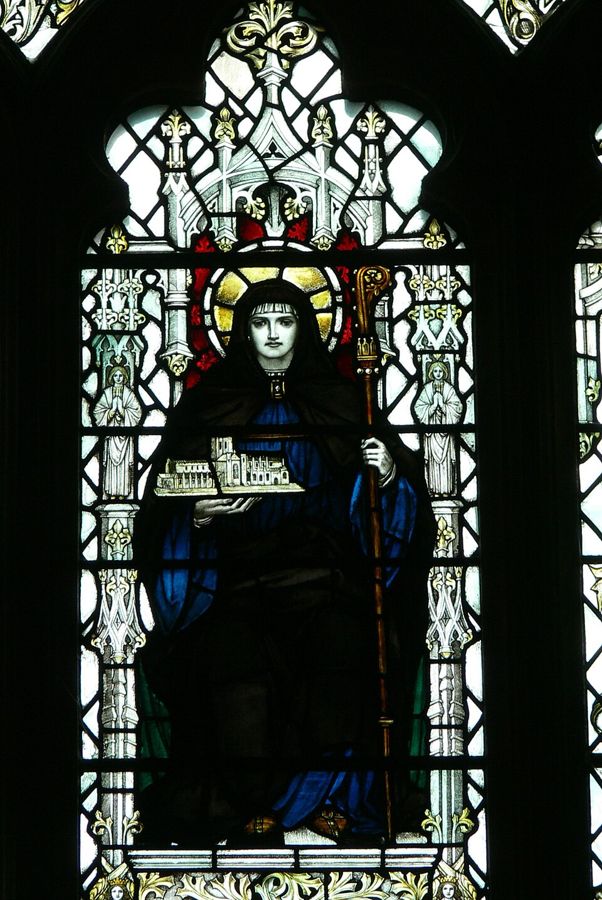
Werburga, patroness of Chester, was born at Stone, in Staffordshire, and was the daughter of Wulfhere, King of Mercia [the Anglo-Saxon kingdom of the English Midlands], or the Midland English. From the lips of her sainted mother, Ermingilde, she received those first lessons of Christian truth which afterwards produced such beautiful fruit in her life.
Being one of four children, all trained under the same godly discipline, she is said to have excelled them all in virtue and discretion. Her mind was open to receive good impressions, and she listened with earnest attention to every word of instruction and advice. Thus, she "daily grew in grace, and in the knowledge of our Lord and Saviour Jesus Christ:" her mind continually expanding under the influence of holy thoughts and pure desires. At an age when most persons of her exalted position would have been found joining in the giddy whirl of pleasure, she found truest joy in contemplation of heavenly things, and holiest bliss, arising from a pure conscience chastened by fasting and sanctified by prayer. She daily assisted her mother in the performance of the whole Church Offices, and spent much time on her knees in the exercise of private devotions.
Having early resolved to devote herself to a life of virginal purity, she sought every opportunity to prepare her mind for that holy state. But she was not to overcome the world without a struggle. Temptations began to gather around her. The beauty of her person attracted a crowd of admirers, who eagerly sought her hand in marriage. Foremost among these was a prince of the West Saxons, who offered her rich gifts and made flattering proposals. She refused to accept his gifts; and to his proposals answered that she had resolved to become the bride of Christ, and wished no earthly spouse.
Another, and more violent temptation soon presented itself. Werbode, a powerful knight of her father's court, backed by the influence of her father, entreated Werburga to become his wife; but to his entreaties she turned a deaf ear. Imagining that to this refusal she was influenced by her two brothers, who were then under the instruction of S. Chad, and resolving by fair or foul means to compass his designs, Werbode sought an opportunity to murder the two brothers, and thus remove them from his path. In the accomplishment of this diabolical design, he was, to a certain extent, assisted by the father, whom he had incensed against his sons. Werbode soon after died a miserable death. The king, stung by remorse, saw reflected, as in a mirror, all the deeds of his past life, and remembered how he had promised to extirpate idolatry from his dominions, but had failed to perform his vow. With earnestness he began to atone for his faults; destroyed the idols and converted their temples into churches, built the great abbey of Peterborough, founded the priory of Stone, and in every way endeavoured to propagate the true faith among his people.
Seeing this happy change in his disposition, Werburga revealed to her father the earnest desire of her heart, and earnestly entreated his permission to consecrate herself wholly to God. At first he appeared to be very grieved, but yielding at length to her passionate entreaties, Wulfhere, attended by his whole court, conducted her with great state to the convent of Ely. Here they were met at the gates by a long procession of nuns, singing hymns of praise and thanksgiving to God. Werburga, falling on her knees, begged of the royal abbess, S. Etheldreda, that she might be received as a postulant. Having obtained her request, the voice of praise again ascended to heaven, the virgins chanting the Te Deum , as they returned to the convent. Now followed the usual trials; Werburga was first stripped of her costly apparel, her rich coronet was exchanged for a poor veil, purple and silks and gold were replaced by a rough coarse habit, and she resigned herself into the hands of her superior, henceforward to live only to Christ.
The virgin, with great fervour, now devoted herself to God. Her affections being weaned from earthly things, were fixed more firmly upon those things which are above. By prayer and fasting, by self-sacrifice and mortification, by obedience and penance, she sought to sanctify her soul and body, that she might present them, a holy and acceptable sacrifice, unto God.
After many years she was chosen, at the request of her uncle King Ethelred, to superintend all the religious houses for women in his kingdom. When she entered upon this larger sphere of duty, she laboured with earnest diligence to make all the houses under her care models of exact monastic discipline. Through the liberality of her uncle, she was enabled to found new convents at Trentham, in Gloucestershire; Hanbury, in Staffordshire; and Weedon, in Northamptonshire. These remained for several centuries as evidences of her godly zeal. The king also, at her request, founded the collegiate church of S. John the Baptist, in the suburbs of West Chester, and gave to S. Egwin the ground for the great abbey of Evesham.
S. Werburga, both by precept and example, sought to develope the religious life in those committed to her charge, and many through her influence were won from a life of dissipation and vice to a life of holiness and love.
God, in answer to continual prayers, had crowned her with many spiritual and celestial blessings. The old chroniclers say that she became the most perfect pattern of meekness, humility, patience, and purity. Her fastings and mortifications were almost incredible. She never took more than one meal during the day, and that of the coarsest food: seeking in this to emulate the lives of those fathers of the desert who shed such radiance over the Eastern and African Church. Beside the usual monastic offices, she was in the habit of reciting, upon her knees, the whole of the Psalter daily. She often remained in the church all night, bathed in tears and prostrate in prayer.
In the exercise of these holy devotions she lived to a ripe old age. Receiving at last some premonitions of her approaching departure, she made a farewell visit to all the houses under her care, and exhorted the inmates to prepare for the coming of the heavenly Bridegroom. Then retiring to the convent at Trentham, she quietly waited her departure. The messenger soon came, and found the bride ready, and so with quiet faith and perfect trust she went to the home of her Spouse, on the 3rd of February, 699.
Her corpse, in accordance with her own directions, was conveyed to the monastery at Hanbury. It was interred with great honour, and there remained until the year 708. Then it was disinterred in presence of King Ceolred and many bishops, and transferred to a costly shrine. The old chroniclers say that it was found incorrupt, and remained so until a.d. 875, when, for fear of the Danes [Viking raiders from Scandinavia], who were invading the country, the shrine was carried to Chester. The body, however, fell to dust soon after its translation. In course of time a stately church was erected over the relics [the bodily remains of a saint, or objects they used, kept with honor]; this became the cathedral, and as such exists to this day.
During the reign of Henry VIII., the shrine was desecrated, and the holy relics of S. Werburga scattered abroad. What remained of the costly shrine was afterwards converted into an episcopal throne, and may still be seen, carved with the curious images of kings of Mercia, ancestors of S. Werburga, who flourished eleven centuries ago. To this day it is used as the throne of the bishops of Chester.