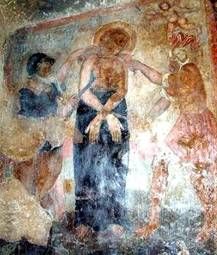
Baring-Gould’s sources: Roman Martyrology. Authority: — A life by John of Nursia, his disciple.] This saint was bom at Vercelli, and was left an orphan in early childhood, but was brought up by a relative with much care. At the age of fourteen he started on a pilgrimage to Compostella. One night he halted, weary and hungry, before a blacksmith's forge, and the man kindly invited him into his house to rest the night The blacksmith was so struck with the piety of the boy, who rose in the night to pray, that he besought him to remain in his house; but William refused, urging his resolve to make a pilgrimage first to Compostella, and then to the Holy Land. He persuaded the smith to make him two iron rings, and to forge them round his body, so that he could not take them off. And then he set forward on his journey. On his return home, he prepared to start for the Holy Sepulchre, but changed his mind, and sought out a hermitage on Monte Virgine, between Nola and Benevento, where he dressed himself in a coat of mail next to his skin, and led a life of the most rigorous austerity. Near his cell was a little spring, whence William supplied himself with water. One night a bear came to it, trampled it and made it muddy, so that William was unable to drink the water. He spent the day in mending his little fountain, but again the bear spoiled his work. This happened repeatedly; at last, one day, William found the bear in the act of drinking. He rushed on the animal, his armour clanking, and shouted, “Away beast! why dost thou trample on and defile the spring I have laboured at so long?" Then the bear, scared away, fled and returned no more. Several priests having placed themselves under the direction of S. 5". William.
Wiliam, he formed them into a congregation, with rules; but after a while, finding that they could not endure the severity of the rule, and sought relaxation, he left them, and retired first to one place and then to another. He settled for a while on Monte Laceno, but the height and consequent cold was so great that a few of the more zealous who had followed him now left him, and William himself after enduring the rigours of the place a little longer, fired his hut, and deserted the mountains for a more congenial spot among the rocks of Serra Cognati, where he erected huts and was joined by some of his disciples. It was a wild spot in a remote solitude, only invaded by hunters. There he made a garden, but was annoyed by a wild boar which broke down the hedge and trampled on his young plants. “Who will defend my garden ?” cried the saint, and two wolves came out of the forest and drove the boar away.
John of Nursia was sent by the community on Monte Virgine with a message to S. William. Having found him, the saint insisted on John spending the night in his cabin. Now the cabin had an ante-room with an opening in the roof through which the light streamed, and which also served as a chimney when a fire was lighted. At night William retired into the inner chamber and left John to sleep or watch in the outer room. It was a moonlight night, and a silvery ray descended through the gap overhead and streaked the floor. About the third hour of the night, John, who was awake and musing, saw two white owls flitting over the house, and all at once they descended through the gap, and flashed to and fro in the silver beam, casting luminous reflections about the little cell from their white wings. “ They are angels come to visit William/7 said John to himself; and he slept not another wink that night On his return to Monte Virgine, he told what he had seen. “Yes,” said the hermits there, “they were certainly angels.” Roger I., king of Naples, having heard of his virtue, sent for him, and built him a house at Salerno, opposite his own castle, so that he could often consult him.
Before long he became the object of slander, and those who disliked his influence said to the king, “He is an impostor, a hypocrite.” And the admiral whispered, “ Eve seduced Adam and lost him Paradise, and Solomon the Wise fell into folly through his wives. Try this young ascetic with the fascination of a pair of black eyes.” The king laughed, and said, “As you list.” Nor was it long before a young woman of light and wanton life was found who undertook to lead the saint into transgression. She sought him in conversation, and he guilelessly listened to her, and she gradually unfolded her toils before him. “ Let us meet alone. I will come and see thee after nightfall” “Come, in God's name.” Now when the sun went down in the sea, William said to his disciples, “ Light a great fire on the hearth.” So they kindled one. “ Heap on more wood.” And the fire roared up the chimney in a sheet of flame illumining every cranny of the room. “Go!” So they went out, and left the saint alone. Presently he approached the fire, when the flame had abated, and throwing back his serge sleeves, with bare hands and arms, he parted the fire in the midst, and then stood up, for the door opened, and the woman entered. William took his cloak and threw it between the heaps of glowing embers, and then laid himself down between them, and shook the sparks over him, and turning his face, kindled by the fire-glow, on the harlot, said “ Come and share my bed.” She shuddered and cried, and the king and the admiral rushed in, and drew William from his fiery couch. But the woman stpod abashed, and £ William. 365 suddenly, she tore off her gay head-dress, and piled-up towers of artificial hair, and broke the bracelets off her arms, and dashed them all down, and clasped her hands over her eyes, and fell weeping at the feet of the man of God.1 The woman became a sincere penitent, and having placed all her possessions at the disposal of S. William, he founded a convent at Venossa, into which she entered, and after a long probation became abbess, and is numbered with the blessed penitents, with Magdalene, and Margaret of Cortona, and Pelagia, under the name of the Blessed Agnes of Venossa.
The king thoroughly convinced of the sincerity of the saint, endowed Monte Virgine, and accorded privileges to several monasteries founded by S. William. Feeling his end approaching, the saint retired to a monastery he had erected at Guglieto, near Norcia, to prepare for death. He was carried into the church and laid on the earth, and there breathed his last, on or about the 25th June, 1142. The congregation which he founded, having no written rule, was incorporated by Alexander III. with that of S. Benedict [father of Western monks (d. c. 547), author of the Rule] S. William is generally represented kneeling before an image of the Blessed Virgin, to recall Monte Virgine his principal foundation.
1 The same story is told of S. Peter Gonzales (April xsth,) but the story is no doubt adapted to Gonsales from that of S. William, for there Is no early or trustworthy history of Peter G onzales, whereas that of S. William was written by bis own disciple.