Baring-Gould’s sources: Danish Kalendars. Authorities Saxo Grammaticus Hist. Den. lib. xi.] S. William of Roskilde was an English priest, chaplain to King Canute. In a voyage to Denmark which he made with the king, William was so moved with compassion at the sight of the barbarism and superstition of the Danes, that he resolved to tarry in Denmark, and preach there the Gospel. He was elevated to the episcopal throne of Roskilde in 1044 on the death of Aage, the second bishop, by King Swend Estrithson. At this time he was at the court of that magnificent prelate Adalbert of Bremen, who aspired to the patriarchate of the North of Europe. He was brought from Bremen to the isle of Seeland, and there consecrated Bishop of Roskilde. At this time another English bishop, Eilbert, occupied the see of Funen. Swend was warmly attached to William, and the bishop reciprocated his affection with no less ardour. Yet William was not disposed to let his attachment interfere with what he believed to be his duty.
On the death of his wife, Gunhild, Swend married his step-daughter, Guda, daughter of Gunhild by her first husband, King Anund of Sweden. Such a marriage offended public decency as well as church law. William and Egino, Bishop of Dalbye, rebuked the king, and when he would not listen to their remonstrances, they appealed to Adalbert of Bremen. The archbishop wrote to Swend, threatening him with excommunication. “ Let the haughty prelate beware/7 said the king, “ or I will tear down his church, and translate the archbishopric from Bremen to Hamburg.,7 Adalbert appealed to Rome. Pope Victor II. and the Emperor Henry IV. both wrote to Swend, and this, together with the repeated injunctions of S. William, induced the king to separate from Guda in 1055. After this he remained unmarried.
The conduct of Adalbert irritated Swend so greatly, that he expressed his wish to have an archbishopric erected in his own domains. He had S. William undoubtedly in view, and had he succeeded, Roskilde would have been constituted the metropolitan [the archbishop who heads a group of dioceses] see of the North. But the powerful opposition of Adalbert prevented the execution of his design, and half a century later, Lund instead of Roskilde was elevated to this dignity.
One New Year’s Eve there was much drunkenness at the royal board; and during the feast some of those at table whispered words concerning the king which were not complimentary. Their words were repeated. The revellers staggered in the early morning, before dawn, to the church of the Holy Trinity, to hear matins; and the furious Swend detached some of his body-guard to kill the jesters in the SepL 2.] S. William.
church. Swend himself proceeded in state to the house of God somewhat later to hear mass; but S. William came forth in his pontificals, and barred the way against the king with his pastoral staff. “Stand back, executioner!” The body-guard drew their swords, still stained with blood shed on the holy floor, and threatened the bishop. His countenance was unmoved, and he did not swerve from his post. Swend turned round, and walked gloomily back to his palace. The fumes of wine wore off; conscience spoke; and, feeling how guilty he had been, in an access of remorse, he stripped off his royal robes, and barefoot he sought the church, flung himself before the door, and kissed the earth.
In the meantime the bishop had begun mass. But when he heard that the king was at the door, he arrested the chanting, went to the gates, absolved Swend, embraced him, and bade him re-apparel himself in his royal robes. Two days Swend remained shut up in his palace; on the third he went to the church in state, ascended to the high altar, and before all the people, confessed his crime, praised the mercy of the bishop, who had given him absolution so readily, and endowed the church of Roskilde, in expiation, with large estates in Seeland. The year in which this took place is not stated, but Suhm thinks it was in rofr, shortly before Swend’s abortive attempt on England. The king’s affection for S. William was not shaken by these acts; he manifested the warmest love both for the bishop and his church.
After a reign of thirty years, King Swend Estrithson died in Jutland at the end of April, 1076, so beloved by his people that he was allowed in the last parliament of his bonders that he held to nominate his successor; a right which no King of Denmark possessed without their consent, as the crown was elective. He made his bonders promise that he should be buried in Roskilde cathedral, which Bishop William had erected, and which he had endowed. His body was afterwards brought to Seeland, and placed at Ringsted, till the cathedral was completed, and ready to receive it. When the church was ready, S. William ordered two graves to be made side by side, assuring the clergy that he had often prayed God not to part him from his monarch and best friend, and that he knew he would be laid beside him.
Then he rode to meet the funeral convoy; and when he came to a forest which lies between Roskilde and Ringsted, he bade his attendants hew down branches, and fashion a bier, which was to be borne after him.
And now in the distance was seen, winding through the fern, under the beech leaves, browning with the first autumnal tints, the black procession, and the wailing chant of the priests reached the bishop’s ear. He descended from his horse, drew off his coat, and laid himself on the sward, lifting his hands and eyes to the sky that twinkled through the shifting network of leaves, and prayed God to join him to his dear king. So, thus lying on the bilberries and sweet grass, whilst nearer and louder waxed the advancing “ De profundis,” his spirit sweetly sped. “ They were lovely and pleasant in their lives, and in death they were not divided.”
When the convqy bearing the dead king came to the spot, the servants of the bishop had laid their dead master on his leafy bier, and the two parties united in one sad wail of sorrow for both the holy dead.
In process of time the church was enlarged by a succeeding bishop; and when the new building was well-nigh finished, the tomb of Bishop William was removed to make room for the columns of the choir. That night, so runs the legend, the saintly prelate appeared to the sacristan, B. Margaret of Louvain, who slept within the building. “ Why/' said he, “ have I been parted from my friend ?” then he struck the walls with his crozier, and down they fell about the ears of the alarmed sacristan, who, however, escaped scathless from among the ruins.
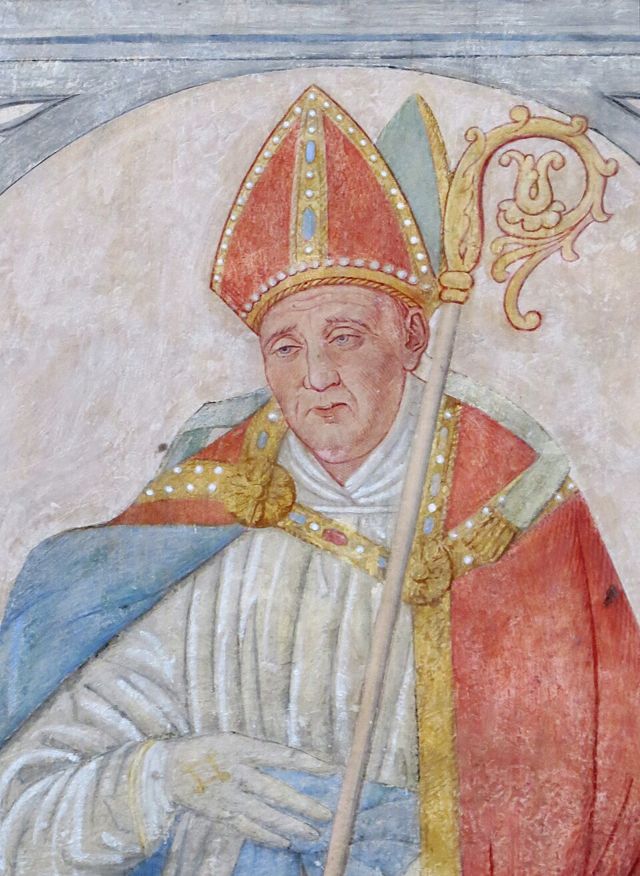
In the sixteenth century Bishop Urn caused his bones to be disinterred and placed in a pewter coffin in a hole of a pillar of the choir, over which his portrait was painted in fresco; and there they remain to this day undisturbed.