St. Francis of Assisi

The rich kid who gave it all away

Pray the novena →

St. Francis

St. Francis of Assisi

Francis grew up rich, wanted to be a knight, and then gave it all up, down to the clothes he was wearing, to live poor and follow Jesus. He preached to birds, made peace with enemies, and started a movement that still has tens of thousands of friars.

Feast day

October 4
blessing of animals

Patron of

Animals
Ecology
Italy

Their story

Giovanni di Pietro Bernardone, nicknamed Francesco, was born in Assisi around 1181 to a rich cloth merchant. He spent his youth on parties and dreamed of knighthood. He was captured in a war with Perugia and spent about a year as a prisoner, then fell seriously ill. Afterward the old life no longer satisfied him. He met a leper on the road and, against his own disgust, kissed him.

Praying in the crumbling chapel of San Damiano around 1205, he heard the crucifix say: “Francis, go, rebuild my house, which as you see is falling into ruin.” He took it literally, sold his father's cloth to pay for repairs, and was dragged before the bishop by his furious father. In front of the town he stripped off his clothes, handed them back, and said that from now on he would say only “Our Father who art in heaven.” Followers gathered; Pope Innocent III approved their simple rule in 1209 or 1210.

He went to Egypt during the Fifth Crusade (1217–1221, a failed Christian campaign against Egypt) in 1219 and met Sultan al-Kamil peacefully. He set up a living Nativity scene at Greccio in 1223. In 1224 on Mount La Verna he received the stigmata, the wounds of Christ. Nearly blind and ill, he composed the Canticle of the Creatures, praising God for Brother Sun and Sister Moon. He died on October 3, 1226, and was canonized (officially declared a saint by the pope) two years later. People follow him because he took the Gospel at its word and found joy, not loss, in having nothing.
Struggles & surrender

What they wrestled with, and how they gave it to God

  • Worldly ambition ·
    As a young man he dreamed of glory as a knight. Imprisoned after Assisi's war with Perugia (1202) and later ill, he set out again for war in 1205 but turned back at Spoleto after a dream told him to serve 'the Master rather than the servant' (Thomas of Celano and the Legend of the Three Companions).
  • Disgust he overcame ·
    In his Testament he wrote that seeing lepers had been 'too bitter' for him, but the Lord led him among them, and 'what had seemed bitter to me was turned into sweetness of soul and body.'
  • Illness and darkness ·
    In his last years he was nearly blind, in constant pain and carried the stigmata (the wounds of Christ in his body). In this state, in 1225, he composed the Canticle of the Creatures, later adding a verse praising God 'for Sister Bodily Death'.

Why they’re the patron of…

  • Animals · Tradition
    Early lives by Thomas of Celano and Bonaventure tell of him preaching to birds near Bevagna and calling creatures his brothers and sisters. The wolf of Gubbio story comes from the later Little Flowers and is legend.
  • Ecology ·
    John Paul II named him patron of those who promote ecology in 1979 because of the Canticle of the Creatures.
  • Italy ·
    Pius XII named him co-patron of Italy with Catherine of Siena in 1939.

Devotions & practices

  • The Canticle of the Creatures
    His own hymn (1225), one of the earliest poems in Italian, praising God “through Brother Sun.”
  • “Make me an instrument of your peace”
    Popularly called the Prayer of St. Francis, but it was first printed in France in 1912 and is not by him.

The short version

Francis of Assisi (c. 1181–1226) was the son of a wealthy cloth merchant. After a conversion in his twenties he renounced his inheritance and founded the Order of Friars Minor. He died on October 3, 1226, and was canonized two years later. Pope Pius XII named him a patron of Italy in 1939.

Three things you might not know

He set up a live Nativity scene at Greccio in 1223, often called the first crèche.

Tradition holds he received the stigmata, the wounds of Christ, at La Verna in 1224.

The famous 'Peace Prayer' ('Make me an instrument of your peace') is not by him: it first appeared in a French magazine in 1912.

The novena

Nine days · one intention

A novena is nine days of prayer for one intention, modeled on the nine days the apostles and Mary prayed between the Ascension and Pentecost (Acts 1–2). Pray this each day:

Nine days · Free

Pray the novena
with us.

One short email a day for nine days. The day's prayer, a line from St. Francis's story, and a nudge to keep going.

Your Confirmation saint?

Choose St. Francis if…

  • you love animals and creation
  • you want to live simply and give more away
  • you want to be a peacemaker

Take the saint finder →  Need a sponsor?

Wear their medal

[Affiliate placeholder: Catholic Company St. Francis of Assisi medal]

“Praised be You, my Lord, with all Your creatures.”

Canticle of the Creatures, St. Francis
Also walking with you
St. Thérèse of Lisieux

St. Thérèse

Feast · October 1 — The saint of small things done with great love
St. Carlo Acutis

St. Carlo

Feast · October 12 — God's influencer
St. Jude Thaddeus

St. Jude

Feast · October 28 — Patron of hopeless causes
Sources & notes

Story sources

Sources

Credits

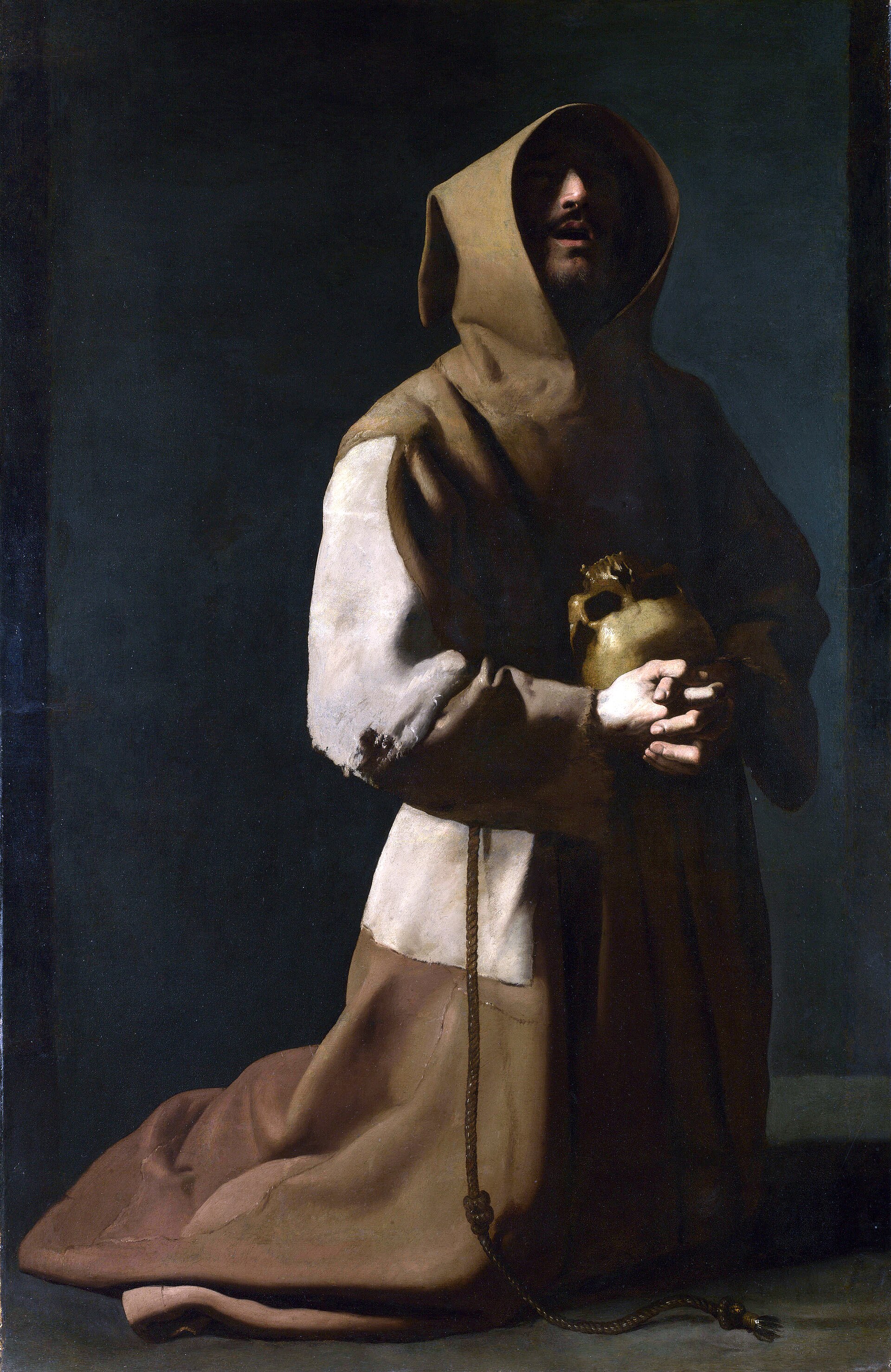
Image: Francisco de Zurbarán, Wikimedia Commons (Public domain)

We only print prayer texts we can trace to a public-domain printed source, and we have not verified one for St. Francis yet. Until we do: for nine days, pray an Our Father, a Hail Mary and a Glory Be, then add your intention and “St. Francis, pray for us.”

Notes

Story retold in our own words from the cited sources.