Their story
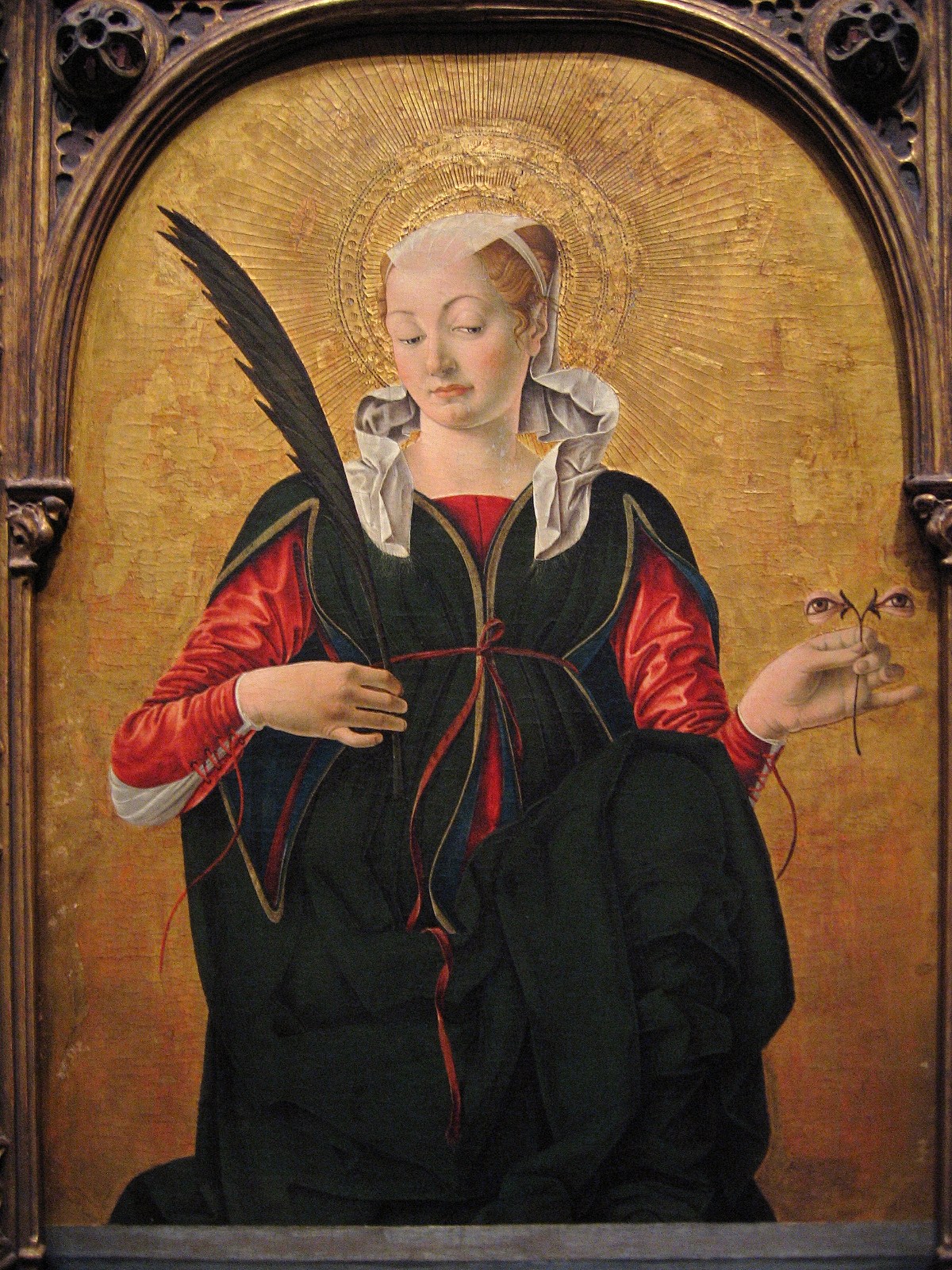
Lucy was a young Christian of Syracuse, Sicily, martyred during the persecution of Diocletian (Diocletian was Roman emperor 284–305; the 'Great Persecution' of 303–311, when imperial edicts ordered churches and Scriptures destroyed and Christians forced to sacrifice to the Roman gods) around 304. Her historical existence is supported by a 4th-century inscription found in Syracuse that names her feast. At Mass her name is still said in the Roman Canon (the oldest of the Mass's Eucharistic Prayers), in the 'Nobis quoque peccatoribus' list of martyrs prayed after the consecration. Being named there is an ancient honor showing she was venerated very early.
Her Acts (the written account of a martyr's trial and death), written later, tell the story this way: her widowed mother Eutychia suffered from a long illness, and Lucy took her to the tomb of St. Agatha in Catania to pray. The mother was healed. Lucy persuaded her to give the family's wealth to the poor. Her rejected suitor reported her to the governor Paschasius. He ordered her taken to a brothel, but guards could not move her, even with oxen. An attempt to burn her failed, and she was killed with a sword.
Her name comes from lux, light, and her feast, December 13, fell near the winter solstice under the old calendar (the Julian calendar, used before the 1582 Gregorian reform). In Sweden girls in white with crowns of candles still mark the day. People follow Lucy because, in the story, she gave away everything and could not be moved.