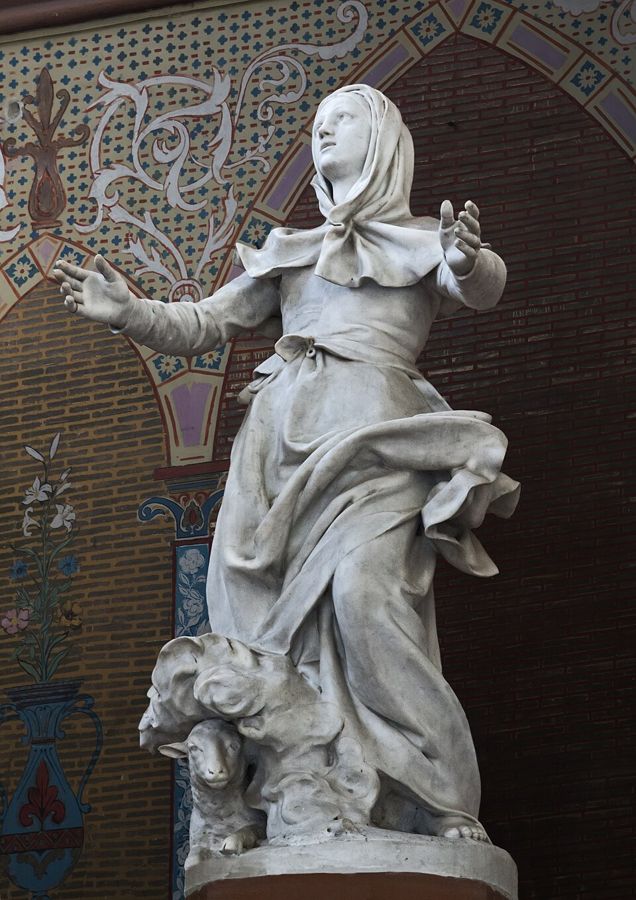
Bl. Germaine Cousin

Germaine was born in 1579 at Pibrac near Toulouse with a deformed hand and scrofula, and lost her mother as a baby.

Read the essentials →
June 15 · Virgin

Bl. Germaine Cousin

Bl. Germaine Cousin

Germaine was born in 1579 at Pibrac near Toulouse with a deformed hand and scrofula, and lost her mother as a baby.

Traditional feast

June 15
1914 / pre-1969 calendar, per Baring-Gould (1897)

Current feast

June 15
Secondary source · Wikipedia

Represents

Virgin

Their story

Adapted in modern English from the Catholic Encyclopedia (1913) · original text below

Germaine was born in 1579 at Pibrac near Toulouse with a deformed hand and scrofula, and lost her mother as a baby. Her stepmother treated her cruelly and kept her out with the sheep, sleeping in the stable or on vine branches.

She heard Mass every day, leaving her flock in God's care, and no wolf ever harmed it. The Rosary was her only book, she shared her bread with the poor, and she taught the village children. The source says the swollen stream sometimes parted to let her cross.

At last her father took her side, but she asked to keep her humble place. In early summer 1601 he found her dead on her bed of vine-twigs, aged twenty-two. In 1644 her body was found fresh and incorrupt (not decayed after death).

Struggles & surrender

What they wrestled with, and how they gave it to God

  • Unwanted at home ·
    Born sick and deformed and soon motherless, she was driven out by her stepmother to sleep in the stable. She answered with patience, prayer and sharing her bread, and asked to keep her lowly place even when her father relented.

Early life

Selected sentences from the original account, unaltered.

Her heart was full of compassion for those who suffered, for she had known little else save suffering, neglect, and poverty from childhood. This irritated her father and step-mother, and they accused her of taking their bread to give to the poor.

What they represent

How they teach us to live

Drawn from themes in the original account

Give to people in need. The account records care for the poor.

Keep their day. Remember them on June 15 with a short prayer, and ask for their help.

From the Catholic Encyclopedia

1913 · 1012 words

Born in 1579 of humble parents at Pibrac, a village about ten miles from Toulouse; died in her native place in 1601. From her birth she seemed marked out for suffering; she came into the world with a deformed hand and the disease of scrofula, and, while yet an infant, lost her mother. Her father soon married again, but his second wife treated Germaine with much cruelty. Under pretence of saving the other children from the contagion of scrofula she persuaded the father to keep Germaine away from the homestead, and thus the child was employed almost from infancy as a shepherdess. When she returned at night, her bed was in the stable or on a litter of vine branches in a garret. In this hard school Germaine learned early to practise humility and patience. She was gifted with a marvellous sense of the presence of God and of spiritual things, so that her lonely life became to her a source of light and blessing. To poverty, bodily infirmity, the rigours of the seasons, the lack of affection from those in her own home, she added voluntary mortifications and austerities, making bread and water her daily food. Her love for Jesus in the Blessed Sacrament and for His Virgin Mother presaged the saint. She assisted daily at the Holy Sacrifice; when the bell rang, she fixed her sheep-hook or distaff in the ground, and left her flocks to the care of Providence while she heard Mass. Although the pasture was on the border of a forest infested with wolves, no harm ever came to her flocks.

She is said to have practised many austerities as a reparation for the sacrileges perpetrated by heretics in the neighbouring churches. She frequented the Sacraments of Penance and the Holy Eucharist, and it was observed that her piety increased on the approach of every feast of Our Lady. The Rosary was her only book, and her devotion to the Angelus was so great that she used to fall on her knees at the first sound of the bell, even though she heard it when crossing a stream. Whenever she could do so, she assembled the children of the village around her and sought to instil into their minds the love of Jesus and Mary. The villagers were inclined at first to treat her piety with mild derision, until certain signs of God's signal favour made her an object of reverence and awe. In repairing to the village church she had to cross a stream. The ford in winter, after heavy rains or the melting of snow, was at times impassable. On several occasions the swollen waters were seen to open and afford her a passage without wetting her garments. Notwithstanding her poverty she found means to help the poor by sharing with them her allowance of bread. Her father at last came to a sense of his duty, forbade her stepmother henceforth to treat her harshly, and wished to give her a place in the home with the other children, but she begged to be allowed to remain in the humbler position. At this point, when men were beginning to realize the beauty of her life, God called her to Himself. One morning in the early summer of 1601, her father finding that she had not risen at the usual hour went to call her; he found her dead on her pallet of vine-twigs. She was then twenty-two years of age.

Her remains were buried in the parish church of Pibrac in front of the pulpit. In 1644, when the grave was opened to receive one of her relatives, the body of Germaine was discovered fresh and perfectly preserved, and miraculously raised almost to the level of the floor of the church. It was exposed for public view near the pulpit, until a noble lady, the wife of François de Beauregard, presented as a thanks-offering a casket of lead to hold the remains. She had been cured of a malignant and incurable ulcer in the breast, and her infant son whose life was despaired of was restored to health on her seeking the intercession of Germaine. This was the first of a long series of wonderful cures wrought at her relics [the bodily remains of a saint, or objects they used, kept with honor]. The leaden casket was placed in the sacristy, and in 1661 and 1700 the remains were viewed and found fresh and intact by the vicars-general of Toulouse, who have left testamentary depositions of the fact. Expert medical evidence deposed that the body had not been embalmed, and experimental tests showed that the preservation was not due to any property inherent in the soil. In 1700 a movement was begun to procure the beatification of Germaine, but it fell through owing to accidental causes. In 1793 the casket was desecrated by a revolutionary tinsmith, named Toulza, who with three accomplices took out the remains and buried them in the sacristy, throwing quick-lime and water on them. After the Revolution, her body was found to be still intact save where the quick-lime had done its work.

Read the rest of the article

The private veneration of Germaine had continued from the original finding of the body in 1644, supported and encouraged by numerous cures and miracles. The cause of beatification was resumed in 1850. The documents attested more than 400 miracles or extraordinary graces, and thirty postulatory letters from archbishops and bishops in France besought the beatification from the Holy See. The miracles attested were cures of every kind (of blindness, congenital and resulting from disease, of hip and spinal disease), besides the multiplication of food for the distressed community of the Good Shepherd at Bourges in 1845. On 7 May, 1854, Pius IX proclaimed her beatification, and on 29 June, 1867, placed her on the canon of virgin saints. Her feast is kept in the Diocese of Toulouse on 15 June. She is represented in art with a shepherd's crook or with a distaff; with a watchdog, or a sheep; or with flowers in her apron.

GUÉRIN in Petits Bollandistes, 15 June; VEUILLOT, Vie de la bienheureuse Germaine (2d ed., Paris, 1904).
Read more

The full original · 454 words

Read Baring-Gould’s full account

Baring-Gould’s sources: Modern Gallican Martyrologies. Beatified by Pius IX., May 7th, 1854.] The Blessed Germaine Cousin was born at Pibrac, near Toulouse, about the year 1579. Her father was a poor labourer. The child was scrofulous; this disorder had crippled her hand and scarred her neck. Her mother died in her infancy, and her father married again. The step-mother took an aversion to the poor little girl, and treated her with great harshness. Germaine was sent to guard sheep, as much to keep her out of the house and from her step-mother, as for any other reason; and a shepherdess she remained till she died. In the solitude of the pastures to which she drove her sheep, she found peace, and time and place for prayer. She was ignorant of much, but not of the science of the Cross. Her father’s affection was wholly devoted to his children by the second wife, and the poor little shepherdess would have felt utterly desolate, had she not discovered the rich treasury of the love of God, “When my father and my mother forsake me, the Lord taketh me up.” She assisted every day at mass. When the bell rang in the church tower, Germaine would place her crook, distaff, and spindle on the ground and say, “ Fear nothing, little flock, remain here, and no harm can befall you,” and then make her way to the church, and on her return rarely find that the sheep had strayed far. Her devotion to the Blessed Sacrament was so vehement, that when the bell rang, it was as though a thousand cords drew her to the foot of the altar, and she could not snap them. She confessed and communicated every Sunday. Sometimes the children of Pibrac on a spring or summer day came to the forest fringe where she fed her sheep, and then the simple and B. Germaine Cousin.

…unlettered peasant girl gathered the little ones around her, and taught them what she knew of the truths of religion. To reach the church she had to cross a stream. Once it was boiling like a torrent, and some folks of Pibrac said, “ Germaine will not come to church to-day.” But they were mistaken, she boldly plunged through the brown foaming stream.

Her heart was full of compassion for those who suffered, for she had known little else save suffering, neglect, and poverty from childhood. If she could collect a little money, it was given to the needy. She denied herself food that she might share it with the hungry. This irritated her father and step-mother, and they accused her of taking their bread to give to the poor. She denied it, saying that she gave only what she had stinted herself in. One winter’s day, when the ground was covered with snow, the stepmother saw Germaine go out with something in her apron. Thinking it was bread, she caught up a stick and ran after her. Two persons of Pibrac were in the way, and seeing the woman rushing after the girl, hastened to interfere, and asked the step-mother the occasion of her anger. 44 She steals the bread of the house to give away I” exclaimed the woman, pointing at the girl with the stick; 44 1 will prove it you,” and rushing upon Germaine she plucked her apron down. Bunches of flowers of rich colour and rare perfume fell on the snow. From that time Germaine was treated with some respect Her father forbade his wife to maltreat her, and even showed the poor girl some return in tenderness. But God had proved and perfected His child in the school of adversity, and now He called her to Himself, when she was aged twenty-two.

On the night of her death, two monks were walking to Pibrac, overtaken by the darkness they had lost their way, and were obliged to spend the night under the trees of the CJune *$• forest At midnight a blaze of light filled the forest, and they saw a train of maidens dressed in white go toward the hovel of Laurence Cousin. Presently they returned. But there was one more in their number, and she was crowned with spring flowers. Next morning the monks learned that during the night Germaine Cousin had died. She was buried in the church at Pibrac, where her body now lies enshrined. A pilgrimage is made to Pibrac on June 15 th, every year.

The shepherd girl is represented with distaff and spindle, and a sheep at her side, sometimes with roses in he* apron. June,*•) 6\S. Cyriac and yulitta. 219

Feast days

Feast: June 15

Nine days · Free

Pray the novena
with us.

One short email a day for nine days. The day's prayer, a line from Bl. Germaine Cousin's story, and a nudge to keep going.

Also on June 15
Sts. Vitus, Modestus and Crescentia

Sts. Vitus

June 15 · Martyrs
D

St. Dulas

June 15 · Martyr
St. Vougas

St. Vougas

June 15 · Feast
← All 1726 saints in the library
Sources & notes

Feast-day sources

Story sources

Sources

Credits

Image: Eglise Sainte-Germaine Statue par Alexandre Falguière 1877.jpg · Didier Descouens · CC BY-SA 4.0, via Wikimedia Commons

From Sabine Baring-Gould, The Lives of the Saints, new edition in 16 vols. (London: John C. Nimmo, 1897–98); text from the Internet Archive scan (OCR, lightly cleaned; errors possible). Public domain.

Image: Didier Descouens, Wikimedia Commons (CC BY-SA 4.0)

From “Catholic Encyclopedia (1913)/St. Germaine Cousin,” The Catholic Encyclopedia (New York: Robert Appleton Company, 1907–1914), via Wikisource. Public domain. Matched by name and feast date; text unedited except for our bracketed notes in grey.

From Sabine Baring-Gould, The Lives of the Saints, new edition in 16 vols. (London: John C. Nimmo, 1897–98); text from the Internet Archive scan (OCR, lightly cleaned; errors possible). Public domain in the United States. Reproduced unedited, except for short bracketed notes in grey that we added to explain names and terms (“S.” is the old abbreviation for Saint). Some history and judgments reflect 19th-century scholarship.