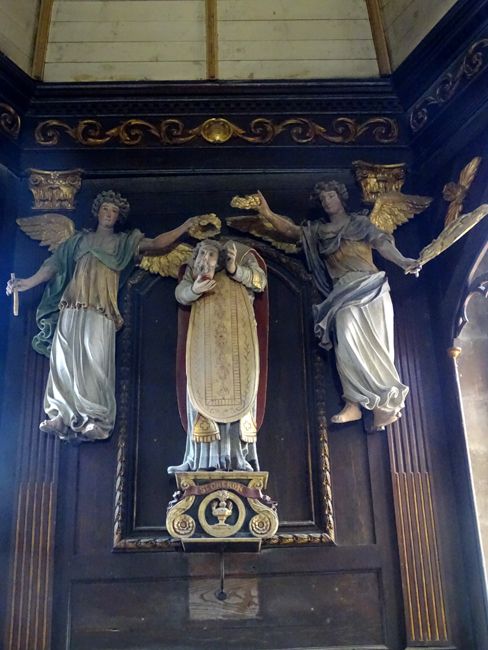
Baring-Gould’s sources: Necrologium Islandicum. Authorities: — The Kristni Saga, the Sagas of S. John of Holum. The Hungurvaka and Thattr of Isleif.] On the maps of Iceland, one is pretty sure to see Skalholt marked as a town, and in some geography books it is set down as the capital of the island. Yet it consists of a farm and a church. The situation is beautiful: from a vast green swamp rises a verdant mound, swept on the south by a mighty river. Picturesque hills rise out of the plain, and far away, blue and silver in the distance, rise the vast masses of Eyafialla and Hechla. Skalholt was the first episcopal seat in Iceland, it was given to the church by Gizur, the second bishop, and remained the seat of a bishop, the metropolitan of the island till the change of religion.
The first resident bishop in Iceland was Islief, son of Gizur the White, who had persuaded his countrymen to adopt Christianity, For the maintenance of the bishop the old temple-tax was awarded; this was a rate levied in heathen times on the landowners, for the support of the ancient religion and its rites, and it became now the revenue of the bishop. But the sum was too small for the purpose, and it was of necessity that the head of the Icelandic Church should be a man of large private means.
Of Isleif we are told: — “He was pinched in his housekeeping, in such demand was his money; the incomings were small, and the outgoings great, consequently his housekeeping was a matter of difficulty;”1 and again: — “When he returned to his bishop’s seat he was at Skalholt, but because half of his land was the personal property of his wife, Dalla, it was difficult for him to manage, for at that time there was no tithe.” 2 Isleif died on July 5th, 1080; and his son Gizur was elected to the vacant bishopric. He accordingly sailed for Germany and went to Rome, where he was well received by Pope Gregory VII., the famous Hildebrand, in 1012, and was sent by him to be ordained by Archbishop Hartwig of Magdeburg, one of the Saxon prelates who adhered to his cause, against the emperor. Gizur crossed the Alps, reached Magdeburg, and was consecrated bishop on September 4th, in the same year. He then returned to 1 Hungurvaka, c. 2. 3 Isleif ’s Thattr. B. Gizur.
Iceland, which he reached in the spring of 1084, having spent the winter in Denmark. In Iceland he became extremely popular. It was some time before he could take possession of Skalholt, as it was the property of his mother, Dalla, but on her death he gave the farm to the Church, and thenceforward it became the seat of the bishop. He then built a cathedral church of wood, and dedicated it to S. Peter. We are also told that Bishop Gizur gave the church at Skalholt “the white vestment with purple ornaments, which since has been used as the best.”1 The condition of the Church was greatly improved by the introduction of the tithe, which was imposed on all the laud in 1097, during the episcopate of Gizur. The w Hungurvaka ” says: — “These men were coeval with Bishop Gizur, the priest Sasmund of Oddi, who was so able a man, and better educated than most, and Marcus Skeggjason, the lawgiver, who was the wisest man and greatest poet of his time. These men took counsel together, and brought other chiefs into conference with them, and decided to introduce a law that the people should value and tithe their property half-yearly, as is the custom in other Christian lands. They, by their recommendation and urgency, persuaded the people to submit to the tithe, and the money so obtained was thus portioned; — One share went to the bishop, one to the church fabrics, one to the maintenance of the clergy, and the fourth to the poor, and no such support to the well-being of the see was after obtained as this introduction of tithe, which was brought about through Bishop Gizur’s care, and which was granted because he was so much beloved.” — Hungurvaka,, c. 6. After Gizur had been bishop more than twenty years, he 1 Hungurvaka, u. 5.
resolved to divide his immense diocese, and he appointed John Ogmundson to be bishop of the northern half of the island. The southern half he reserved for the diocese of Skalholt. In the year 1117 he fell ill, being then aged seventy-five years. He was afflicted with ulcers over his whole body, which gave him great pain, and prevented him from sleeping. His wife 1 asked him what he would like his friends to ask of God for him. “Not that my pains may be loosened,” he answered; “for I am ready to bear the chastisements of the Lord.” When asked if he would like to be buried beside his father, Bishop Isleif, he answered, “No, I am not worthy.” All his sons died before their father except one; and he left a daughter behind him. He was buried beside Isleif. He was forty years old when he was made bishop, and he ruled the see thirty-two years. His death was lamented throughout Iceland.
® The bishops and clergy of Iceland were married till the 13th century. •S'. Conon and his Son.