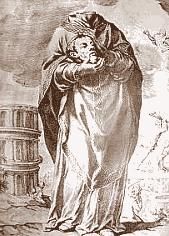
Baring-Gould’s sources: Inscribed in his additions to Usuardus by Herman Greven, in the German Martyrology of Canisius, and by Ferrarius in his General Catalogue of the Saints. Not mentioned in the Anglican or Roman Martyrologies, but it is certain that Thomas of Lancaster received veneration shortly after his execution, and that miraculous cures were attributed to his relics.
There have been, as there probably ever will be, great differences of opinion as to the justice of beheading Thomas, Earl of Lancaster, cousin-german to king Edward II.
Edward of Carnarvon had received his father's final instructions before Edward I. died. Of these the principal were; that he should devote a certain sum to the succour of the Holy Land; that he should persist in the conquest of Scotland; and that he should not recall his favourite, Piers de Gaveston (a young Gascon, whom the king had lately banished), without the consent of parliament.
Every one of these commands were directly violated by the young king. His first act was to send for Gaveston; and to confer on him the royal earldom of Cornwall. The old ministers and judges were nearly all dismissed. Langton, bishop of Coventry, the treasurer of the late king, who had formerly reproved the extravagance of the prince and his favourite, was thrown into prison. Gaveston received the money left for the crusade, was made lord chamberlain; betrothed to Margaret de Clare, niece of the king; and presently, when Edward went to marry Isabel of France at Boulogne, left regent of England.
The jealousy of the great nobles was already excited; but when they beheld the king, on his return, rush into the arms of his favourite without regarding them; and when they saw Gaveston take precedence of them all at the coronation of Edward, their anger burst forth. Three days after the ceremony they called upon the king to dismiss his minion. Edward deferred the matter until parliament should meet, hoping by that time to soothe their resentment. All his efforts, however, was rendered nugatory by the pride and insolence of Gaveston, and the nobles insisted on his expulsion. Edward was obliged to give way, and Gaveston to swear that he would never return. The king, however, escorted him to Bristol with every mark of honour, and mortified his enemies still more by appointing the exile his lieutenant in Ireland.
From the day of Gaveston's departure the king laboured to effect his recall. He solicited the intervention of the pope; and having obtained a conditional abrogation of the oath taken by Gaveston, ordered him to return. Receiving him in person at Chester, he brought him to meet parliament. Here he induced the bishops and peers to consent that his favourite should remain in England; but they added,—as long as he conducted himself well.
In a very short time, however, the absolute ascendancy of Gaveston over the king, his ostentation and presumption, had revived the animosity of the barons. Lancaster and his friends refused to attend the next parliament. Edward, who wanted money, found it necessary to yield. He prologued the parliament to London, and leaving Gaveston in retirement, repaired to the capital. The great barons attended with such a military force, that Edward was obliged to grant all their demands. A committee of seven prelates, eight earls, and six barons, under the name of ordainers, was appointed, with full powers to redress the grievances of the nation. Gaveston was again banished and as speedily was recalled by the king in defiance of his parliament. The barons then took up arms, and captured Gaveston at Scarborough (May 19th, 1312), and executed him by order of Lancaster and the other insurgent nobles at Blacklow, near Coventry.
The news of this audacious deed affected the king with the most passionate grief, to which was quickly added a fierce desire for revenge. His anger was not diminished when the barons followed up the blow by a peremptory demand that the ordinances for the better government of England and the rectification of flagrant abuses should be carried into effect. A superficial reconciliation was however effected. The parliament assembled at Westminster hall, and Edward having taken his seat on the throne, the earl of Lancaster and his associates knelt before him, and solicited a pardon for the acts which had offended him. Taking each petitioner by the hand, the king bestowed upon him the kiss of peace, promised, and the next day published, a general amnesty.
Some time after the death of Gaveston, the ordainers had imposed upon the king, as chamberlain, a young man named Hugh le Despenser, son of one of the great barons. From an object of dislike, he soon became the favourite of Edward. With his father, he had ably supported the king in his resistance to the earl of Lancaster, and he had become especially odious to the earl's party. But, however loyal, the chamberlain was undoubtedly rapacious; and a harsh attempt to enforce the feudal law to his own advantage, excited the lords Marchers of Wales to arm against him. The earl of Lancaster soon joined them; and the united barons, marching upon London, decreed that the Despensers (who were both absent), should be banished. The bishops protested; but the king and his friends were forced to assent to this lawless proceeding. Two months after the king recalled the Despensers, and took the field against the barons. The earl assaulted the royal castle of Tichhill; but failing in his attempts, he hurried southwards to stop the advance of Edward at Burton-on-Trent. The king, however, forced the passage of the river, and the barons retreated hastily to Pontefract. There a stormy council was held. Lancaster was for making a stand at that point; but over-borne by his associate, he resumed the retreat. At Boroughbridge, however, he found the way barred by a strong force under Sir Andrew Harkeley, governor of Carlisle, and Sir Simon Ward, sheriff of Yorkshire. After a vain endeavour to gain the adhesion of Harkeley, who had formerly received knighthood at his hands, Lancaster resolved to force the passage of the bridge; but the earl of Hereford having been slain in the attempt, and an attack by a ford having been repulsed, earl Thomas took refuge in a chapel, saying, as he looked upon the crucifix; "Lord, I render myself to Thee and Thy mercy." He was, nevertheless, dragged out by the royalists, who, despoiling him of his rich surcoat, clothed him in a common livery, and conveyed him down the river to York, where he was received with every kind of insult. Thence he was taken to Pontefract Castle, which he at that time possessed in the right of his wife, the heiress of the De Lacys, and presented to the king.
The death of Gaveston was now to be avenged. The earl of Lancaster was brought a prisoner into his own hall; and there the king, with the earls of Kent, Richmond, Pembroke, the elder Spenser, and other of his party, condemned him to be drawn, hanged, and beheaded. Edward, however, remitted the more degrading parts of the sentence. The earl was at once delivered into the hands of a band of Gascons, who put an old cap on his head, set him on a lean white pony, and led him out to immediate execution. The presence of his confessor [in old usage, a saint who was not martyred, or who suffered for the faith without being killed], a Dominican monk, who walked by his side, did not save the earl from the insults of the royalist rabble. They threw pellets of dirt at him, and derisively saluted him as "king Arthur." In this manner he was conducted to the summit of a hill without the town, where he was ordered to kneel, with his face to the north, and then his head was stricken off by "a villain of London."
A martyr to religion Thomas of Lancaster was not, but he was a martyr for the rights and liberties of English people.
He both furthered the cause of public liberty, and perished in its defence. Witness the part he took in framing the ordinances "for the common benefit of the kingdom, and the peace and prosperity of all the people generally." All his transactions show that the earl was a man of noble purposes, naturally averse to arbitrary power, and a lover of liberty in the true and rational sense of its value. The sentence pronounced against him was formally revoked by act of parliament; and the priory church at Pontefract, which claimed to have his body buried on the right hand of the high altar, became the scene of a series of miracles. There is a record in the Corpus Christi College at Cambridge "of the miracles God wroughte for Seint Thomas of Lancaster: wherefore the king lete close the church doors of Pountfret of the Prioree, for no man shall come therein to the body for to offeren." The veneration extended to London and became so prominent that a royal proclamation was issued denouncing and threatening the worshippers of the effigy: "Inimici et rebelli nostri fotue accedentes eam absque auctoritate Ecclesiæ Romanæ tanquam rem sanctificatam colunt et adsunt, asserentes ibi fieri miracula, opprobrium totius Ecclesiæ, nostri et vestri dedecus, et animarum populi predicti periculum manifestum, ac pernisiosum exemplum aliorum." This reverence therefore, however produced, was of a national and unauthorized character; but within five weeks after the accession of Edward III. a special mission was sent to the pope from the king, imploring the appointment of a commission to institute the usual canonical investigation preparatory to the canonisation of a Christian hero. In June of the same year a king's-letter was given to Robert de Weryngton, authorising him and his agents to collect alms throughout the kingdom for the erection of a chapel on the hill where the earl was beheaded. Three years later (that is in 1330) the embassy was repeated, urging the attention of the court of Rome to a subject that so much interested the Church and people of England; and in the April of the following year three still more important envoys were sent with letters to the pope, to nine cardinals, to the refendary of the papal court, and to the three nephews of his holiness, intreating them not to give ear to the invectives of malignant men who had asserted that the earl of Lancaster connived at some injury offered to certain cardinals at Durham in the late king's reign. It is affirmed that, on the contrary, the earl defended those high personages at his own great peril; and the reiterated demand for his sanctification appeals to the words of Scripture, "Knock, and it shall be opened unto you."
Of this strange story no continuation appears till fifty-nine years later, when Walshingham, the Benedictine [monks following the Rule of St. Benedict] monk of St. Alban's, chronicling the events of 1390 (the thirteenth year of Richard II.), writes, " hoc quoque anno sanctus Thomas de Lancastria canonizatus est ." The same event is recorded by John Capgrave with the discrepancy of one year. Writing of 1389, he narrates: "And this same year was Thomas of Lancaster canonised, for it was seid commounly that he should nevir be canonised onto the time that all the juges that set upon him were ded, & all her issew."
Notwithstanding the distinct assertions of these two ecclesiastical historians, the festival of Thomas of Lancaster is not set down in any of the Salisbury Service books either printed or in manuscript. Nor does his feast come among those which Lyndwode speaks of as introduced in later years. Butler makes no mention of him in his Lives of the Saints , nor do the Bollandists [Jesuit scholars who since the 1600s have critically studied the lives of the saints] give to him more than half-a-dozen lines, mentioning him amongst those whom they do not propose to notice.
A stone coffin found in a field not far from S. Thomas's Hill, near Pontefract, in the year 1828, which in local histories has been supposed to contain the bones of the earl, is still to be seen in the grounds of Lord Houghton, at Fryston Hall. The heavy lid was removed in the presence of Mr. T. Wright, Rev. C. Hartshorne, and other members of the Archæological Association, and the bones taken out and examined. The head was found between the leg bones. All were of unusually large proportions. They were afterwards restored, with the exception of the skull, to their ancient resting-place. The skull is preserved in Fryston Hall.