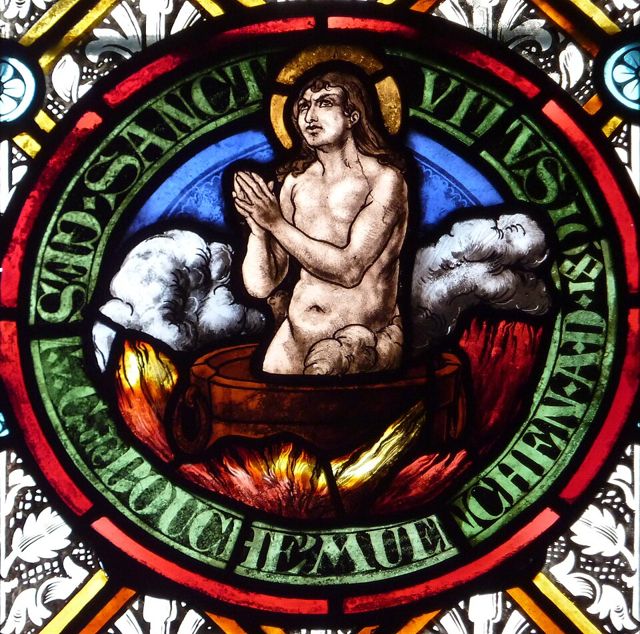
Read Baring-Gould’s full account
Baring-Gould’s sources: All Latin Martyrologies, but nearly all wrong about the locality of the martyrdom, putting the two saints down as having suffered at Antioch. The Latin martyrologists were misled by the apocryphal Acts of SS. Cyriac and Julitta, which had been condemned as fabulous by Pope Ge Iasi us. In the Roman Breviary of 1479 SS. Cyriac and Julitta were in. serted on June 15th; in that of 1522, three lessons were introduced from the apocryphal Acts, but were expunged from the next edition, and the festival itself was abolished by Pius V. Gregory XIII. restored the commemoration, but placed it on June i6tb, the day in the ancient Martyrologies, with a brief account of the martyrs from the more authentic Acts. By the Greeks and Russians on July 151b. Also the Armenians, Nestorians and the Abyssinians on Jan. 20th. The account of SS. Cyriac and Julitta which is alone trustworthy is contained in a letter from Theodore, Bishop of Iccnium, to Bishop Zeno, about A.D. 520. The reason of Theodore writing it was in order to correct the fables which were in circulation relative to the martyrs. He got much of his information from an old man who belonged to the same family as the saints, and from the tradition of the Church of Iconium.] HE persecution of Diocletian raged in the province of Lycaonia. Julitta, a widow lady of Iconium, escaped with her little boy, named Cyriac,1 aged three, and two maid-servants, to Seleucia, but 1 Commonly called in trance S. Cyr. In England S. Cyrcs or Cyrus. finding that Alexander, the governor of Seleucia, was executing the edicts of the emperors with great rigour, she left Seleucia and went to Tarsus in Cilicia. But Alexander, the governor, happened to arrive in Tarsus at the same time, heard of the strange Christian lady who had just taken up her residence there, and ordered her to be arrested. The servants fled and concealed themselves, but Julitta was brought before the governor with her little boy running at her side. Alexander demanded her name, quality, and country, but to all his questions she answered, “ I am a Christian.” Then Alexander ordered the usual tortures to be applied, the rack and the scourge; and to keep the child quiet, he took him on his knee, and began to fondle him. But the little Cyriac seeing his mother stripped and stretched on the rack and beaten, screamed and struggled to get to her. In vain did Alexander attempt to divert the child's attention. The boy turned and slapped him on the face and cried, “lam a Christian also." Then the governor, in a sudden burst of passion, flung the boy from him down the marble steps of his throne, and the child’s skull was broken, and the steps stained with his blood. Julitta thanked God that her child had been found worthy to win the crown of martyrdom, and this tended further to exasperate the judge, who ordered her head to be struck off, and the body of the child to be thrown where the carcases of malefactors were usually cast The two maids, who had remained in concealment, privately buried the bodies of both the martyrs in a field near the city, and on the accession of Constantine, revealed the place.
Relying on the apocryphal Acts as an authority, and ignorant that they had been condemned as spurious by Pope S. Gelasius, S. Ambrose [bishop of Milan (d. 397)], bishop of Auxerre, sought and found the relics [the bodily remains of a saint, or objects they used, kept with honor] of S. Cyriac at Antioch, where the saint never had been, and translated them to Auxerre, whence fragments have been distributed to a great number of places; but we cannot regard them as genuine.