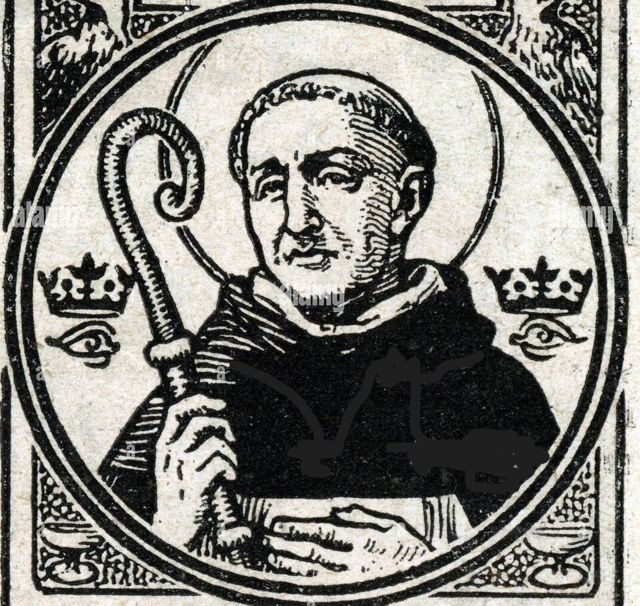
Read Baring-Gould’s full account
Baring-Gould’s sources: Roman Martyrology. Not in Sarum or York Kalendars, nor in the martyrology of Bede. Ado is the only one who gives them a day, and that June stand, along with S. Alban. Baronius seems to have inserted these names on July xst, because he found Aaron, the brother of Moses, to be commemorated on that day. Authorities: — Gildas, or rather the author of the “ De Rxcidio Britannic a," for an account of whom see June 32nd, p. 295. After the pseudo-Gildas, a writer of the 7th cent,, is Bede, in his Ecclesiastical History, B. I., c. 7. Geoffrey of Monmouth, whose testimony is only valuable so far as he is a collector of popular legends and ballads, also mentions' Julius and Aaron, V., c. 5, and IX,, LDAS says thatSS. Julius and Aaron, “citizens of Caerleon,” suffered shortly after S. Alban. Bede says, “ At the same time suffered Aaron and Julius, citizens of Caerleon, 1 and many VOL. VII.
1 ** Cive* urbis legonium.’* IJuly «. more of both sexes in several places, who, when they had endured sundry torments, and their limbs had been torn after an unheard-of manner, yielded their souls up, to enjoy in the heavenly city a reward for the sufferings which they had passed through."
This is a mere paraphrase of the words of the pseudoGildas, “The other holy martyrs were tormented with divers sufferings, and their limbs were racked in such unheard-of ways, that they, without delay, erected trophies of their glorious martyrdom even in the gates of the city Jerusalem.” Geoffrey of Monmouth (d. 1154) quotes Gildas also without acknowledgment, “The other two, *>., Julius and Aaron, after being torn limb from limb, in a manner unheard-of, received the crown of martyrdom, and were elevated up to the gates of the heavenly Jerusalem.” He says elsewhere of Caerleon that “ it was in Glamorganshire upon the river Usk, near the Severn Sea.... it was also famous for two churches, whereof one was built in honour ot the martyr Julius, and adorned with a choir of virgins, who had devoted themselves wholly to the service of God; but the other, which was founded in memory of S. Aaron, his companion, and maintained a convent of canons, was the third metropolitan [the archbishop who heads a group of dioceses] church in Britain.”
It will be seen that all derive their information from Gildas, and it is difficult to conjecture whence he drew his. That two martyrs were commemorated at Caerleon is probable enough, but no trustworthy evidence places their martyrdom in the persecution of Diocletian [Roman emperor 284–305, who began the ‘Great Persecution’ of Christians in 303]. This is a mere conjecture, apparently, of the not very scrupulous or exact author who calls himself Gildas. Giraldus Cambrensis bears testimony in his Itinerary to there having been the two churches in Caerleon in his day (d. 1223), dedicated to these saints.
July