A

A shepherd who stayed with his people through hard times.

Read the essentials →
January 31 · Bishop

St. Aidan or Maidoc of…

St. Aidan or Maidoc of Ferns

A shepherd who stayed with his people through hard times.

Traditional feast

January 31
1914 / pre-1969 calendar, per Baring-Gould (1914)

Current feast

Not verified yet

Represents

Bishop

Their story

Adapted in modern English from Alban Butler's Lives of the Saints · Baring-Gould original below · little is known

Butler calls him Maidoc, or Maodhog, also known as Aidan and Mogue. He was born in Connaught. As a young man he went to Wales and lived under the abbot St. David.

He returned to Ireland with several monks, founded many churches and monasteries, and became bishop of Ferns. Cambrensis shows that his feast was kept in Wales in the twelfth century, and he was also honoured in Scotland. Butler and Baring-Gould agree on 632.

Early life

Selected sentences from the original account, unaltered.

S. Maidoc or Aidan was the son of Setna, a noble of Connaught, by his wife Edna; who, having for a long time no heir, sought that blessing from God by alms-deeds and prayers; which was at last granted. This child of prayer was born in the island called Innis-Breagh-muigh, in a lake in the diocese of Kilmore, and from his childhood declined evil and followed that which is good.

What they represent

How they teach us to live

Drawn from themes in the original account

Feed your mind with Scripture and good books. Learning and the Scriptures matter in this life.

Pray a little every day. Prayer runs all through this account.

Build up the community you belong to. This life was lived with and for a community.

Learn from the kind of life it was. A shepherd who stayed with his people through hard times.

Read more

The full original · 442 words

Read Baring-Gould’s full account

Baring-Gould’s sources: S. Aidan of Ferns is not to be confounded with the illustrious S. Aidan of Lindisfarne, the apostle of Northumbria, who is commemorated on Aug. 31st. The name seems to have been a very common one in Ireland, for Colgan asserts that there are in the ancient Irish Martyrologies as many as thirty-five Saints of this name. Authority: an ancient life from Kilkenny, but certainly not more ancient than the 12th cent.

S. Maidoc or Aidan was the son of Setna, a noble of Connaught, by his wife Edna; who, having for a long time no heir, sought that blessing from God by alms-deeds and prayers; which was at last granted. This child of prayer was born in the island called Innis-Breagh-muigh, in a lake in the diocese of Kilmore, and from his childhood declined evil and followed that which is good. After having learnt the first rudiments of piety in his own country, he left home, and sailed into Britain, to place himself under the discipline of the great S. David of Menevia. With that holy man he remained many years, and was one of his favourite disciples. A remarkable instance of his prompt obedience is related. Being called by a superior from reading his book in the field near the monastery, to follow a pair of oxen at the plough, he made such haste to obey, that he left his book open in the field, a heavy shower of rain fell, but when he recovered the book it was not wet. S. David had seen him leave the volume open before the rain fell, and calling him to him, bade him prostrate himself as a punishment for having, as he supposed, by his carelessness, spoiled a valuable book. S. Maidoc at once obeyed, and S. David went about his work and forgat him. After some hours, when the office was being said, he observed that Maidoc was not present. Then he sent in quest of him, and he was found prostrate on the sea shore, where his master had bidden him lie, and he had not risen, because S. David had not removed his penance.

At length, with the blessing of his master, taking with him other religious of Menevia, he returned to Ireland, where he founded many churches and monasteries; of which the chief was Ferns to which he was consecrated first Bishop. The prodigies related of him, are like so many in the lives of the Irish Saints, quite incredible, as for instance, his having driven to Rome and back in twenty-four hours, his having fed six wolves with six sheep and then restored the sheep whole; his having brought a sea-cow out of the ocean to draw his plough, and having returned from a visit to S. David in Wales on the back of a sea-monster; his having called his bell, which he had left behind him Wales, and it came over the waves with promptitude.

All these are fables, which accumulated in process of time about the lives of the Irish Saints, before they were committed to writing.
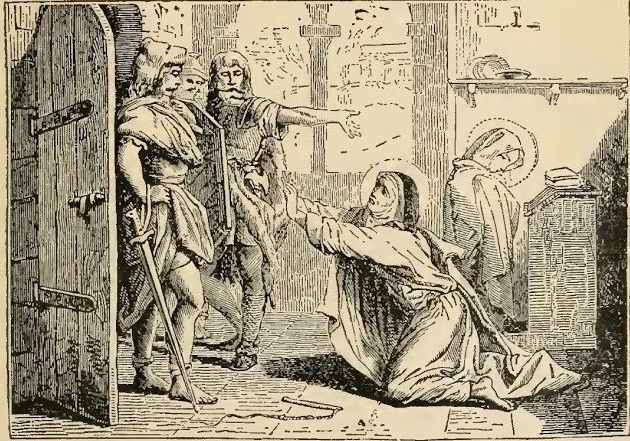
Feast days

Feast: January 31

Nine days · Free

Pray the novena
with us.

One short email a day for nine days. The day's prayer, a line from St. Aidan or Maidoc of…'s story, and a nudge to keep going.

Also on January 31
Sts. Cyrus, John and Others in Egypt

Sts. Cyrus

January 31 · Martyrs
St. Marcella

St. Marcella

January 31 · Widow
U

St. Ulphia

January 31 · Virgin
← All 1726 saints in the library
Sources & notes

Feast-day sources

Story sources

Sources

Credits

From Sabine Baring-Gould, The Lives of the Saints, new and revised edition (Edinburgh: John Grant, 1914; first edition 1872). Public domain.

From Sabine Baring-Gould, The Lives of the Saints, new and revised edition (Edinburgh: John Grant, 1914; first edition 1872). Public domain in the United States. Reproduced unedited, except for short bracketed notes in grey that we added to explain names and terms (“S.” is the old abbreviation for Saint). Some history and judgments reflect 19th-century scholarship.