N
St. Nicetas
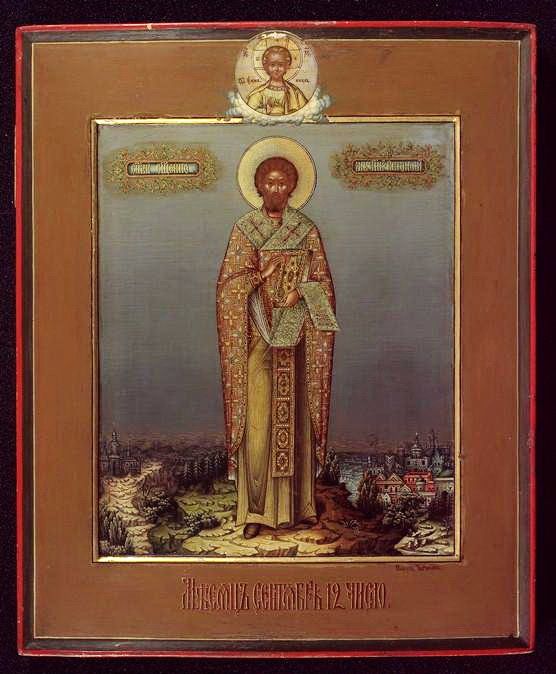
St. Autonomus
M
A shepherd who stayed with his people through hard times.
September 12
Not verified yet
Bishop
One day a huntsman lighted on the cave where the young wolves were, and was amazed to find among them a beautiful child. “When I was little and young and feeble thou didst nourish and cherish and protect me, and now that thou art old and grey and weak, shall I not render the same love and care to thee ? Authority A Life late, and therefore not thoroughly trustworthy.] S. Guy or Guido was born about a.d. 950, at BerchemSaint-Agathe, according to some; according to the general opinion, at Anderlecht near Brussels, in a poor house situated near the convent of the Minims, called S. * * * * * 11 Sinte-Wyen gelege/' which has since been decorated with his statue.
Pray a little every day. Prayer runs all through this account.
Give to people in need. The account records care for the poor.
Look after people who are sick or suffering. The sick come up again and again in this story.
Learn from the kind of life it was. A shepherd who stayed with his people through hard times.
One day a huntsman lighted on the cave where the young wolves were, and was amazed to find among them a beautiful child. He took it in his arms and carried it home, followed by the she-wolf, howling and snapping at his cloak. And long, long afterwards, when Ailbe was bishop, there was a great wolf-hunting party in Emly, and an old grey she-wolf, pursued by the huntsmen, tied to the bishop, and laid its head on his breast “ I will protect thee, old mother !” said the bishop, drawing his mantle round the aged beast. “When I was little and young and feeble thou didst nourish and cherish and protect me, and now that thou art old and grey and weak, shall I not render the same love and care to thee ? None shall injure thee. Come every day with thy little ones to my table, and thou and thine shall share my crusts.” And so it was. None ventured to lift a spear against the aged foster-mother of the bishop; and every day she and her little ones came to his hall, and sat, and ate what he gave them.
Ailbe, according to Tirechan, was ordained priest by S. Patrick [apostle of Ireland (5th century)]. When yet a heathen, his soul yearned for better S. Guido.
i S i things, and as, when keeping sheep, a Christian priest heard him praying with eyes uplifted to heaven for light and grace, he took the boy and taught and baptized him. Joscelin reckons Ailbe among the disciples of S. Patrick. * The legendary life, which unfortunately the Bollandists [Jesuit scholars who since the 1600s have critically studied the lives of the saints] have not printed, and which is yet, so far as I am aware, unpublished, contains many wonders. S. Ailbe wished once to give to the king of Munster a hundred horses; so he went to the top of a mountain, and prayed, and a cloud arose out of the sea, and came to the mountain top, and then burst, and from its womb issued a hundred noble steeds. The accurate annals both of Ulster and of Innisfallen place the death of Ailbe in the year a. d. 527, S. GUIDO, a [Belgian Martyrologies. Modern Roman Martyrology. Authority A Life late, and therefore not thoroughly trustworthy.] S. Guy or Guido was born about a.d. 950, at BerchemSaint-Agathe, according to some; according to the general opinion, at Anderlecht near Brussels, in a poor house situated near the convent of the Minims, called S. * * * * * 11 Sinte-Wyen gelege/' which has since been decorated with his statue. The poverty of the family to which he belonged obliged Guido to serve as labourer. One day, having left his work to go to his prayers, an angel guided his plough for him. The same story is told of S. Isidore the ploughman of Madrid. The farmer saw other miracles wrought by his servant. He took up earth in his hands, and it changed into bread. He stuck his staff into the ground, and it put forth leaves, and became an oak called the Sinte-Wyden-Eik, cut down in 1633, because it was dying of old age, and was replaced by another tree which exists still on the side of the road from Anderlecht to Itterbeck.
On reaching man's estate, Guido resolved to renounce the world. He wandered about unable to find a solitary place that suited his fancy. At last he reached the hamlet of Laeken, and remained there serving the priest as sacristan. He devoted himself wholly to his sacred office. The altar was kept neat and clean, was decorated with fresh flowers, and the whole church was a model of tidiness. After a while an acquaintance, a Brussels merchant, persuaded him to join in some small commercial speculations, and Guido satisfied his conscience when beginning business as a chapman that he would make his fortune speedily, and thus would be able to give liberally to the poor. But one day the boat containing the goods of the two associates sank in the Senne, and Guido returned to Laeken thoroughly disgusted with mercantile ventures, and resolved to have nothing more to do with them.
Shortly after he departed for the Holy Land. At Rome he met Wondulf, dean of Anderlecht, who knew him by reputation, but did not recognise him travel-soiled, and with a long beard. When Guido declared his name, the dean greeted him in broad Flemish with rapture, and the two went on together on their way to Jerusalem, solacing one another's ears with the sound of their mother-tongue. On their way back the dean died. Already, before his departure, he had attained miraculous powers; one day, according to tradition, his servants when they went to sow his field, found it already full of wheat in full ear with blue corncockles and scarlet poppies growing amidst the corn. The spot, situated in the plain of Scheut, near the road called <k des mendiants,” has preserved the name of “ den akker van mirakel,” or the miraculous field. According to some, it was in this field that the angel ploughed for S. Guido; and on this account it is also called “Sinte Wyden-bunder.’' Guido reached Brabant exhausted with his labours and hardships, after an absence of seven years. On arriving at Anderlecht he was received by a poor peasant, to whom he related the particulars of his journey, and the last days of Wondulf. The clerks of Anderlecht came to visit him, and he surrendered into their hands the ring of the dean. They found Guido sick to death. He had broken a blood-vessel, and was sinking fast. He was transported to the hospital, and died there in the midst of a blaze of supernatural light, on the 1 2th of September, a.d. 1012.
After Guido had been buried, his virtues were well nigh forgotten, but a horse having struck his tomb with his hoof, fell dead, and this was supposed to indicate the merits of the saint. Onulf, Lord of Anderlecht, at once surrounded the tomb with a hedge. Two serfs having laughed at the idea that Guido was a saint, fell back dead. Thereupon ensued great excitement and devotion. In 1054 an oratory was erected over the tomb. The body was afterwards translated to a new church, and the bones washed in a spring, which has ever since been regarded as miraculous. It is at the north side of Anderlecht, and is called “ den Welden-berch.” On a blue stone above it may be read the words “Sanctus Guido, 0 (ra) P (ro) N (obis). 1786.” The Blessed Guido (in Flemish, Wyden ), is represented in pilgrim’s habit, with horse and ox at his feet, a harrow at his side, and in one hand two palms.
Feast: September 12
One short email a day for nine days. The day's prayer, a line from St. Ailbe of Emly's story, and a nudge to keep going.
From Sabine Baring-Gould, The Lives of the Saints, new edition in 16 vols. (London: John C. Nimmo, 1897–98); text from the Internet Archive scan (OCR, lightly cleaned; errors possible). Public domain.
From Sabine Baring-Gould, The Lives of the Saints, new edition in 16 vols. (London: John C. Nimmo, 1897–98); text from the Internet Archive scan (OCR, lightly cleaned; errors possible). Public domain in the United States. Reproduced unedited, except for short bracketed notes in grey that we added to explain names and terms (“S.” is the old abbreviation for Saint). Some history and judgments reflect 19th-century scholarship.