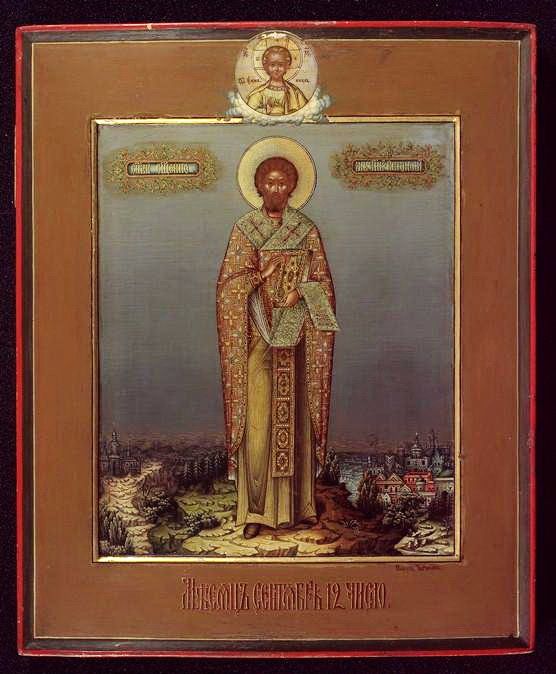
Faithfulness to Christ when it cost everything.
September 12
Not verified yet
Martyr
Maximinus then poked a red hot skewer in at one ear of his son and out at the other, without in the smallest degree affecting the hearing of the indomitable youth.
Share your faith, in words and by example. Preaching and conversion are central here.
Learn from the kind of life it was. Faithfulness to Christ when it cost everything.
…sent against him to tear him into five thousand pieces. But he converted and baptized them all; and they went back to the Emperor without the fragments of flesh which were expected of them. For as a matter of fact they had minced the martyr into five thousand pieces, but the bits had run together again like globules of mercury, and S. Nicetas sat up again unhurt. The shock and surprise of seeing the hashed martyr open his eyes and talk, completely convinced the five thousand and led to their baptism. Maximinus then poked a red hot skewer in at one ear of his son and out at the other, without in the smallest degree affecting the hearing of the indomitable youth. Then the unnatural parent hung him up by the feet, tarred him, and set fire to him, but still could not hurt him. In despair, he flung him down a well, but S. Michael pulled him out again, and announced to all people and nations that whoever should invoke S. Nicetas would certainly obtain all he desired.
Maximinus then promised his son to believe in Christ if he would raise from the dead some corpses buried under a pillar. Nicetas at once raised a host of dead men, and as they were all heathens whom he had resuscitated, he baptized them. The Emperor then ordered his son to be beaten; thereat the Empress, who had borne patiently the hashing and skewering, remonstrated, and an insurrection having broken out, the enraged mob rushed on Maximinus and massacred him. Nicetas baptized the mob, and then tranquilly expired.
The body of S. Nicetas is shown in the church of S. Raphael at Venice. An office, with lesson from these Acts, was approved by Clement VIII.
Feast: September 12
One short email a day for nine days. The day's prayer, a line from St. Nicetas's story, and a nudge to keep going.
From Sabine Baring-Gould, The Lives of the Saints, new edition in 16 vols. (London: John C. Nimmo, 1897–98); text from the Internet Archive scan (OCR, lightly cleaned; errors possible). Public domain.
From Sabine Baring-Gould, The Lives of the Saints, new edition in 16 vols. (London: John C. Nimmo, 1897–98); text from the Internet Archive scan (OCR, lightly cleaned; errors possible). Public domain in the United States. Reproduced unedited, except for short bracketed notes in grey that we added to explain names and terms (“S.” is the old abbreviation for Saint). Some history and judgments reflect 19th-century scholarship.