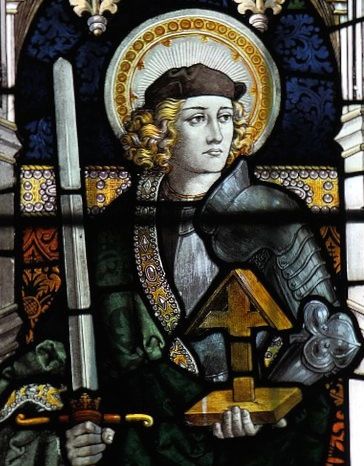
St. Aloysius Gonzaga

…open his door more than slightly, and then resolutely shut his eyes whilst listening to the message.

Read the essentials →
June 21 · —

St. Aloysius Gonzaga

St. Aloysius Gonzaga

…open his door more than slightly, and then resolutely shut his eyes whilst listening to the message.

Traditional feast

June 21
1914 / pre-1969 calendar, per Baring-Gould (1897)

Current feast

June 21
Verified · General Roman Calendar

Represents

Feast

Their story

Adapted in modern English from the Catholic Encyclopedia (1913) · original text below

Aloysius Gonzaga was born on 9 March 1568 in the castle of Castiglione. At eight he was placed at the court of Francesco de' Medici in Florence, and two years later he went to Mantua. At twelve, at Brescia, he came under the guidance of St Charles Borromeo, who gave him his First Communion. In 1581 he went to Spain with his father, and he and his brother became pages to the son of Philip II. There he resolved to become a Jesuit (member of the Society of Jesus, founded by St. Ignatius of Loyola).

Back in Italy in 1584, he had great difficulty winning his father's consent. On 2 November 1585 he renounced his inheritance in favour of his brother, which needed the emperor's approval, since Castiglione was an imperial fief, and he entered the Society of Jesus later that month. He made his vows on 25 November 1587 and began studying theology.

In 1591, in his fourth year of theology, famine and plague broke out in Italy. Though his own health was delicate, he gave himself to nursing the sick. On 3 March he fell ill, and he died on 21 June 1591. He was canonized (officially declared a saint by the pope) in 1726, and his remains lie in the church of Sant'Ignazio in Rome.

Early life

The book says little or nothing about early life. This is how the account begins.

…open his door more than slightly, and then resolutely shut his eyes whilst listening to the message. He assured his director that he did not know one lady of his relations by sight, much less one of the female servants of the palace. His modesty was carried to such a pitch that he could not even change his stockings in the presence of a footman.

What they represent

How they teach us to live

Drawn from themes in the original account

Keep their day. Remember them on June 21 with a short prayer, and ask for their help.

From the Catholic Encyclopedia

1913 · 399 words

​Aloysius Gonzaga, Saint, b. in the castle of Castiglione, 9 March, 1568; d. 21 June, 1591. At eight he was placed in the court of Francesco de' Medici in Florence, where he remained for two years, going then to Mantua. At Brescia, when he was twelve, he came under the spiritual guidance of St. Charles Borromeo, and from him received First Communion. In 1581 he went with his father to Spain, and he and his brother were made pages of James, the son of Philip II. While there he formed the resolution of becoming a Jesuit, though he first thought of joining the Discalced Carmelites. He returned to Italy in 1584 after the death of the Infanta, and after much difficulty in securing his father's consent, renounced his heritage in favour of his brother, 2 November, 1585, a proceeding which required the approval of the emperor, as Castiglione was a fief of the empire. He presented himself to Father Claudius Acquaviva, who was then General of the Society, 25 November, 1585. Before the end of his novitiate, he passed a brilliant public act in ​philosophy, having made his philosophical and also his mathematical studies before his entrance. He had in fact distinguished himself, when in Spain, by a public examination not only in philosophy, but also in theology, at the University of Alcalá. @media all and (max-width:360px){.mw-parser-output .img-center,.mw-parser-output .img-floatleft,.mw-parser-output .img-floatright{float:none!important;clear:none!important;margin:0 auto!important;padding:0!important}}.mw-parser-output .img-center{float:left;clear:both;width:100%!important;margin:1em auto;padding:0}.mw-parser-output .img-center img,.mw-parser-output .img-floatleft img,.mw-parser-output .img-floatright img{max-width:100%;height:auto}.mw-parser-output .img-floatleft{float:left;clear:left;margin:0 1em 0 0;padding:0 0.5em;max-width:100%}.mw-parser-output .img-floatright{float:right;clear:right;margin:0 0 0 1em;padding:0 0.5em;max-width:100%}.mw-parser-output .img-floatmissing{display:block;border:1px solid grey;font-size:83%;font-style:italic}St. Aloysius Gongaza He made his vows 25 November, 1587. Immediately after, he began his theological studies. Among his professors were Fathers Vasquez and Azor. In 1591 when in his fourth year of theology a famine and pestilence broke out in Italy. Though in delicate health, he devoted himself to the care of the sick, but on March 3 he fell ill and died 21 June, 1591. He was beatified by Gregory XV in 1621 and canonized by Benedict XIII in 1726. His remains are in the church of St. Ignazio in Rome in a magnificent urn of lapis lazuli wreathed with festoons of silver. The altar has for its centerpiece a large marble relief of the Saint by Le Gros.

Butler, Lives of the Saints, 21 June; Acta SS., 21 June; Cepari, Life of St. Aloysius Gonzaga; Rouvier, Les Saints de la C. de J. (Paris, 1893).
Read more

The full original · 258 words

Read Baring-Gould’s full account

Baring-Gould’s sources: Roman Martyrology. Beatified by Gregory XV., in 1621, canonized by Benedict XIII., in 1726. Authorities: — A life by Cepari, the master of novices, under whom S. Aloysius was; and other notices of him by Conrad Janing, S. J., in the Acta Sanctorum, June the 4th.] S. Aloysius Gonzaga was the son of Ferdinand, marquis of Castiglione, of the family of the dukes of Mantua. His mother was lady of honour to Isabella, wife of Philip II. of Spain, in whose court the marquis of Castiglione also lived in great favour. S. Aloysius was bom in the castle of Castiglione, near Brescia, on the 9th of March, 1568. At the age of seven he began to manifest an earnest desire to live to God alone; however at the age of eight he and his brother Ralph, were placed at the court of Francis de Medicis, grand duke of Tuscany, and aftor two years were transferred to the court of the duke of Mantua. At the age of eleven he resolved to resign his title and family honours to his brother. In 1580 he made his first communion at the hands of S. Charles Borromeo. In 1581 his father attended the Empress Mary of Austria, wife of Maximilian II., and sister of Philip II. of Spain, to Spain. He took with him his sons, and they were made pages by the king to his son James. And now Aloysius resolved to quit the world and join the Society of Jesus. His father strongly opposed this, but was finally over* come by the resolution of his son, and Aloysius entered on his noviciate in the house of the Order in Roma# in 1585. His health gradually declined, and in 1591 he was attacked by a malignant fever caught from feverpatients in a hospital in which he ministered with indefatigable zeal. He died of this disease shortly after S. Aloysius is regarded as a model of virtue of a certain stamp, little appreciated by Teutonic nations, of what stamp the following anecdotes will show. So great was his acquired modesty that he would not speak with his mother in a room alone, when he was ten years old. Indeed he never looked any woman in the face; and if his mother sent a message to him by some lady in attendance on her, he would not •S'. Aloysius Gonzaga.

…open his door more than slightly, and then resolutely shut his eyes whilst listening to the message. He assured his director that he did not know one lady of his relations by sight, much less one of the female servants of the palace. His modesty was carried to such a pitch that he could not even change his stockings in the presence of a footman. When in Spain, as page to the infante James, he was obliged to be much in the presence of the queen. He was asked once what she was like, whether she was beautiful. “ I cannot tell,” answered the boy, “ I have never looked at her face.” He is said to have recited a “ Hail Mary ” at every step on the stairs. This must naturally have made his ascent and descent of the stairs a slow process, highly conducive to his own spiritual advance, but inconvenient to his mistress when he was sent on an errand. He singularly loved suffering and insult, and the contempt of men of the world, which his conduct was so eminently calculated to elicit. He therefore delighted to carry a wallet through the streets of Rome, begging from door to door, and to sweep the kitchen, and carry away the filth of the house. In his last sickness some very nauseous medicine was given him. Another youth also ill, who was given a similar draught, gulped it hastily down. Aloysius sipped his medicine leisurely, so as to prolong his disgust, and thereby increase his merit.

Feast days

Feast: June 21

Nine days · Free

Pray the novena
with us.

One short email a day for nine days. The day's prayer, a line from St. Aloysius Gonzaga's story, and a nudge to keep going.

Also on June 21
St. Eusebius of Samosata

St. Eusebius of Samosata

June 21 · Bishop
St. Alban

St. Alban

June 21 · Martyr
M

St. Maen

June 21 · Abbot
← All 1726 saints in the library
Sources & notes

Feast-day sources

Story sources

Sources

Credits

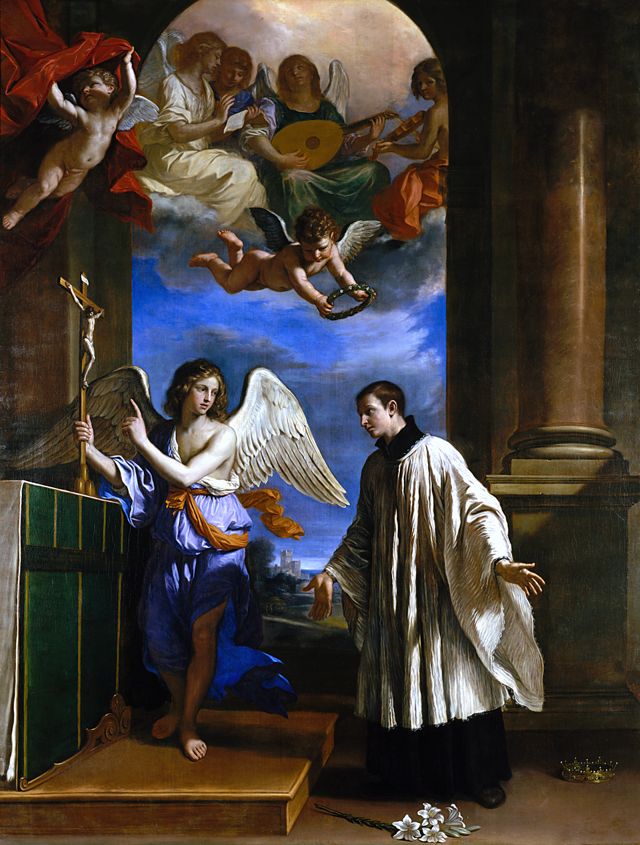
Image: The Vocation of Saint Aloysius Gonzaga.PNG · Guercino · Public domain, via Wikimedia Commons

From Sabine Baring-Gould, The Lives of the Saints, new edition in 16 vols. (London: John C. Nimmo, 1897–98); text from the Internet Archive scan (OCR, lightly cleaned; errors possible). Public domain.

Image: Guercino, Wikimedia Commons (Public domain)

From “Catholic Encyclopedia (1913)/St. Aloysius Gonzaga,” The Catholic Encyclopedia (New York: Robert Appleton Company, 1907–1914), via Wikisource. Public domain. Matched by name and feast date; text unedited except for our bracketed notes in grey.

From Sabine Baring-Gould, The Lives of the Saints, new edition in 16 vols. (London: John C. Nimmo, 1897–98); text from the Internet Archive scan (OCR, lightly cleaned; errors possible). Public domain in the United States. Reproduced unedited, except for short bracketed notes in grey that we added to explain names and terms (“S.” is the old abbreviation for Saint). Some history and judgments reflect 19th-century scholarship.