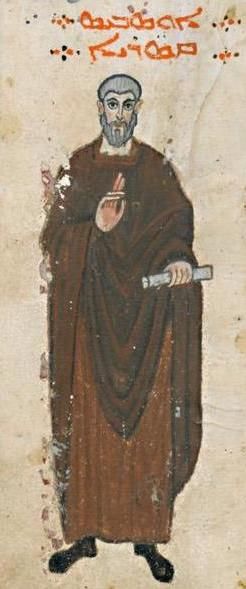
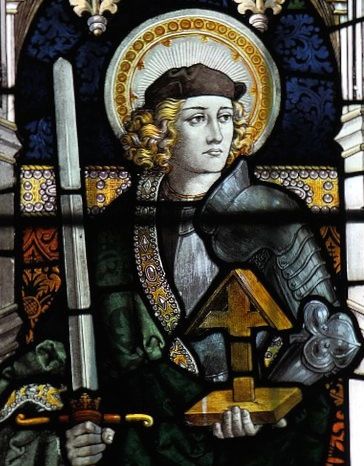
Baring-Gould’s sources: Roman Martyrology. Greek Mensea on June 22nd. Authorities: — Theodoret, S. Greg. Naz. Oral., Ac.] The see of Antioch was vacant in the beginning of 361, and Constantius assembled a council there to compose the religious controversies which distracted the East. The bishops assembled urged the immediate appointment of a prelate to this important see. After some dispute, S. Meletius (Feb. 12th), was chosen. His gentleness and piety had won the respect of all, and the Arians expected that his gentleness would prove compliant to false doctrine, as it was tender towards sinners. They were mistaken, he preached daily the doctrine of the co-equal divinity of the Son with the Father. The Arians were furious, and desired to cancel his appointment. But this could only be effected by obtaining the decree of appointment drawn up and signed at the time of his instalment, which had been placed in the hands of S. Eusebius, bishop of Samosata. After the council, S. Eusebius had retired to his bishopric, carrying the document away with him, as the guardian of it The emperor, at the request of the Arians, sent a message to Eusebius to give it up. The bishop replied, 11 1 cannot surrender a public deposit without the consent of all those who entrusted it to me.” Constantius, irritated at this reply, wrote to him again, insisting on the surrender, and threatening, if he refused, to have his right hand cut off.” Eusebius calmly presented both his hands to the bearer of the letter, and said, 11 Strike them both off, I will not surrender the document.” But the officer had not received orders to fulfil the threat, and he returned to Constantius.
[lane Eusebius [Eusebius of Caesarea (d. c. 339), the first historian of the Church], bishop of Caesarea, in Cappadocia [a region of central Turkey], died in 370, when Valens, the Arian [followers of Arius, who taught that the Son is a created being, not fully God] emperor, was persecuting the Church. The see of Caesarea [a bishop’s “see” is his diocese, named from his seat (Latin sedes)] was one of the most important in Asia Minor, it was the capital of Cappadocia, and perhaps of all the so-called diocese of Pontus [a region on the Black Sea coast of Turkey], half Asia Minor. The clergy of Caesarea, according to custom, wrote to the bishops of the province, and they arrived to conduct the election of a successor. The aged Gregory of Nazianzus (the father of S. Gregory Nazianzen), wrote to S. Eusebius of Samosata, to implore his succour in the matter, although he did not belong to the province, and represented to him the peril of the church of Caesarea, which ran the risk of receiving a heretic as its chief pastor. S. Eusebius hastened to Caesarea, and his presence was efficacious in sustaining the cause of the Catholics, and his influence led in a measure to the election of S. Basil (see p. 196.) S. Gregory of Nazianzus was so well satisfied with the zeal of the Bishop of Samosata in this most trying time, that in a letter written at the time, he styles him the pillar of the truth, the light of the world, the vehicle of the favours of God towards His people, and the support and glory of all the orthodox.
When the persecution of Valens broke out, S. Eusebius was not satisfied with confirming his own flock against the assaults of heresy, but he visited the afflicted churches in Syria, Phoenicia, and Palestine, disguised in the dress of an officer, encouraging the faithful, ordaining priests where needful, assisting the orthodox bishops in filling vacant sees with worthy pastors. His activity incensed the Arians, and in 374 Valens sent an order for his banishment. The officer who came to execute the order appeared before Eusebius. The bishop quietly bade him conceal his errand, 14 lest the people in their June ax.] S. Eusebius.
zeal should drown you.” He then said the evening service, took one domestic with him, and crossed the Euphrates at night. Some of his flock overtook him; he recited to them texts about obedience to rulers, accepted a few gifts from his dearest friends, prayed for them all, exhorted them to steadfastness in the faith, and went his way. His people would not speak to or visit the Arian bishop who was appointed his successor. After he had been at the public bath, they let out the water as impure. The new bishop, a gentle-spirited man, could not bear to be under the ban of his nominal flock, and resigned the see. The next Arian bishop was of sterner stuff, and punished abhorrence with sentence of exile. Zeal for the truth sometimes degenerated into fanaticism. Some boys were playing ball in the street and the ball bounded between the legs of the ass on which the Arian prelate ambled along. They uttered a cry, and passed the ball through a fire to remove the infection. The bishop was angry, and revenged himself by punishing the priest Antioch us, nephew of S. Eusebius, and the deacon Evolcius, both zealous Catholics. Valens was killed in the battle of Hadrianople, August 9th, 378, and was succeeded by Gratian, who recalled the exiles. Eusebius returned to Samosata, and with his customary energy, went about various cities, establishing Catholic bishops. He lost his life in this pious labour. In a little city of Syria, an Arian woman flung down a tile from the roof of her house on the head of Eusebius, who died shortly afterwards, having, before he died, exacted a promise from his friends never to search for the woman.