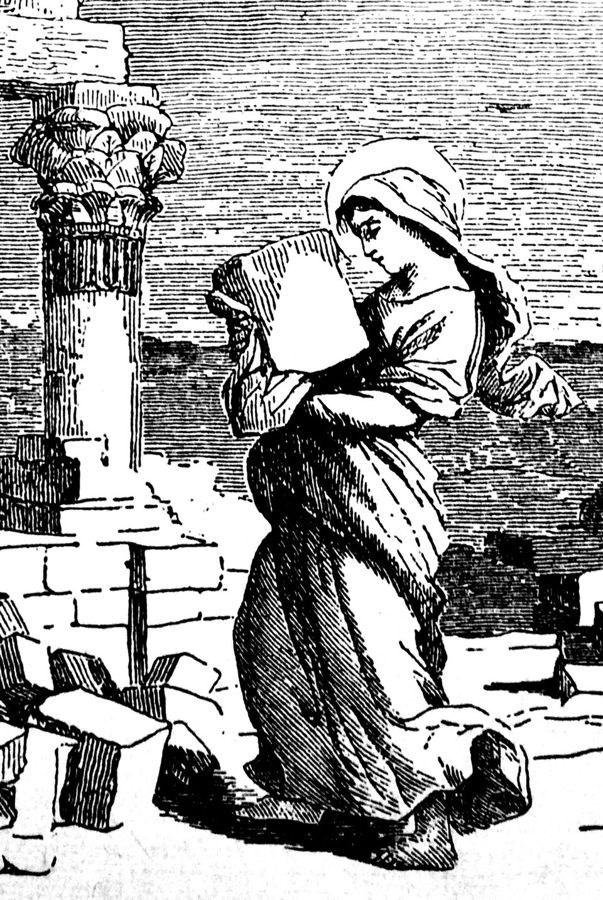
Baring-Gould’s sources: Roman Martyrology. Authority:—A life written by Eginus the monk, about the year 960, not, apparently entire, and the Lections of the Breviary of Camerino.
S. Ansewin, or Hanse-win, was a native of Camerino, in Tuscany. He retired in early life into the solitude of Castel-Raymond, near Torcello, after his ordination as priest. He was appointed chaplain and confessor [in old usage, a saint who was not martyred, or who suffered for the faith without being killed] to the emperor Louis, and in 822, he was nominated to the bishopric of his native city. A strange legend of his expedition to Rome to receive consecration has been recorded by his biographer. On arriving at Narni, with a cavalcade of nobles and friends who accompanied him from Camerino, they put up at a tavern for refreshment, and asked for wine. The publican, an ill-conditioned fellow, served them with what they desired, but Ansewin, looking at it, detected that it was watered, and sharply rebuked the taverner. The man surlily replied that they must drink what was set before them, and that it was no odds to him whether they liked his wine or not.
"Now, friend," said the bishop-elect, "we have no drinking vessels with us, so bring us forth horns or goblets."
"Not I," answered the publican, "I provide wine, but customers usually bring their own cups."
"But, friend, we have none with us." "That is your affair, not mine," answered the fellow rudely. "Then we must do what we can," said Ansewin, drawing off his cape, and holding out the hood. "Come, host! pour the wine in here." The man stared, and then burst into a roar of laughter. But Ansewin persisted. "Then, fool, I will do so, and waste the liquor, but mind, you pay for it," said he. "Pour boldly," said the bishop-elect, holding the hood distended; and the inn-keeper obeyed. Then two marvels occurred, the hood retained the liquor, and served as a drinking horn to all the company, and the water which had diluted the wine separated from it, and flowed away over the edge.
He ruled his diocese with great prudence, and in time of famine, by his wise regulations and abundant alms, greatly relieved the sufferings of the poor. He was absent from his dear city where he had been born, and which he had ministered to with so much love, when he was stricken with mortal sickness. He was greatly distressed at the prospect of dying out of his diocese, and ordered a horse to be brought that he might ride home. His companions, seeing death in his face, remonstrated; but he persisted in his command, and when his horse was brought to the door, he descended, supported by his friends to it. Then the horse knelt down, and suffered the dying man to mount him without effort. As soon as he was in Camerino, he ordered all his flock to assemble to receive his final blessing, and then gently expired.
Relics at Camerino, in the cathedral, and a portion of the shoulder in the Vatican.
In art he is represented with his hood full of wine.