Baring-Gould’s sources: Roman Martyrology, on the authority of Usuardus. By the Greeks on July 25th. Authority:—An ancient Greek life, published by Bollandus, quoted by S. John Damascene (730). There are other, more modern, versions of the ancient life.
In the reign of Theodosius [name of Roman emperors; Theodosius I (379–395) made Christianity the state religion] the First, Antigonus, governor of Lycia, and his wife, Euphrasia, were blessed by God with a little daughter, who was named after her mother. Antigonus and his wife feared God, and served Him with all their hearts, and with one consent resolved to bring up their little child as a bride of Christ. Shortly after Antigonus had formed this resolution he was called out of the world. When the child was five years old, the emperor, who had taken the little girl under his protection, proposed to the mother that she should be given in marriage to the son of a wealthy senator, in accordance with the custom of the times, to betroth maidens of high rank from infancy. The mother consented, and received the betrothal presents from the parents of the boy, and the marriage was arranged to take place as soon as the maiden was of a sufficient age. But in the meantime, some changes in the imperial household having thrown Euphrasia, the mother, out of favour, she retired into Egypt with her daughter, under pretext of visiting her relatives, and whilst there she travelled into Upper Egypt, and saw with admiration and respect the holy lives of the solitaries who inhabited the deserts of the Thebaid [the desert region of Upper (southern) Egypt].
In the Thebaid was a convent of a hundred holy women, and the widow found great delight and exceeding profit in visiting it frequently, taking with her each time her little child, who was then aged seven. The mother superior was warmly attached to the beautiful girl, and one day drawing the child towards her, before her mother, asked Euphrasia if she loved her. "That do I," answered the child, looking up into her face. "Well, will you come and live with us, then?" enquired the superior, playfully. "I would," replied Euphrasia, "if I did not think it would trouble my mother." "And now, my pet," said the superior, "which do you love best, your little husband or us sisters." "I have never seen my little husband, nor has my little husband ever seen me, so we cannot love each other much," answered the child; "but I do love you sisters very much, because I know you. Which do you love best, my little husband or me?" "Oh," said the nun, "I love you much the best; but I love Jesus Christ above all." "So do I," said the child, "I love you very much, but I love Jesus Christ best."
The mother, Euphrasia, looked on smiling, and with tears in her eyes, as this simple conversation, which has been blown down to us through more than fifteen centuries, passed between the old nun and the child. Then she took her child's hand to lead her away. But the young Euphrasia implored her mother to let her remain, and she, supposing this was a mere infantine caprice, consented, thinking that she would soon weary of the cloister life. But it was not so. The child clung to the sisters, in spite of every hardship and trial inflicted on her to persuade her to go. She was told she must fast, and learn the Psalter by heart, if she remained, and sleep on the hard ground. She was ready for all, rather than depart. Then the superior said to the mother, "Leave the little girl with us, for the grace of God is working in her heart. Your piety and that of Antigonus have opened to her the most perfect way." Then Euphrasia, the mother, took her child in her arms, and going before an image of our Blessed Lord, she held up the little girl, and said, weeping, "My Lord Jesus Christ, receive this child into Thy protection, since she desires Thee only, and devotes herself to Thy service alone." And she blessed her daughter, saying, "May the Lord, who made the mountains so strong that they cannot be moved, confirm thee in His holy fear." But when the parting came, she burst into a flood of tears, and the whole community wept with her. A few days after, the superior brought the young Euphrasia into the chapel, and vested her in the religious habit, and kneeling down by the tiny novice, she prayed, "O King of ages, finish in this child the work of sanctification that Thou hast begun. Give her grace to follow in all things Thy holy will, and to place in Thee her hope and confidence."
When her mother saw her in her austere habit, she asked her if she were content. "Oh, mother!" cried the child, "It is my marriage garment, given me on my espousals to Jesus." "May He, sweet child, make thee worthy of His love," said the mother.
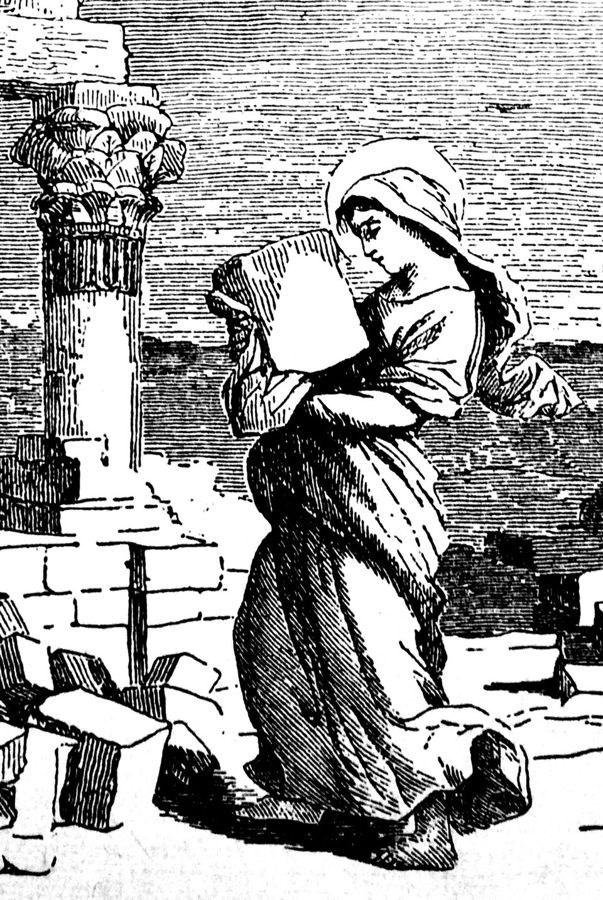
Years passed away, and the little flower grew up and bloomed in the cool shade of the cloister, and her mother had rejoined Antigonus in bliss, when the emperor wrote to Euphrasia to order her instantly to return to Constantinople and marry the young man to whom he had betrothed her. She was of imperial blood, and Theodosius considered that, on the death of her mother, the charge of Euphrasia, who was now an heiress and very wealthy, devolved on him. She replied, imploring him to allow her to follow her vocation, and requested him to dispose of all her property for the benefit of the poor. Euphrasia was then aged twelve. Theodosius, satisfied that she was in earnest, obeyed her request, and troubled her no more about the marriage. But now arrived a critical time of life, when youthful spirits and passions were in effervesence, and she was cruelly tormented with vain imaginations and temptations to go forth into that wondrous world of which she knew so little, but which, clothed in the rainbow tints of infantine remembrance, allured her fancy. To divert her attention, and at the same time to prove her obedience, the superior one day pointed to a great heap of stones, and bade her carry them to the top of a little sand hill, some distance off. Euphrasia obeyed cheerfully, toiling at removing the stones under the hot sun, one by one, to the place indicated. Then she came joyously to the superior, and signified to her that the task was accomplished. "Bring them all back again," said the mother superior. And the young nun hasted to obey. Next day she presented herself before the superior once more. "I have changed my mind," said the mother; "take the stones back again to the top of the mound." And thirty times did she make Euphrasia carry them back; and each time was she obeyed with cheerfulness.
She was then sent into the kitchen, and made to chop up the wood for the fire, bake the bread, and cook the food. The sister who undertook this arduous task was usually exempt from attending the midnight offices, but Euphrasia never missed being present in choir with the others, and when she was twenty, she was taller and plumper than any of the other sisters, her face had lost none of its beauty and freshness, but beamed with amiability. She had her trials, being for some time vexed with the contradiction of one of the sisters, who took a spite against her, being filled with jealousy of her virtues, and she once seriously injured her foot with the axe when chopping up wood. But God favoured her, and gave her the power of working miracles, and she cast evil spirits out of many that were possessed, and healed many that were sick. And when she was about to die, Julia, a favourite sister, who inhabited the same cell, implored Euphrasia to obtain for her the grace to be her companion in heaven, as she had been her associate on earth. Then, when Euphrasia was dead, sister Julia cast herself on her tomb, and wept and prayed, and the third day she was called away to be with her friend in the heavenly kingdom. Now, when the aged superior saw this, she longed greatly to enter also into her rest; it was she who had admitted Euphrasia, and it grieved her sore to be left in the desert when her spiritual daughter had entered the Promised Land. So she prayed also, and when the nuns looked into her cell in the morning, she had joined Euphrasia and Julia.