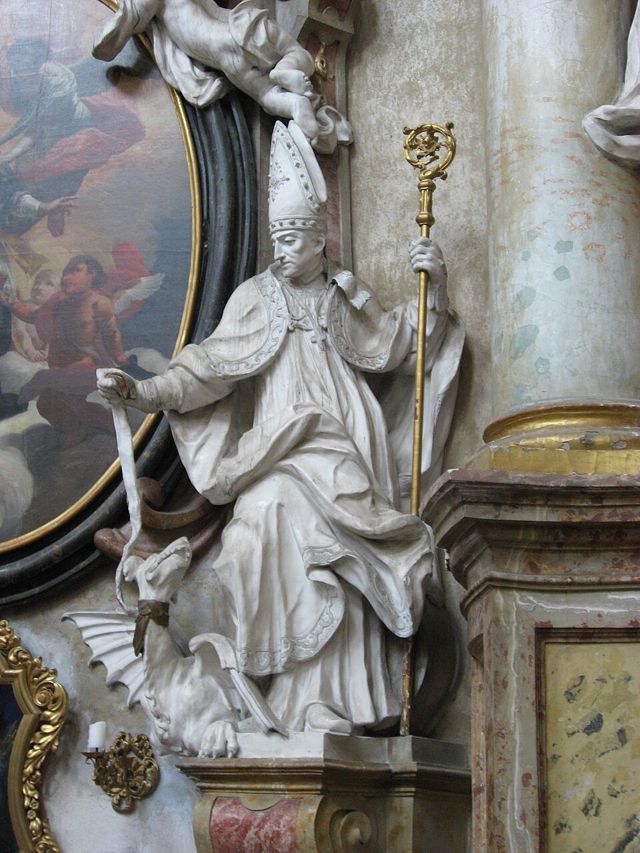
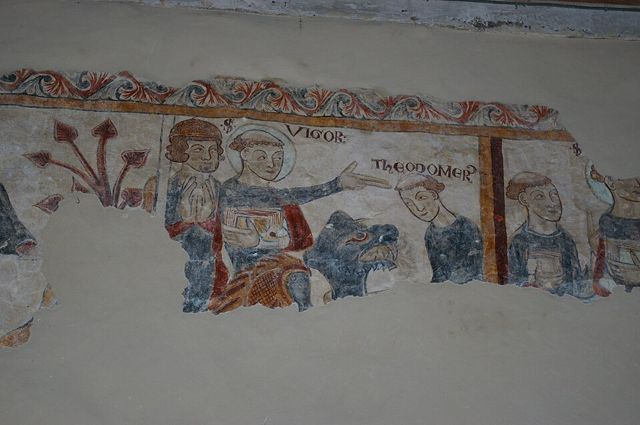
Baring-Gould’s sources: Roman and Gallican Martyrologies. Authority: — A Life written apparently by S. Praejectus, Bishop of Clermont, d. 674, in Labbe, If we were to believe what S. Praejectus, or the 7th century author of the Life of S. Austremonius states, this saint was one of the seven ty-two disciples of our Lord; of these Gratian went to Tours, Trophimus to Arles, Paul to Narbonne, Satuminus to Toulouse, and Martial to Limoges. Of these only Satuminus and Austremonius received the grace of martyrdom. Austremonius came to Gaul with the others mentioned, and betook himself to Auvergne, of which district he became the apostle. Once a year he, Martial, and Satuminus met to take counsel together on the conduct of their dioceses, and the means they should adopt to advance the faith and overthrow heresy.
After having laboured some while among the volcanic cones of Auvergne, Austremonius went to Bourges, and ordained his disciple Ursinus to the episcopal throne of that city. He preached in the Nivemais and Limousin. In Clermont, the capital of Auvergne, and throughout the province, he founded many churches, and ordained priests to them. After having been bishop of Cler.nont for thirty-six years, he resigned his pastoral crook into the hands of his disciple Urbicius, and retired into the monastery of Issoire that he had founded, and which was crowded with monks. Not. i.] 6*. Austremonius.
There were many Jews in Auvergne, and Austremonius greatly incensed them by converting and baptizing the son of one of their principal rabbis. The father, in a rage, killed his son, and flung the body down a well. S. Austremonius went in procession to the well with incense and lights, and recovered the body of the Jewish youth, who is venerated under the title of S. Lucius. At this time he was called to the deathbed of his disciple S. Marius, who was living in the valley of Jomens. He went to see him, accompanied by his priest Nectarius and his archdeacon Mammetus. He buried S. Marius, and raised a church over his tomb at the cost of the faithful of the neighbourhood, and consecrated it with great pomp. He received also from the nobles of the neighbourhood estates, which they gave for the endowment of this church.
From thence he went to Compendiac, where he dedicated a church to S. Michael, and enriched it with representations of the whole celestial hierarchy.
On his way back to Issoire he was waylaid by the Jew whose son he had baptized, and his head was struck off by the Jew, and thrown down a well. Mammetus, his archdeacon, ran away and hid in a cave.
S. Urbicius came with great pomp and buried the saint's body. His head was traced to the well by the drops of blood that had fallen from it, and was recovered. The people shouted for the “ cutting off of the Jews from among the Christians," but the author of the Life fails to tell us if this led to a massacre of them.
In considering this Life, we are struck at once with the incongruity of the events recorded with the date given to S. Austremonius. In the ist century, long before the persecutions of Dedus and Diodetian, at the time, however, of that of Marcus Aurelius, S. Austremonius is building churches, endowing monasteries, conducting solemn processions, with [Nor. z.
lights and incense. Such things could not have taken place before the end of the 4th century. His life is that of a bishop of the 5th or 6th century. He dedicates a church to S. Michael, and such dedications are not known before 492. The history of the early bishops of Gaul [roughly modern France and Belgium] has suffered so much from being written from uncertain tradition, under the influence of a mistaken zeal to thrust their dates back to the 1st century, so as to make them disciples of Christ, or specially commissioned by S. Peter, that we are left to conjecture to establish their real dates.
S. Austremonius is represented as the master of Urbicius, first bishop of Bourges. He was immediately succeeded by S. Sevitian, who is thought to have sat between 280 and 296; but the dates of the eleven first bishops of Bourges cannot be fixed with certainty, till Leo, who assisted at the Councils of Angers and Tours; he sat between 453 and 461. Some of the bishops inserted in the lists before him are very doubtful. The first bishop of Clermont whose date can be fixed approximately is S. Nepotian, who died in 388. He was preceded by S. Illidius, between whom and S. Urbicius was only one occupant of the see. If there be any truth in the statement that S. Austremonius founded churches and monasteries, his date cannot by any possibility be thrust further back thpn He is called in French S. Stremoiru.
The relics [the bodily remains of a saint, or objects they used, kept with honor] of S. Austremonius are exhibited to the veneration of the faithful at Mauzac, whither they were translated by Adebert, Bishop of Clermont Not. x.] ■S’. Marcellus.