A shepherd who stayed with his people through hard times.
Read the essentials →A shepherd who stayed with his people through hard times.
Read the essentials →A shepherd who stayed with his people through hard times.
November 1
November 1
Bishop
…filled it with the juice of the grape. And as the vessels were not of glass, the mistake was not discovered till Marcellus poured the contents over the fingers of the bichop at the “ Lotio manuum.” On another occasion he poured chrism over the bishop’s hands, so that he or the sacristan must have been given to making blunders.
Learn from the kind of life it was. A shepherd who stayed with his people through hard times.
Keep their day. Remember them on November 1 with a short prayer, and ask for their help.
…filled it with the juice of the grape. And as the vessels were not of glass, the mistake was not discovered till Marcellus poured the contents over the fingers of the bichop at the “ Lotio manuum.”
On another occasion he poured chrism over the bishop’s hands, so that he or the sacristan must have been given to making blunders.
There was in the cathedral a chorister boy named Minutius, aged ten, who had a sweet voice like a bird. The archdeacon gave him the antiphon to sing one day, not knowing that the bishop had ordered another boy to sing it. Minutius chanted the antiphon, and the bishop was furious. He sent for the boy, and had him whipped. The child began to scream. Prudentius shortly after lost his voice, the east wind 7/as probably blowing; and S. Marcellus took occasion to lecture the prelate on his injustice to the little choir-boy. Prudentius was penitent, and found his voice to acknowledge that he had acted out of temper, and had dealt unmercifully by the poor child. Prudentius died about the year 400, and was buried in the chapel of SS. Peter and Paul, where afterwards rose the church of S. Genevieve. The clergy and people of Paris elected Marcellus in his room. He applied himself at once with fervour to discharge all the functions of his office: to the conversion of sinners, the instruction of the ignorant, the reconciliation of enemies, to the visiting of the sick, the relief of the necessitous, the succour of prisoners, and the ministration of the sacraments. He laboured to bring about a good understanding between himself and his people; so that they came not only to speak of him as a pastor, but to love him as a father. Venantius Fortunatus tells us another story, which makes us hesitate to accept his other accounts of miracles without qualification.
A lady of rank and wealth, who had led a disorderly life, Nov. i.] S. Vigor. died, and was buried in the cemetery outside the town. Her character was pretty well known, but as she had not been excommunicated, she was not denied Christian burial. But no sooner was she in her grave than a great black serpent was seen to glide out of the wood, approach her tomb and burrow into it, throw out the earth, expose her mouldering corpse, and pasture on the ghastly remains.
This created a sensation in Paris, and the news reached the ears of the bishop. Marcellus went in full pontificals against the serpent, and coming to the grave, the hideous creature stood up and threatened him; he hit it thrice on the head with his pastoral staff, knocked it over, and then looping his stole round the dead beast, trailed it after him through Paris.
He died on November 1st, 436; but as this day is the Feast of All Saints, S. Marcellus is commemorated in the diocese of Paris on November 3rd.
His relics [the bodily remains of a saint, or objects they used, kept with honor] were dispersed at the Revolution, but some particles of bone are said to be preserved at Longpont, a parish formerly in the diocese of Paris, but now in that of Versailles.
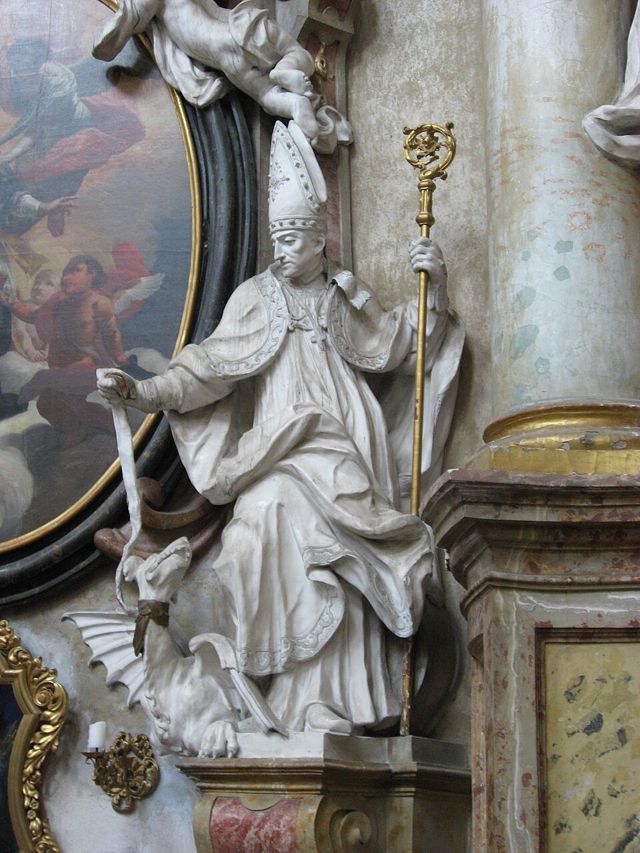
S. Marcellus is represented in art with a dragon, the neck surrounded by his stole.
Feast: November 1
One short email a day for nine days. The day's prayer, a line from St. Marcellus of Paris's story, and a nudge to keep going.
Image: Rajhradský klášter, socha (11).jpg · Dezidor · CC BY 3.0, via Wikimedia Commons
From Sabine Baring-Gould, The Lives of the Saints, new edition in 16 vols. (London: John C. Nimmo, 1897–98); text from the Internet Archive scan (OCR, lightly cleaned; errors possible). Public domain.
Image: Dezidor, Wikimedia Commons (CC BY 3.0)
From Sabine Baring-Gould, The Lives of the Saints, new edition in 16 vols. (London: John C. Nimmo, 1897–98); text from the Internet Archive scan (OCR, lightly cleaned; errors possible). Public domain in the United States. Reproduced unedited, except for short bracketed notes in grey that we added to explain names and terms (“S.” is the old abbreviation for Saint). Some history and judgments reflect 19th-century scholarship.