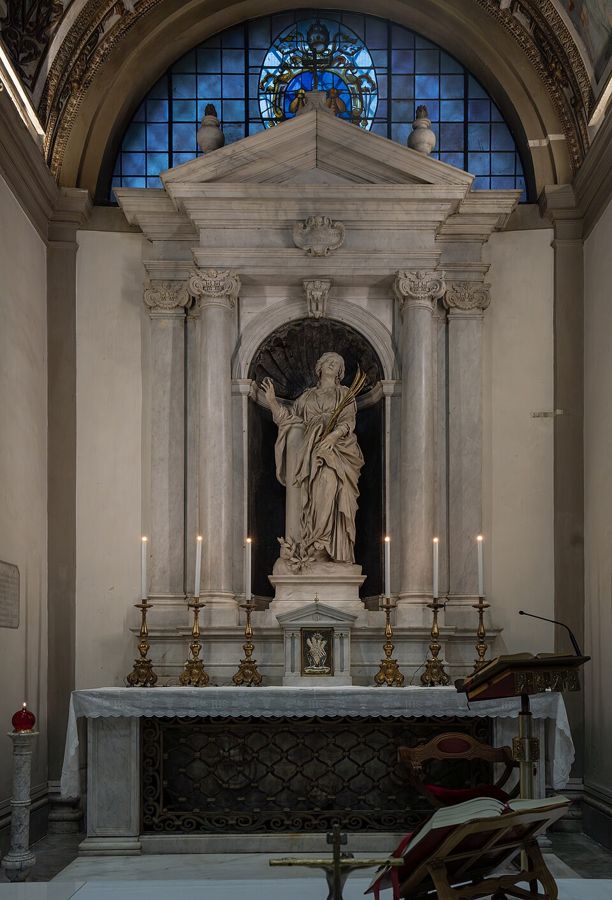
St. Bibiana

Faithfulness to Christ when it cost everything.

Read the essentials →
December 3 · Virgin, Martyr

St. Bibiana

St. Bibiana

Faithfulness to Christ when it cost everything.

Traditional feast

December 3
1914 / pre-1969 calendar, per Baring-Gould (1897)

Current feast

December 2
Secondary source · Wikipedia

Represents

Virgin
Martyr

Their story

Adapted in modern English from the Catholic Encyclopedia (1913) · original text below · little is known

What is certain is that Pope Simplicius consecrated a basilica in Rome holding the body of the martyr Bibiana, and it still stands. Nothing more is known historically.

Legend: she was the daughter of Flavianus and Dafrosa, persecuted under Julian the Apostate (emperor 361–363, raised Christian, who tried to restore paganism). She buried her mother and sister in their own house, then died under torture, and the house later became her church.

Early life

The book says little or nothing about early life. This is how the account begins.

Thin entry · the 1897 book gives only 128 words. We have not filled the gap with invented detail.

…been in vain solicited to evil by an old woman to whom she was confided, was tied to a pillar and scourged to death. Either there had been such a martyr in an earlier persecution, which is probable, or the romance which passes as her acts had acquired sufficient credence to impose on a pope a century later. For it would appear that Pope Simplicius built a church over her remains, near the Licinian palace.

What they represent

How they teach us to live

Drawn from themes in the original account

Stay faithful when it costs you. This account is about holding firm under pressure.

Learn from the kind of life it was. Faithfulness to Christ when it cost everything.

From the Catholic Encyclopedia

1913 · 268 words

The earliest mention in an authentic historical authority of St. Bibiana (Vibiana), a Roman female martyr, occurs in the "Liber Pontificalis" where in the biography of Pope Simplicius (468-483) it is stated that this pope "consecrated a basilica of the holy martyr Bibiana, which contained her body, hear the 'palatium Licinianum' " (ed. Duchesne, I, 249). This basilica still exists. In the fifth century, therefore, the bodily remains of St. Bibiana rested within the city walls. We have no further historical particulars concerning the martyr or the circumstances of her death; neither do we know why she was buried in the city itself. In later times a legend sprang up concerning her, connected with the Acts of the martyrdom of Sts. John and Paul and has no historical claim to belief. According to this legend, Bibiana was the daughter of a former prefect, Flavianus, who was banished by Julian the Apostate [Roman emperor 361–363 who tried to restore paganism]. Dafrosa, the wife of Flavianus, and his two daughters, Demetria and Bibiana, were also persecuted by Julian= Dafrosa and Demetria died a natural death and were buried by Bibiana in their own house; but Bibiana was tortured and died as a result of her sufferings. Two days after her death a priest named John buried Bibiana near her mother and sister in her home, the house being later turned into a church. It is evident that the legend seeks to explain in this way the origin of the church and the presence in it of the bodies of the above mentioned confessors. The account contained in the martyrologies of the ninth century is drawn from the legend.
Read more

The full original · 128 words

Read Baring-Gould’s full account

Baring-Gould’s sources: Roman Martyrology. Usuardus, Ado, Notker, &c. Authority: — The Acts, which are wholly untrustworthy.]. BIBIANA was the daughter of Flavian, prefect of Rome, and his wife Dafrosa. Her sister’s name was Demetria. In the reign of Julian the apostate Apronius was appointed governor of Rome, and he began to persecute the Church — not in fact, but in the fabulous acts. As a matter of fact there was no persecution in the reign of Julian, though some Christians did suffer in the army under other accusations. Bibiana was, of course, not in the army, and it is most improbable that any virgin suffered for her faith in the reign of Julian. However, the story goes on to say that Apronius arrested and executed her father, Flavian, and he receives commemoration on December 22. Dafrosa was next decapitated, and is venerated on January 4. Demetria, when brought before the governor, died of excitement, and Bibiana, after having 6*. Peter Chrysologus.

…been in vain solicited to evil by an old woman to whom she was confided, was tied to a pillar and scourged to death. Either there had been such a martyr in an earlier persecution, which is probable, or the romance which passes as her acts had acquired sufficient credence to impose on a pope a century later. For it would appear that Pope Simplicius built a church over her remains, near the Licinian palace. Pope Urban VIII. discovered the bodies of Bibiana, Demetria, and Dafrosa, and placed them in a porphyry shrine under the high altar. The office for S. Bibiana is a semi-double in the Roman Breviary. The pillar at which she was scourged to death is shown at Rome in the church bearing her name.

Feast days

Feast: December 2
Traditional: December 3

Nine days · Free

Pray the novena
with us.

One short email a day for nine days. The day's prayer, a line from St. Bibiana's story, and a nudge to keep going.

Also on December 3
St. Francis Xavier

St. Francis Xavier

December 3 · Feast
St. Birinus of Dorchester

St. Birinus of Dorchester

December 3 · Bishop
A

St. Attala

December 3 · Virgin, Abbess
← All 1726 saints in the library
Sources & notes

Feast-day sources

Story sources

Sources

Credits

Image: Santa Bibiana by Bernini.jpg · RealRome · CC BY 4.0, via Wikimedia Commons

From Sabine Baring-Gould, The Lives of the Saints, new edition in 16 vols. (London: John C. Nimmo, 1897–98); text from the Internet Archive scan (OCR, lightly cleaned; errors possible). Public domain.

Image: RealRome, Wikimedia Commons (CC BY 4.0)

From “Catholic Encyclopedia (1913)/St. Bibiana,” The Catholic Encyclopedia (New York: Robert Appleton Company, 1907–1914), via Wikisource. Public domain. Matched by name and feast date; text unedited except for our bracketed notes in grey.

From Sabine Baring-Gould, The Lives of the Saints, new edition in 16 vols. (London: John C. Nimmo, 1897–98); text from the Internet Archive scan (OCR, lightly cleaned; errors possible). Public domain in the United States. Reproduced unedited, except for short bracketed notes in grey that we added to explain names and terms (“S.” is the old abbreviation for Saint). Some history and judgments reflect 19th-century scholarship.