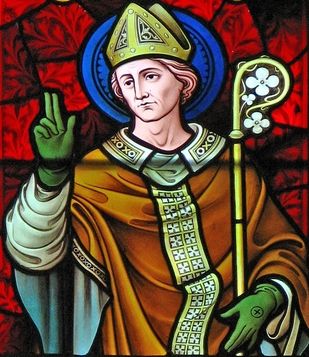
St. Birinus of Dorchester

A shepherd who stayed with his people through hard times.

Read the essentials →
December 3 · Bishop

St. Birinus of Dorchester

St. Birinus of Dorchester

A shepherd who stayed with his people through hard times.

Traditional feast

December 3
1914 / pre-1969 calendar, per Baring-Gould (1897)

Current feast

December 3 (also listed: September 4)
Secondary source · Wikipedia

Represents

Bishop

Their story

Adapted in modern English from the Catholic Encyclopedia (1913) · original text below

Birinus was the first Bishop of Dorchester-on-Thames and the Apostle of Wessex. According to Bede (the English monk-historian, d. 735) he came to Britain on the advice of Pope Honorius I, after being consecrated bishop at Genoa, and promised to preach where no one had preached before.

He arrived in 634 and found the West Saxons so pagan that he stayed with them. King Cynegils was baptised in 635, with St Oswald of Northumbria as his godfather. Oswald married Cynegils' daughter. The two kings gave Birinus Dorchester for his see, where he built many churches.

A legend tells how he walked on the sea to fetch the corporal in which he always carried the Eucharist. He died on 3 December 650. His relics were later moved to Winchester, where Bishop Ethelwold placed them in a shrine of silver and gold in 972.

Early life

The book says little or nothing about early life. This is how the account begins.

A story, not told by Bede, but by later historians, who incorporated legend in their records, with slightly differing details, is that Birinus, having celebrated the holy sacrifice before going on board ship, left behind him his corporal, which was the gift of Honorius. When he remembered it, 1 Birinus is probably Bjorn or Baerin or Berin, a compound expressive of Bear in some form. High or Low German.

What they represent

How they teach us to live

Drawn from themes in the original account

Share your faith, in words and by example. Preaching and conversion are central here.

Learn from the kind of life it was. A shepherd who stayed with his people through hard times.

From the Catholic Encyclopedia

1913 · 366 words

Confessor, first Bishop of Dorchester (in what is now the County of Oxford, not Dorchester, the capital of Dorsetshire), and Apostle of Wessex [the Anglo-Saxon kingdom of southern England]; date of birth unknown; died 3 December, 650, at his see and was buried in his own church there. Later (680) his remains were deposited by Bishop Headda in the cathedral at Winchester, where finally (4 September, 972) Bishop Ethelwold enshrined them in silver and gold. According to Bede [English monk and historian (d. 735)], Birinus came to Britain on the advice of Pope Honorius I (625-638), having been consecrated bishop by Asterius at Genoa. He promised "to sow the seed of the holy faith in the inner parts beyond the English", but on his arrival (634) found the West Saxons so pagan that he decided to devote his ministry to them. God blessed his zeal by the conversion of their king, Cynegils (635), of his son Cwichelm (636), and of Cwichelm's son Cuthred (639). Cynegils' daughter (Cyneburga?) was also baptized, and Oswald, the holy King of Northumbria [the Anglo-Saxon kingdom of northern England and south-east Scotland], who had come to Cynegils in suit of her hand, was sponsor to her father and wedded her. Doubtless his presence helped Birinus much in his first spiritual conquests. Immediately after this, Oswald and Cynegils gave him Dorcic, or Dorchester, the capital of Wessex, for his see, where "he built and consecrated many churches and by his labours called many to the Lord".

Birinus had great devotion for the Body of Our Lord, as is shown in the account of his walking on the sea to procure the corporal given him by Pope Honorius, wherein he ever carried the Blessed Eucharist. Field strangely disposes of this miracle and others as allegorical or fabricated, after allowing, however, that their chroniclers had some common source of information lost to us now. Many miracles took place at the discovery of Birinus's relics [the bodily remains of a saint, or objects they used, kept with honor], and Huntingdon among others speaks of "the great miracles of Birin". At present, there is a growing devotion to him in the Established Church. due probably to the connection of the royal family with Cedric, a side branch of whose stock was Cynegils. Field enumerates many modern Protestant memorials. The Catholics of Dorchester honoured their patron, in, 1849, with a beautiful chapel.

Read more

The full original · 799 words

Read Baring-Gould’s full account

Baring-Gould’s sources: Roman Martyrology. Hereford Kalendar, not that of Saram. Authorities: — Bede, H. E. iii. 7; Roger of Wendover, Florence of Worcester, Henry of Huntingdon, &c.] Birinus, monk of S. Andrew's monastery in Rome, a child of illustrious parents, though apparently not of Roman but of Teutonic race,1 came to England at the instigation of Pope Honorius, though probably as the result of his own convictions, for he declared to the Pope that he “ would sow the seed of the holy faith in the inner parts beyond the dominions of the English, where no other teacher had been before him." He received episcopal consecration from Asterius, bishop of Genoa.

A story, not told by Bede [English monk and historian (d. 735)], but by later historians, who incorporated legend in their records, with slightly differing details, is that Birinus, having celebrated the holy sacrifice before going on board ship, left behind him his corporal, which was the gift of Honorius. When he remembered it, 1 Birinus is probably Bjorn or Baerin or Berin, a compound expressive of Bear in some form. High or Low German.

VOL. XV. 2 Pec. y the ship was already out at sea; in his sorrow, Birinus threw himself overboard and made for shore, recovered the corporal, and returned over the water to the ship, which remained stationary in spite of an off-shore wind. When the heathen mariners saw that his garments were not wet, they were amazed, and eagerly desired baptism. The ship was driven by the wind and weather to the coast of the Gewisse, or West Saxons, where he landed, 634. The voyage was represented in a window at the abbey church of Dorchester, but nothing remains of it but a few fragments of painted glass.

Finding that all the inhabitants were pagans, he determined to preach the word of God there, before proceeding further. Next year he was at the court of Cynegils, king of Wessex [the Anglo-Saxon kingdom of southern England]; Oswald, the saintly king of Northumbria [the Anglo-Saxon kingdom of northern England and south-east Scotland], was also there, having come to demand of Cynegils the hand of his daughter Cuneberga in marriage. Cynegils was baptized in the presence of Oswald, who stood sponsor to him, and, as Bede says, “ by an alliance most pleasing and acceptable to God, first adopted him, thus regenerated, as his son, and then took his daughter in marriage.” The union, according to later Roman usage, would have been regarded as incestuous, and demanded a special and expensive dispensation. The baptism is supposed to be represented on the font in Winchester Cathedral, and Robert of Gloucester thus recounts it in his Chronicle: — “ Saint Birin the bishop, a holy man was, That into this land, through the pope Honorius, sent was To turn king of Westsex, Kingils, to Christendom And that land of Westsex, and to this land he come. S. Birin him to Christendom tumde through Gode’s grace And as God wolde, S. Oswald was in thulke place; And of holy font stone this great king did nome And his Godfader was, in his Christendom. 6*. Biriwus.

S. Oswald and this other king, through our Lourde’s grace Provided S. Birin to his will, a place That Dorchester is called, that beside Oxenford is, As in the east south, and seven mile I wis.” While Oswald remained with Cynegils, they consulted together concerning the establishment of a bishop’s see, and as the kingdom of Mercia [the Anglo-Saxon kingdom of the English Midlands] was without a bishop, Dorchester near Oxford was fixed upon as being convenient for the two kingdoms. The jurisdiction of the bishop extended therefore over the modem dioceses of Winchester, Lichfield, Worcester, Hereford, Bath and Wells, Salisbury, Lincoln, Ely, Oxford, Gloucester and Bristol, Exeter, Peterborough, and Chester. This arrangement was evidently but a temporary one, for Cynegils began to rebuild the cathedral at Winchester, but died before it was completed, in the thirtyfirst year of his reign, having enjoyed the happiness of a long-extended peace. His remains are placed with those of King Ethelwulf in a mortuary chest in Winchester Cathedral, on the screen on the north side of the sanctuary. After the death of Cynegils, his son Kenwalch succeeded. “ He refused to embrace the mysteries of the faith, divorced his wife, the sister of Penda of Mercia, and married another.” This proceeding called down on him the wrath of the redoubtable Penda, who attacked, defeated, and drove him from Wessex. For three years he took refuge with Anna, the Christian king of the East Angles, and there, considering the political necessity of the case, or growing tired at once of the new wife and of the position of a dethroned king, he returned to the embraces of Penda’s daughter and the Christian Church. He was baptized by Bishop Felix, of East Anglia, in 646. He was then restored to his kingdom. He set to work at the completion of the church at Winchester, and it was consecrated on Christmas Day, 648. We have no record of the labours of Birinus during the time he had the spiritual charge of the kingdoms of Wessex and Mercia. History only sums up the events of his life by informing us that he planted Christianity firmly everywhere, and consecrated churches. He gave his spirit to heaven on the 3rd December, having governed his church fourteen years. He was buried at Dorchester, but his body was removed to Winchester by Bishop Hedda, and an entrance to a vault in the cathedral bears his name amongst those of others whose bones repose therein.
Feast days

Feast: December 3

Nine days · Free

Pray the novena
with us.

One short email a day for nine days. The day's prayer, a line from St. Birinus of Dorchester's story, and a nudge to keep going.

Also on December 3
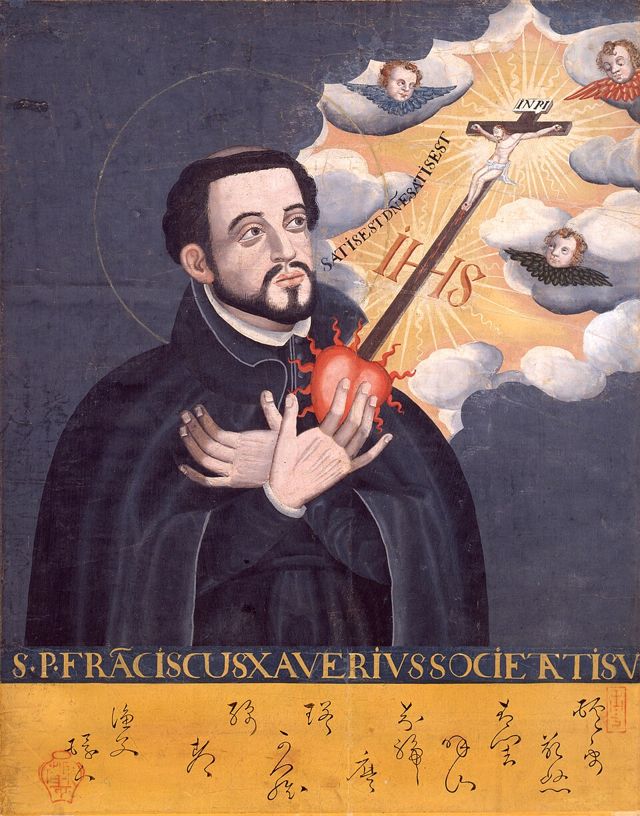
St. Francis Xavier

St. Francis Xavier

December 3 · Feast
St. Bibiana

St. Bibiana

December 3 · Virgin, Martyr
A

St. Attala

December 3 · Virgin, Abbess
← All 1726 saints in the library
Sources & notes

Feast-day sources

Story sources

Sources

Credits

Image: Saint Birinus.jpg · StephenPaternoster · CC BY-SA 3.0, via Wikimedia Commons

From Sabine Baring-Gould, The Lives of the Saints, new edition in 16 vols. (London: John C. Nimmo, 1897–98); text from the Internet Archive scan (OCR, lightly cleaned; errors possible). Public domain.

Image: StephenPaternoster, Wikimedia Commons (CC BY-SA 3.0)

From “Catholic Encyclopedia (1913)/St. Birinus (Berin),” The Catholic Encyclopedia (New York: Robert Appleton Company, 1907–1914), via Wikisource. Public domain. Matched by name and feast date; text unedited except for our bracketed notes in grey.

From Sabine Baring-Gould, The Lives of the Saints, new edition in 16 vols. (London: John C. Nimmo, 1897–98); text from the Internet Archive scan (OCR, lightly cleaned; errors possible). Public domain in the United States. Reproduced unedited, except for short bracketed notes in grey that we added to explain names and terms (“S.” is the old abbreviation for Saint). Some history and judgments reflect 19th-century scholarship.