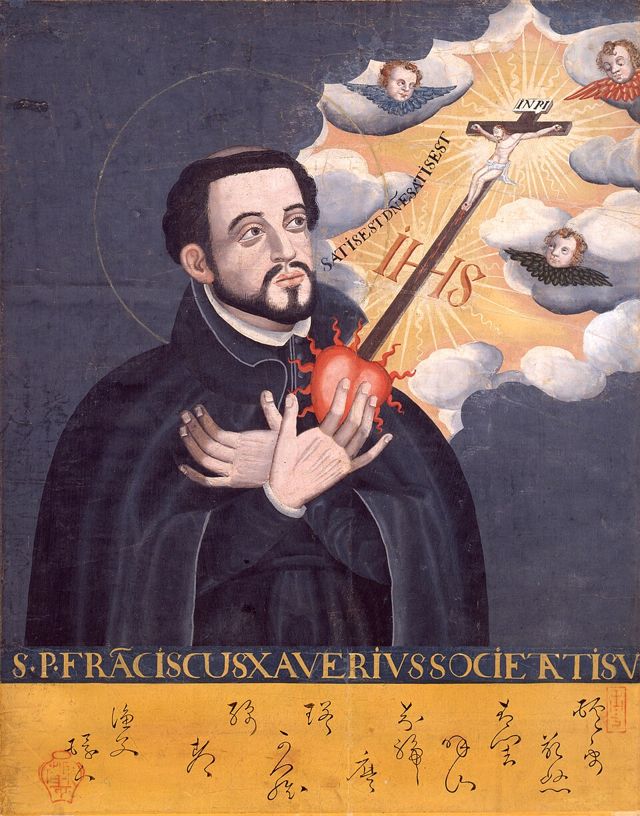
Baring-Gould’s sources: Roman Martyrology on December 3; but inserted in this volume for convenience. Beatified by Paul V. in 1554, and canonized by Gregory XV. in 1662. By brief of Benedict XIV., in 174 7, S. Francis Xavier was honoured with the title of Patron of the East Indies. Authorities: — (1) His own Letters. (2) A Life by Turselini, published in Rome Portugesa, Lisb. 1655. (5) The acts of canonization of S. Francis; and the biographies by Lucena, Orlandino, Garci, Mafifei, &c. In compiling this biography much use has been made of “ The Life and Letters of S. Francis Xavier,” by F. Henry J. Coleridge, S.J., London, 1872.] S. Francis Xavier was born at the castle of Xavier, near Pampeluna, in 1506. His father’s name was Don Juan S. FRANCIS XAVIER. Alter Cahier Nov. 3a] S. Francis Xavier. 603 de Jasso, and he was one of the privy council of John III. of Navarre. After a common Spanish custom, Francis received the surname of his mother, who was the heiress of the family of Xavier as well as of that of Azpilcueta.1 Francis was sent to the university of Paris, to be educated for the Church, and took his degree of Master of Arts in 1530. There he met S. Ignatius Loyola and Pierre Lefevre, and these two holy men exerted the influence of their respective qualities of resolution of purpose and tenderness of devotion on the susceptible character of Xavier at the time when most open to impression. The father of Francis had been put to considerable expense in order to support his son at the university, and now that his education was complete, he obtained for him a canonry at Pampeluna, and desired him to return to Spain, where he could easily obtain him honourable and lucrative benefices.
But Francis was already fallen under the control of the master spirit of Ignatius, and he could not tear himself away. A servant, impatient at the spell which that remarkable man was weaving round the soul of his young master, attempted to assassinate Ignatius. His attempt failed, and served the contrary purpose, it drew Xavier closer to Loyola.
In the vacation of 1535 he yielded himself up to the direction of his friend, who put him through his course of spiritual exercises. He had already, along with Ignatius, and the five other first founders of the Jesuit Order, made a vow of poverty and chastity at Montmartre, on the feast of the Assumption, 1534. These confederates were bent on visiting the Holy Land together, and together labouring at the impracticable task of converting Mussulmans to the Gospel and the sacred obligations of humanity. On the 1 Martin Azpilcueta married Joanna Xavier, heiress of the family of Xavier; and left an only child, Maria, the mother of the saint, married to Juan di Jasso. 15th of November, 1536, they started together to go to Venice, and there embark on their mad enterprise. Ignatius was not with them, he was then in Spain, but he promised to meet them at Venice.
The party of pilgrims travelled on foot through France. It was not a propitious time for travellers. Charles V. had invaded the south-eastern provinces of France, and Francis I. had ordered the devastation of the country before him. The northern frontiers of France were invaded from the Netherlands. Xavier, Rodriguez, and others of the party were Spaniards, and it was probable that they would be taken up as spies. At the outset of the pilgrimage, Francis Xavier obstructed the progress by falling ill. He had bound cords round his legs and arms as tight as they could be drawn, as a sort of penance for having formerly indulged in healthy exercise and athletic sports. Walking with whipcord bound about his thighs proved painful and impracticable, and before reaching Meaux his power of endurance failed, and he was obliged to allow his companions to remove the strings. It was found that they had buried themselves in the flesh, and that the legs and arms were swollen. In after times some of the companions loved to imagine that there was something miraculous in the removal of the cords. The party had fallen prostrate in prayer round the swelled legs, and the cords snapped of their own accord. But one can hardly suppose that there was not a member of the party with a pocket knife, or a knife procurable in the hostelry, in which case only would they probably have resorted to prayer.
On reaching the frontiers of France toward Lorraine, they went to confession and communion. Lorraine was dangerous ground to them. Whilst they travelled through France, the Frenchmen of the party spoke, and said that they were pilgrims bound for a shrine of S. Nicolas near •S’. Francis Xavier.
Metz. On crossing the border, the Spaniards became spokesmen, and the French relapsed into silence. They met with great linguistic difficulties when they crossed the Vosges and got among Germans.
At Basle they rested three days. Between Basle and Constance they passed through a village which was keeping high holiday for the marriage of its parish priest, who had probably lived previously in concubinage. The villagers were breathing free at the illicit connection being transformed nto a recognized and religious union. Near Constance they were challenged to controversy by another parish priest, who was already married and had a large family of children. He invited them to supper, but they declined to eat at the same table 'with him.1 The priest argued that as S. Peter was married, and S. Paul allowed marriage to bishops, his union was allowable. We are told by Rodriguez that the party speedily reduced him to silence, by what arguments he does not say.
Constance, like Basle, was in the hands of heretics; and mass was only allowed in a church outside the walls of the town, and all who assisted at it had to pay a certain fine. A little further on the pilgrims came to a hospice, at the door of which an old woman met them, and began to genuflect, kiss their rosaries, and cry out in German that she was an old Catholic, delighted to see men who were still faithful to the Church. She ran in, and brought out a lapful of legs, and arms, and heads, and fingers of sacred statues, and the fathers prostrated themselves in veneration before the sacred fragments.
The band of companions arrived at Venice about the feast of the Epiphany, 1537. Ignatius was there, awaiting 1 The Pope whose benediction they were about to seek and obtain was Paul HI., who, as Cardinal Alexander Farnese, had become the father of an illegitimate son and daughter.
them. Several months must pass before they could sail for Jerusalem, and it was determined to spend part of this time among the poor in the hospitals at Venice, and the rest in a journey to Rome to obtain the blessing of the Pope. Francis Xavier was appointed to attend the hospital of the Incurables. He was to be the servant of all there, to wait upon the sick, dress their wounds, sores, and ulcers, make their beds, prepare their food, instructing them, consoling them, preparing them for the last sacraments, and after their death carrying them forth for burial. He here indulged himself in what seems to be a preliminary process among aspirants after sanctity of modern days, — sucking ulcers. All the filthy particulars may be read in Turbellini and Rodriguez, and in English, by any one who cares to have his stomach turned, in the Life by Father Coleridge. After nine weeks thus spent in Venice, the little party set out on foot for Rome. Ignatius did not go with them, for Cardinal Carafa, afterwards Paul IV., was jealous of the scheme of the new society. He had helped S. John Cajetan to found the Theatine Order, and he did not wish to see a new society tread on its heels and usurp the attention of the world, always attracted by novelty. The party that started for Rome was composed of nine companions. It was determined that they should observe the strictest poverty, and keep Lent [the forty days of fasting before Easter] with severe fasting. The roads were bad, the rains incessant, and the country in parts flooded. They begged for their food. Simon Rodriguez gives us a picture of such a proceeding. At Ancona one of the companions, who seems to have been Francis Xavier, went about the market barefoot, his robe tucked up to his knees, begging of the market-women apples, radishes, and lettuces.
Untroubled by any suspicions about the truth of the fable attaching to the shrine of Loreto, and unobservant of the S. Francis Xavier.
fact that the holy house was built of the red stone of Ancona, the nine companions poured forth their devotions at Loreto, and gathered a plentiful supply of indulgences. At Rome each went to the hostel of his own nation. They were presented to the Pope, Paul III., by Pedro Ortiz, ambassador of the Emperor Charles V. at the Roman Court, and they amused the jovial pontiff during his dinner by disputing on points of theology. He gave them leave to go to Jerusalem, if they particularly desired it; and they returned with joy to Venice. The whole party received ordination on the ensuing Midsummer Day, 1537. As for the expedition to the East, that had to be postponed, as war between the Turks and Venice had broken out. It was determined, when the hopes of going to Palestine grew fainter, that they should disperse among the cities of Italy for a twelvemonth, and do what they could for the good of souls. Xavier went with Bobadilla to Bologna. There Xavier lodged with Hieronimo Casalini, rector of Santa Lucia. His time was spent in preaching in the public piazzas, in hearing confessions, visiting the hospitals, and catechizing children. Towards the end of winter he was summoned by S. Ignatius to meet him in Rome. The whole of the little company assembled in Rome; Ignatius submitted to them his thoughts concerning the erection of the society into a religious Order. The mission to Palestine was rendered impossible; in its place God had opened to them a work in Italy, a mighty harvest to be gathered in. To extend the faith of Christ, to root out heresy and vice, such were their objects, and they could be attained elsewhere than in Palestine. Let them bind themselves together by vow, under one head, and perpetuate, beyond the span of their own lives, the bond of charity which united them. Ignatius did not insist on an immediate answer to his proposals, he would leave his companions time to reflect and pray God to guide them in arriving at a satisfactory decision.
There were difficulties internal and external. The chief difficulty as to the formation of a body under one head seems to have consisted in the intention of the companions to offer themselves unreservedly to the Pope. If the Pope were to send them hither and thither, how were they to maintain the tie that bound them together? There were also great external difficulties to contend with, much opposition and calumnies raised against them. The religious Orders were at this time so corrupt, so luxurious, and lax, and giving such occasion of scandal, that there were thoughts in high places of either abolishing them altogether, or of reducing them to four. The idea of a new Order would hardly be tolerated — a new Order, moreover, which was to depart from the normal monastic type in many essential particulars.
The question as to the retention at all costs of the union which had proved so happy and so useful was unanimously decided upon; the question of obedience to one head cost much hesitation and dispute. The decision, however, was unanimous in favour of the addition of a third vow of obedience to the vows of poverty and chastity; and a document was drawn up, and signed by all the companions on the 15 th of April, 1539, pledging them all to enter the society as soon as it received papal approval and confirmation. A fourth vow was shortly after added, binding the members to go on any mission on which the Pope should send them, whether among heathen or among Christians. The desired papal confirmation was granted by Paul III. in 1 540, but the bull was not formally promulgated till the spring of 1541.
In May of the year 1539 the brethren dispersed again on their missionary labours; but Xavier was required to remain S. Francis Xavier.
at Rome with Ignatius, to act as secretary to the Society. But suddenly, on March 15 th, 1540, Ignatius summoned Francis Xavier to his room, and told him that he was to leave Rome next day in company with the Portuguese ambassador, Pedro de Mascarenhas, to join Rodriguez on the first missionary expedition of the Society to the East Indies. It was one of those providential arrangements which seem the result of chance. Govea, privy councillor of John III. of Portugal, had written to Ignatius about the spiritual wants of the Indies, and he had recommended the king to apply for several of the companions of Ignatius as missionaries to the heathens there.
The king ordered Mascarenhas to ask for six, Ignatius could only spare two. He nominated Rodriguez and Bobadilla. Rodriguez sailed at once to Lisbon to see the king, taking with him as a companion Father Paul of Camarino, a late acquisition to the Society. Bobadilla did not arrive in Rome till just before the ambassador was about to start, and then fell too ill to be moved. Mascarenhas could not wait, and Ignatius was obliged on the spur of the moment to nominate a substitute. His choice fell on Xavier. S. Francis had just time to seek and obtain the blessing of Paul III., then he embraced S. Ignatius for the last time, and set forth on his long wanderings, which were to end twelve and a half years later on the coast of China. Francis went direct to Lisbon, leaving behind him his written promise to agree to any arrangements that should be made in the constitution of the Society when finally approved, and his suffrage for the election of the superior. He declared that he thought it right that Ignatius, as their old and true master, should be their head.
On reaching Lisbon, Francis was presented at court. King John was an eminently pious monarch, and all the courtiers affected enthusiastic piety; had he been the reverse, they would have accommodated themselves with equal facility to his most profane and licentious caprices. Now they rushed breathless from one religious ministration to another, vying with one another as to who could confess and communicate oftenest. And the court presented to the eye the sanctity of a convent. The king and queen were so delighted with Francis Xavier and Rodriguez, that after the first interview they ordered off all the pages to confession to them. These youths were required by their Majesties to go to confession twice a week, and this discipline, if it did not make them hypocrites, made them saints. One Miguel de Souza is reported to have survived the process of having his spiritual concerns regulated for him like an ordinary piece of court etiquette, without any deadening and deterioration of his conscience, and he became eventually a Jesuit. Francis had two companions given him before he started, Father Paul of Camarino, and Francis Mancias, a Portuguese. The latter was a dull, homely, ignorant man, not yet in Holy Orders, and certain to be plucked if examined for Orders by a bishop in Europe. It was hoped that the bishop of Goa would be less exacting. Xavier was nominated Papal Nuncio of the Indies.
Francis was to sail for India with the new governor, Don Martin Alfonso da Sousa. The king commanded the count of Castaneras to provide Francis with everything he might need for the voyage. Francis said that he professed religious poverty, and would rely on the providence of God. He could only be induced to accept a few books of devotion, and some warmer clothing for the storms of the Cape of Good Hope. The count asked him if he did not want a servant to attend on him. It would ill become the dignity of a papal nuncio to cook his own food and wash his own linen.
Francis answered that he had his two hands, and that they alone should wait on his necessities. On April 7, 1541, S. Francis Xavier.
his thirty-fifth birthday, S. Francis set sail from Lisbon. He found himself in the midst of society to which he was new. Hitherto he had lived either with students or with his own religious brethren; he had associated with men of position and learning, with men who felt, or affected, great respect for religion. He was now brought into contact with the boisterous licence of rude sailors and adventurers, cooped up together for a tedious and dangerous voyage of six months within the wooden walls of a galleon. The vessel contained nine hundred sailors, soldiers, and passengers. He was of a refined, delicate, even haughty nature, and those with whom he was cast were coarse, rude, and disorderly. He, however, threw himself into the life amidst these strange associates with earnest purpose of doing the best he could for them. Many years afterwards, Don Diego di Norona, a Portuguese captain, was in the same vessel with S. Francis. He was curious to see and know him, on account of his reputation for sanctity: on asking which he was, he was shown a person standing in the midst of a group of men round a table where a game of chess was going on. He was talking with the soldiers, the crew, the merchants’ clerks, who composed the crowd, at his ease with all, and all at their ease with him. The gentleman was scandalized, and declared to a friend that the Padre Santo, as he was called, was just like any other priest. At the end of the voyage, however, he sent a servant to follow and see what became of him. Francis went aside into a wood and began to pray, and the servant soon ran to call his master to see the saint in an ecstasy lifted from the ground in his prayers. There was ample field for his zeal on board the ship in which he sailed. He mixed freely with all, especially with those who had most need of him, and he won upon them so far that the habit of swearing sensibly decreased, and many enmities were temporarily made up. He began to hear confessions regularly and frequently. Under the Line the scurvy VOL. xiv.
broke out and caused great ravages, it was a sort of plague: friends neglected friends, the sick were left to themselves, the medicine ran short, there was no one but Francis and his companions to tend the sufferers. Francis washed them and their linen, dressed their food, and fed them with his own hands. He had a little cabin of his own, but he gave it up to the sick. He had refused to take his meals at the governor’s table, but not to receive the daily portion of food which was sent him from it: this he divided among the sick. On Sundays he preached on deck, the governor himself attending the sermon.
Francis himself appears to have suffered greatly from sickness in the first part of the voyage, which was lengthened beyond the usual time, probably by the calm which often detains vessels near the equator. It was the custom of the Portuguese navigators to sail at a distance round the Cape, so far southwards as to reach a latitude where the cold was sensibly felt. The ship did not reach Mozambique till late in August, at a time when under ordinary circumstances it would have been approaching Goa; and the lateness of the season as well as the prevalence of sickness determined the governor to winter in the island. Francis wrote to the Society at Rome an account of his voyage, and the stay at Mozambique. In it he makes no mention of his own sufferings from a violent fever, of which we learn from the testimony of others. He would not accept the better lodging and care offered him by some of the Portuguese inhabitants, and took his chance with the rest of the sick in the hospital. Indeed, the physician found him, in the height of his fever, visiting and instructing the others. On one occasion when he was ordered to bed, he is said to have answered humbly that he was anxious about the case of one who had not made his peace with God, and that as soon as he had attended him, he would take rest himself. This was a poor sailor delirious with fever, and of whose recovery little hope could be entertained. Francis had him conveyed from the ship to his own bed; next day the man was sensible enough to make his confession; but he died at night, after having received the sacraments. Francis then consented to be nursed himself, and was soon able to resume his labours. In the letter descriptive of his voyage, Xavier gives a curious account of an interview with the sultan of Melinda, into the port of which the vessel put after passing Zanzibar. The sultan, with oriental politeness and exaggeration, in his desire to say something pleasing to the missionary, informed him that the mosques were thinly attended, and the religion of Mohammed was losing its hold on the people. He asked, with a touch of sarcasm, whether it was so among Christians. Xavier repudiated the idea, and told the sultan that Allah held in abomination the prayers of the Mussulmans, and had so willed that their worship, which He rejected with loathing, should come to naught. The sultan “was not satisfied with what I said,” observes the saint in his letter. He adds, “ One sees in such cases as this in what anxiety and despair the life of unbelievers and wicked men is so often passed: and indeed this is in itself a blessing, for thereby they are warned of their state and urged to conversion ” A little further acquaintance with Mohammedans later probably modified this opinion of the restlessness of their souls.
After leaving Melinda, the vessel put into Socotra, and Xavier gives a curious account of the Christian inhabitants, belonging apparently to the Abyssinian Church. “ The people,” he says, “ are wonderfully ignorant and rude: they cannot read or write. They have consequently no records of any kind. Still they pride themselves on being Christians. They have churches, crosses, and lamps. Each village has its caciz, who answers to the parish priest. These caciz know no more of reading or writing than the rest; they have not even any books, and only know a few prayers by heart. They go to their churches four times a day — at midnight, at daybreak, in the afternoon, and in the evening. They use no bells; but wooden rattles, such as we use during Holy Week, serve to call the people together. Not even the caciz themselves understand the prayers which they recite; which are in a foreign language (I think Chaldaean). They render special honours to the Apostle S. Thomas, claiming to be descendants of the Christians begotten to Jesus Christ by that apostle in these countries. In the prayers I have mentioned they often repeat a word which is like our Alleluia. The caciz never baptize any one, nor do they know the least what baptism is. Whilst I was there I baptized a number of children, with the utmost goodwill of their parents. Most of them showed great eagerness to bring their children to me, and made such liberal offerings out of their poverty of what they had to give, that I should have been afraid to refuse the dates which they pressed upon me with such great goodwill. They also begged me over and over again to remain with them, promising that every single person in the island would be baptized. So I begged the governor to let me remain where I found a harvest so ripe and ready to be gathered in. But as the island has no Portuguese garrison, and it is exposed to the ravages of the Mussulmans, the governor would not hear of leaving me, fearing that I might be carried off as a slave. So he told me that I should soon be among other Christians who were not less, perhaps more, in need of instruction and spiritual assistance than the Socotrians, and amongst whom my work would be better spent. “ One day I went to Vespers [the evening prayer of the Divine Office] as recited by the caciz; they lasted an hour. There was no end to their repetitions of prayers and incensings: the churches are always full of incense. Though their caciz have wives, they are extremely.S'. Francis Xavier.
strict in regard to abstinence and fasting. When they fast they abstain not only from flesh meat and milk, but from fish also, of which they have a great supply. So strict is their rule that they would rather die than taste anything of the kind. They eat nothing but vegetables and palm dates. They have two Lents, during which they fast; one of these lasts two months. If any one is profane enough to eat meat during that time, he is not allowed to enter the church.”
The governor was no doubt right: the Portuguese Christians of Goa wanted an apostle quite as much, if not more, than the poor Socotrians. On reaching Goa, Xavier soon discovered what a deplorable condition the Church was in there. The population of Goa was mixed. There were Catholics, Mohammedans, and Hindoos; the Portuguese were composed of sailors, merchants, and soldiers, living in the practice of all the licence of their Mussulman neighbours, with the vice supe-radded, of drinking intoxicating liquors. As few Portuguese women ventured on the long voyage, the settlers lived in concubinage with native women, and their children grew up nominal Christians, but real infidels. There were several churches at Goa, a college called Santa Fe, a languid, ill-supported “ Confraternity of Mercy,” for doing works of charity. An active Inquisition for burning heretics was not yet instituted, it was transplanted from Portugal later, at the request of S. Francis. Turselini gives a lively picture of the manner in which Xavier went about doing all the good he was able to the souls and bodies of men.
“ Xavier,” says Turselini, “ thinking within himself that he ought to apply some remedy to this great evil, began to cultivate the society of the Portuguese by courteous means; thus, on meeting one of them in the streets, he would request him to invite a poor priest to dinner or supper, and this was readily granted. Accordingly, sitting at table he would entreat his host to cause his children to be called; whereupon the little children coming presently at their father’s call, Francis would take them up in his arms and hug them to his bosom, thanking God who had given the father such children, and would pray to God to grant them a good and holy life. Then he would ask that their mother might be called (a thing which in another would have been temerity, but his sanctity easily excused it). When she was come, he would speak sweetly unto her, and commend her heartily to his host, thereby trying to draw him to take her to be his wife, saying that doubtless she was of a disposition as excellent as her countenance was lovely, so that she might well be accounted a Portuguese, that the children which he had by her were certainly worthy of a Portuguese as their father. Why therefore did he not marry her ? What wife could he have better ? And he would do well to provide with all speed for his children’s credit and the woman’s honesty. “ His wholesome counsel proved not unprofitable. For he succeeded in persuading many of them to marry their mistresses. But if by chance he lighted upon any one who had by some ill-favoured Indian woman children like herself, then assuming great indignation, he would cry out, 4 Good God ! what a monster have we here ! Do you keep a devil in your house ? Can you keep company with this ugly beast ? Can you have children by her? Follow my counsel: drive this monster, this hideous creature, out of your house, and seek a wife more worthy of yourself.’ ”
In other words, Francis persuaded the Portuguese to marry such of their mistresses as were good-looking, and to repudiate the ugly ones, and take to their arms women better featured in legitimate marriage.
We may add, to complete the picture, what the same writer adds of another practice of Francis Xavier: “ He, 5. Francis Xavier.
thirsting more after the salvation of souls than his own praise, was always thinking of some new ways how to help them. And he had one invention which showed his Christian simplicity, and was also more profitable in effect, than fair to show. He, a man of grave years and authority, went up and down the highways and streets with a little bell in his hand, calling the children and servants together to Christian doctrine, at the corners of the streets and crossways, sometimes stirring up the inhabitants to piety with these or such like words: £ Faithful Christians, for the love which you bear to Christ, send your children and servants to the Christian doctrine/ This new invention made infinite numbers of children, slaves, and others, flock to him from all quarters; and marching before them, he would lead them into our Blessed Lady’s church, singing the catechism aloud, set to music, and teaching them the same, thereby to cause them the more willingly to come and hear him, and the more easily to remember what was taught them in a song.” As the metrical versions of the catechism set to popular melodies proved very successful, the bishop of Goa introduced them throughout his diocese, till “ in the schools, the highways, the streets, the houses, fields, and ships, the verities of the Christian faith supplanted idle and loose songs.”
From Goa Xavier started for the Fishery coast, where some of the Indians had embraced Christianity. Either before leaving Goa for this mission, or on his return from it, he wrote to S. Ignatius to request him to obtain permission from the Pope that the priests might be permitted in the Indian missions, to administer confirmation with oil consecrated by the bishop, as is customary in the Eastern Church, and occasionally permitted in the Roman Church. He was anxious also that Lent might be moved in India to June and July, as the time of Lent was that most busy, and one 6 1 8 L ives of the Saints.
in which it was impossible to engage the Portuguese and native Christians in devout exercises. He also entreated that the Pope would grant several indulgences, “ a list of which I send in a separate letter.... Of all nations that I have seen,” he says, “ the Portuguese is that which goes farthest in prizing indulgences from Rome.” He asks for an indulgence for an altar that it may be privileged, so that whenever mass is said at it, a soul may be set free from purgatory. He begs for indulgenced rosaries as a present to the governor and his wife; and as the native Christians have a great opinion of S. Thomas, whom they regard as their apostle, he asks that there may be a plenary indulgence attached to his festival and octave. The pearl-fishery coast to which S. Francis went extended from Cape Comorin to Paumbun Pass, a narrow strait between the mainland and some islands and reefs which bridge across to Ceylon. The warm waters of the Gulf of Manaar abound in pearl oysters. The natives had lately been engaged in war with the Mussulmans of Madura, and had been assisted by the Portuguese on condition that they should embrace Christianity.
The Indians occupying this district were called the Paravas. Xavier found them docile and amenable to instruction, as, indeed, they have since proved. The Anglican mission of Tinnevelly, which is the most flourishing in all India, is seated amidst this race, and embraces among its disciples the descendants of the converts of S. Francis. The account he gives of his work amongst these Paravas is too interesting not to be given in his own words. He says, in a letter to the Society at Rome, dated De“ It is now the third year since I left Portugal. I am writing to you for the third time, having as yet received only one letter from you, dated February, 1542. God is my Nov> 3o0 S. Francis Xavier. 6 1 9 witness what joy it caused me. I only received it two months ago — later than is usual for letters to reach India, because the vessel which brought it had passed the winter at Mozambique.
“ I and Francis Mancias are now living amongst the Christians of Comorin. They are very numerous, and increase largely every day. When I first came, I asked them if they knew anything about our Lord Jesus Christ? but when I came to the points of faith in detail, and asked them what they thought of them, and what more they believed now than when they were infidels, they only replied that they were Christians, but that as they are ignorant of Portuguese, they know nothing of the precepts and mysteries of our holy religion. We could not understand one another, as I spoke Castilian and they Malabar; so I picked out the most intelligent and well-read of them, and then sought out with the greatest diligence men who knew both languages. We held meetings for several days, and by our joint efforts and with infinite difficulty we translated the catechism into the Malabar tongue. This I learnt by heart, and then I began to go through all the villages of the coast, calling around me by the sound of a bell as many as I could, children and men. I assembled them twice a day, and taught them the Christian doctrine; and thus, in the space of a month, the children had it well by heart. And all the time I kept telling them to go on teaching in their turn whatever they had learnt to their parents, family, and neighbours.
“ Every Sunday I collected them all, men and women, boys and girls, in the church. They came with great readiness and with a great desire for instruction. Then, in the hearing of all, I began by calling on the Name of the most Holy Trinity, Father, Son, and Holy Ghost, and I recited aloud the Lord’s Prayer, the Hail Mary, and the Creed in the language of the country: they all followed me in the same words, and delighted in it wonderfully. Then I repeated the Creed by myself, dwelling on each article singly. Then I asked them as to each article, whether they believed it unhesitatingly • and all, with a loud voice and their hands crossed over their breasts, professed aloud that they truly believed it. I take care to make them repeat the Creed oftener than the other prayers; and I tell them that those who believe all that is contained therein are called Christians. After explaining the Creed I go on to the Commandments, teaching them that the Christian law is contained in those ten precepts, and that every one who observes them all faithfully is a good and true Christian, and is certain of eternal salvation, and that, on the other hand, whoever neglects a single one of them is a bad Christian, and will be cast into hell unless he is truly penitent for his sin. Converts and heathen alike are astonished at all this, which shows them the holiness of the Christian law, its perfect consistency with itself, and its agreement with reason. After this I recite our principal prayers, as the Our Father and the Hail Mary, and they say them after me. Then we go back to the Creed, adding the Our Father and the Hail Mary after each article, with a short hymn; for, as soon as I have recited the first article, I sing in their language, ‘ Jesus, Son of the living God, grant us the grace to believe firmly this first article of your faith: and that we may obtain this from you, we offer you this prayer taught us by yourself/ Then we add this second invocation: ‘ Holy Mary, Mother of our Lord Jesus Christ, obtain for us from your most sweet Son that we may believe without hesitation this article of the Christian faith.' We do the same after all the other eleven articles.
“We teach them the Commandments in the following way: After we have sung the first, which enjoins the love of God, we pray thus: ‘Jesus Christ, Son of the living God, S. Francis Xavier.
grant us the grace to love Thee above all things and then we say for this intention the Lord's Prayer. Then we all sing together, ‘ Holy Mary, Mother of Jesus Christ, obtain for us from your Son the grace to observe perfectly the first of His Commandments; ’ and then we say the Hail Mary. So we go on through the other nine, changing the words of our little invocation as occasion requires. Thus I accustom them to ask for these graces with the ordinary prayers of the Church, and I tell them at the same time that if they obtain them, they will have all other things that they can wish for more abundantly than they would be able to ask for them. I make them all, and particularly those who are to be baptized, repeat the form of general confession. These last I question after each article of the Creed as it is recited, whether they believe it firmly; and after they have answered Yes, I give them an instruction in their own language, explaining the chief heads of the Christian religion, and the duties necessary to salvation. Last of all, I admit them thus prepared to baptism. The instruction is ended by the Salve Regina, begging the aid and help of our Blessed Lady.
“ As to the number who become Christians, you may understand them from this, that it often happens to me to be hardly able to use my hands from the fatigue of baptizing often in a single day I have baptized whole villages. Sometimes I have lost my voice and strength altogether with repeating again and again the Credo and the other forms. “The fruit that is reaped by the baptism of infants, as well as by the instruction of children and others, is quite incredible. These children, I trust heartily, by the grace of God, will be much better than their fathers. They show an ardent love for the Divine law, and an extraordinary zeal for learning our holy religion and imparting it to others. Their hatred for idolatry is marvellous. They get into feuds with the heathen about it, and whenever their own parents practise it, they reproach them and come off to tell me at once. Whenever I hear of any act of idolatrous worship, I go to the place with a large band of these children, who very soon load the devil with a greater amount of insult and abuse than he has lately received of honour and worship from their parents, relations, and acquaintance. The children run at the idols, upset them, dash them down, break them to pieces, spit on them, trample them under foot, kick them about, and, in short, heap on them every conceivable sort of indignity.1 ”
A judicious introduction of images of the Blessed Virgin, S. Joseph, S. Thomas, and other saints, on which the children were directed to lavish their devotion and towards which to offer their incense and worship, filled the void in their routine of religious exercises which would otherwise have been caused by the havoc wrought among the idols. Xavier proceeds: — “ I have also charged these children to teach the rudiments of Christian doctrine to the ignorant in private houses, in the streets, and the crossways. As soon as I see that this has been well started in one village, I go on to another and give the same instructions and the same commission to the children, and so I go through in order the whole number of their villages. When I have done this and am going away, I leave in each place a copy of the Christian doctrine, and tell all those who know how to write to copy it out, and all the others are to learn it by heart and to recite it from memory every day. Every feast day I bid them meet in one place and sing all together the elements of the faith. For this purpose I have appointed in each of the thirty Christian villages men of intelligence and character who are to preside over these meetings; and the governor, Don Martin Alfonso, who is so full of love for our Society and of zeal for religion, has been good enough at our request to allot a yearly revenue of 4,000 gold fanons for the salary of these catechists/’ Xavier was brought by his work in opposition to the Brahmins. He did not trouble himself with their religion, otherwise than to denounce it as the worship of devils. He heard of the Vedas, which have proved of such incalculable profit to students, but he contemptuously dismissed them from notice as unworthy of translation or serious refutation. Later, the Jesuit missionaries saw the mistake, and forged the Kristni Veda, and endeavoured to pass it off on the Hindoos as one of their ancient works, which contained manifest prophecies of Christ, and exhortations to follow His disciples.
Xavier gives a curious account of a meeting with some Brahmins: — “ One day lately, I happened to enter a pagoda where there were about two hundred of them, and most of them came to meet me. We had a long conversation, after which I asked them what their gods enjoined them in order to obtain the life of the blessed. There was a long discussion amongst them as to who should answer me. At last, by common consent, the commission was given to one of them, of greater age and experience than the rest, an old man, of more than eighty years. He asked me, in return, what commands the God of the Christians laid on them. I saw the old man’s perversity, and I refused to speak a word till he had first answered my question. So he was obliged to expose his ignorance, and replied that their gods required two duties of those who desired to go to them hereafter — one of which was to abstain from killing cows, because under that form the gods were adored; the other was to show kindness to the Brahmins, who were the worshippers of the gods. This answer moved my indignation, for I could not but grieve intensely at the thought of the devils being worshipped instead of God by these blind heathen, and I asked them to listen to me in turn. Then I, in a loud voice, repeated the Apostles’ Creed and the Ten Commandments. After this I gave in their own language a short explanation, and told them what Paradise is, and what Hell is, and also who they are who go to Heaven to join the company of the blessed, and who are to be sent to the eternal punishments of hell. Upon hearing these things they all rose up and vied with one another in embracing me, and in confessing that the God of the Christians is the true God, as His laws are so agreeable to reason. Then they asked me if the souls of men like those of other animals perished together with the body. God put into my mouth arguments of such a sort, and so suited to their ways of thinking, that to their great joy I was able to prove to them the immortality of the soul. I find, by the way, that the arguments which are to convince these ignorant people must by no means be subtle, such as those which are found in the books of learned schoolmen, but must be such as their minds can understand. They asked me again how the soul of a dying person goes out of the body, how it was, whether it was as happens to us in dreams, when we seem to be conversing with our friends and acquaintance ? (Ah, how often this happens to me, dearest brothers, when I am dreaming of you !) Was this because the soul then leaves the body ? And again, whether God was black or white ? For as there is so great a variety of colour among men, and the Indians being black themselves, consider their own colour the best, they believe that their gods are black. On this account the great majority of their idols are as black as black can be, and moreover are generally so rubbed over with oil as to smell detestably, and seem to be as dirty as they are ugly and horrible to look at. To all these questions I was able to reply so as to S. Francis Xavier.
satisfy them entirely. But when I came to the point at last, and urged them to embrace the religion which they felt to be true, they made that same objection which we hear from many Christians when urged to change their life — that they would set men talking about them if they altered their ways and their religion, and besides, they said that they should be afraid that, if they did so, they would have nothing to live on and support themselves by.” The saint had been working for fifteen months among the Paravas when, towards the close of 1543, he Avas obliged to return to Goa to procure assistants. A seminary had been established there, dedicated to S. Paul, for the education of young Indians, but it was as yet in its infancy, and unable to furnish him with efficient assistance. This was placed under the charge of Father Paul of Camerino. The following year he went back to the Paravas with one European missionary, Francis Mancias, and two native priests, Francis Coelho and Joam de Lizana, and Avith a layman named Joam d’Artiaga. Mancias was a stupid but well-intentioned man, hot-tempered and violent, AA^anting in energy, and readily disheartened; he gave S. Francis much trouble. This little party Avas dispersed among the villages of the Pearl Fishery coast, Avhilst the saint went into Travancore, the rajah of Avhich Avas desirous of obtaining the assistance of the Portuguese against certain tributary rajahs Avho Avere ambitious of shaking off their dependence. The people of Travancore received him gladly, and he proceeded amongst them as among the Paravas, breaking doAvn idols and substituting for them saints, baptizing the young, catechizing the children, and distributing a Avritten abridgment of Christian doctrine. By the end of the year it is said that no less than forty-five infant churches had been founded in Travancore.
Francis had hardly learned sufficient of the language during his labours on the Pearl coast to make himself understood. Those eager to discover miracles everywhere relate that at this time he preached in their own tongue to the people of Travancore, which he had never learned, and was perfectly understood not only by them, but by others speaking different dialects. This statement, however, is disposed of by the plain words of Francis himself, in a letter to Mancias from Punical, dated August 21, 1544: “I am almost alone here since Antonio has remained ill at Murappud, and what is very inconvenient, I am working in the midst of a people whose language I do not understand, and I have no interpreter. You know yourself how much the natives understand of our language, so you may easily imagine how I live here, what sort of instruction I can give, when the persons who ought to explain to the people what I say don’t understand me, nor I them. My only eloquence at present is that of signs. However, I am not without something to do, for I require no interpreter to assist me in baptizing the little children just born, and when I see people without clothes or starving, the sight of them tells me what they want.” 1 The rajah of Jafanapatam, in Ceylon, at this period was a usurper, who had dethroned his elder brother, the rightful rajah. The latter appealed to the Portuguese for protection, and the inhabitants of Manaar took up his cause with enthusiasm. In order the more readily to induce the Portuguese to support him, the dethroned rajah invited Portuguese missionaries to Manaar. The reigning prince at once fell on the islanders and massacred them to the number of six hundred. The heirs to the throne fled to Travancore, and thence to Goa, to entreat the Portuguese to send an expedition to revenge the massacre and dethrone the usurper. 1 Such is the fact. Fiction says: “ In Travancore he spoke very well the language of those barbarians without having learned it, and had no need of an interpreter when he instructed them."— Alban Butler, and the “ Process of Canonization.” •i\ Francis Xavier.
Francis visited Cambai, where the governor Da Sousa then was, to urge in person the claims of the young princes. He had little difficulty in persuading him to undertake the punishment of the rajah of Jafanapatam. The subordinate officers along the coast received orders to collect their forces, and Negapatam was named as the place at which the armament was to assemble, and Francis undertook to attend the expedition.
Francis sailed for Negapatam, and a characteristic incident is related of the voyage. The pilot of the vessel was a licentious and godless sailor. Xavier got into conversation with him, and drew him on to speak of religion. He extracted from the rough sailor a promise that he would go to confession when he reached land. When the time came, however, the pilot repented of his promise, and avoided the sight of Xavier. S. Francis, however, met him by chance on the shore, and the man, rather out of shame than any better feeling, consented to make his confession on the spot. Francis told him to begin at once, and they paced up and down for a time, whilst the pilot confessed his sins in a perfunctory way, without the confessor [in old usage, a saint who was not martyred, or who suffered for the faith without being killed] attempting to interrupt or reprove him. After awhile they approached a little chapel, when Francis led him inside, placed a mat for the man to kneel on, and made him begin again. Grace worked on the pilot's conscience, and he made a thorough and perfect confession.
When he arrived at Negapatam, Francis found the Portuguese armament almost ready to sail, but the expedition was put an end to by a strange accident. A Portuguese vessel, richly laden with merchandize from Pegu, ran ashore on the coast of Jafanapatam, and was at once seized by the rajah. The Portuguese officers at Negapatam were either interested themselves in the cargo, or had friends whose money had been staked in it, and they thought of nothing for the moment but recovering it from the rajah by negotiation. He VOL. XIV gt * was probably glad enough to buy them off so easily 3 at all events, the expedition was abandoned.
S. Francis now started on a visit of devotion to Meliapore, the traditional place of entombment of S. Thomas the Apostle. Meliapore is on the Coromandel coast. S. Francis reached it in April, 1545, and took up his quarters in the house of the Portuguese priest, Gaspar Coelho, close to the church of S. Thomas. The presumed relics [the bodily remains of a saint, or objects they used, kept with honor] of the apostle had been discovered by order of King John of Portugal in 1521. They consisted of some bones, a staff, a lance, and a bottle of blood. Somewhat later they were removed to Goa 3 but at this time they were still at Meliapore, together with a wooden church which had miraculously defied the ravages of white ants for fifteen centuries, and which the Portuguese were pleased to believe, or pretend, had been erected by the apostle himself.
There S. Francis indulged in an ecstasy of devotion, spending whole nights in prayer before the tomb containing the supposed relics of S. Thomas, or in a wooden chapel presumably of his erection. After four months spent at Meliapore S. Francis sailed for Malacca. An odd story is told of this voyage. The soldiers who were being conveyed to the fort at Malacca gambled hard. One day a soldier had lost all at cards and fell into despair. S. Francis took the pack in his hands, blessed them, and gave the man money to go on and try his luck once more. He did so and won. When he had recovered what he had lost, Xavier stopped his play, and refused to allow him to proceed. Xavier reached Malacca on September 25, 1545.
No sooner had he arrived than he gave himself up to the immense spiritual needs of Malacca. He began by very great austerities and continual prayers. He is said to have passed two or three days together without eating; his nights were spent in prayer, save a few short hours which he gave 6". Francis Xavier.
to necessary sleep. Two brothers, by name Pereira, watched him by night, and afterwards related how they had seen him immovable on his knees before a crucifix, his eyes swimming with tears, and his face burning like fire. The whole of the day, after he had said mass and recited his office, he gave to the exercise of charity of various kinds which he had already practised in Goa — visiting the sick in the hospital, the criminals in the prison, waiting on them, instructing them, giving them the sacraments, or hearing confessions and teaching in the churches; gathering the children together for the Catechism, teaching them pious songs, with which, as time went on, the houses and the streets began to ring; and going with them through the city at nightfall, calling on the people, by the sound of a bell, to pray for those in mortal sin, and for the suffering souls in purgatory. He preached to the people on Sundays, but his instructions to the children were given daily, and he frequently found time for the slaves, who were in great numbers in the city.
Malacca was never thoroughly converted by Francis Xavier, though he spent more labour upon it, perhaps, than upon any other city in the East, and he left it at last, shaking off the dust of his feet against it, as a testimony that its conversion was hopeless, and ordered the priests of the Society of Jesus to withdraw from it. But this was yet future. One notable improvement he effected. Hitherto full-grown girls had been allowed to frolic about the town dressed as men and without escort. This custom Francis succeeded in putting down. It had naturally led to great licence. “Jewish misbelief was daily increasing in the parts of the East Indies subject to the crown of Portugal,” and he urged the king with great vehemence to establish the Inquisition there to remedy this evil. Accordingly Cardinal Henry, who was then Grand Inquisitor in Portugal, organized an Inquisition in Goa, consisting of inquisitors and their officers, clerks, torturers, and executioners, under Alexius Diaz Falcono. The Holy Office did not, however, begin its bloody work in Goa till March 15, 1560, when S. Francis had been dead some years.1 During his labours and journeys he had been embarrassed for want of missionaries to carry the Gospel to the heathen and to confirm the converted in the faith, but there seems to have been no difficulty found in supplying inquisitors for the racking and burning of those whose faith was doubtful.
He spent only four months in Malacca, and then started for the Moluccas, January 1, 1546. His immediate destination was the island of Amboyna. He was now entering on one of the most adventurous periods of his missionary life, sailing almost beyond the reach of communication with Europe; for on his return he wrote to his friends at Rome that a letter to the Moluccas from thence could not be answered, under the most favourable circumstances, in less than three years and three-quarters. He found, however, Portuguese merchants in most of the places which he visited, and his principal stay was in islands under the Portuguese crown, where there were garrisons, churches, and priests. At Amboyna, Xavier found seven villages of native Christians, but Christians only in name. He at once began his system of baptizing and catechizing. He went about in a native boat from one small island to another on his mission of mercy. A little north of Amboyna lies the island of Ceram, the scene of a miracle gravely recorded in the “ Process of the Canonization.” As Xavier was sailing to Ceram a storm came on, and to allay it Xavier, who knew nothing, and believed less, of the law of storms, their periodicity and their spiral progress, took from his neck a crucifix, “ one 1 Ludov. Paramus, “ De Origine Inquisitionis,” lib. ii. c. 15; and Limborch, “ Hist. Iuquisitionis,” lib. i. c. 25.
Francis Xavier. finger length,” and which he regarded as eminently adapted to arrest the forces of nature and restore the equilibrium of the air. He dipped this crucifix in the sea as he leaned over the side of the boat. It chanced to slip from his fingers, and Xavier was visibly distressed by his loss. On the morrow they reached the island in which is the town of Taroeno, whither the crew was bound; so the vessel was drawn ashore and Xavier got out, and with one companion walked along the shore to Taroeno. And when they had walked half a mile, and far from where the crucifix had been lost, “ behold a sea crab runs out of the sea on to the shore with the aforesaid crucifix, holding it in his claws on either side, upright and lifted up, and so ran to Xavier and stopped in his sight. And Xavier flung himself on his knees, and the crab waited until he had taken the crucifix from its claws, and then ran back again into the sea whence it had come. And Xavier kissed and embraced the crucifix, and crossing his arms on his breast, lay prostrate on the ground in prayer for half an hour, and his companion, who was by his side, did the same, thanking the Lord Jesus Christ for so strange a miracle.”
Francis next visited Ternate, a little islet off Gilolo in the Moluccas, and met there also with some success. His most distinguished convert was the widow of one of the rajahs, a woman who had suffered so much from the ill-usage and injustice of the Portuguese that she had conceived a lively hatred of Christianity. From Ternate he made an expedition to Tolo, a little town probably on the large island of Gilolo, where there were some native Christians. He succeeded there in bringing the people to conversion, and to casting off their allegiance to the rajah of Gilolo; but no sooner was the back of Francis turned, than the rajah appeared at Tolo, and the people, without much difficulty, relapsed into Mohammedanism and into obedience to their prince. The Portuguese governor of Temate, Bernardino da Sousa, organized an expedition of 5,000 men and reduced Tolo to submission to the crown of Portugal and the cross of Christ.
The lovers of marvel have here invented an incident. The town was on a height, and approach to it was difficult, as the only road to it had been blocked with iron spikes. The Portuguese hesitated; the attack seemed likely to fail ignominiously. Then S. Francis fell on his knees and prayed. Suddenly there was an earthquake, then a rending of the mountain which hung over the town, and it exploded, casting forth fire and smoke and cinders with a roar like thunder. The panic-stricken inhabitants came to make their submission, and were reconciled by S. Francis, who obliged them to rebuild the church they had destroyed, and do suitable penance for their apostacy.
Faria y Sousa gives an account of this expedition in his “Asia Portugesa,” which is both circumstantial and reasonable. He was profoundly ignorant of the marvels which attended it, and which have found their way as authentic details of history into the bull of canonization. Xavier returned to Malacca in July, 1547. He was overjoyed on his return to find there three members of the society, the first recruits whom he had seen since he left Europe more than six years before. These were Joam Beira, former canon of Corunna; Nunez Riberio, a Portuguese priest; and Nicolo Nunez, not yet a priest. S. Francis had ordered Father Mancias to come to Malacca, but this man refused to do so; he preferred remaining on the Comorin coast. This disobedience cost him his dismissal from the society. Whilst Francis was at Malacca, the sultan of Aicheen, in Sumatra, sent an expedition to Malacca, which was partially successful. The boats entered the harbour at night and burnt several vessels. The Aicheenese intercepted some fishermen, cut off their noses, ears, and heels, and sent them to the governor of Malacca, with a letter written in their own blood defying him to battle.
The governor was not, however, disposed to revenge this insult; he doubted whether he had vessels and soldiers sufficient. But S. Francis allowed him no rest. He stirred up soldiers and civilians to a passion of rage and revenge, and the governor was forced to organize an expedition for the chastisement of the Aicheenese, which proved successful. A great number of the chief officers of the Aicheenese fleet were killed, and about four thousand were put to the sword. “ Francis, to whom chiefly this victory was due,” says Turselini, “went first to meet the general, and embrace him and the other captains,” on their return in triumph to Malacca.
At Malacca S. Francis met with Anger, a Japanese. The story of this man is curious. He was a person of some distinction in Japan. In the heat of passion he had committed homicide in his own country. He was pursued by the relatives of the man whom he had slain, and took refuge in a monastery of bonzes, expecting to find there not only protection from the avengers of blood, but also peace for his remorseful conscience. He found safety for a time, but was not secure against punishment, and his own conscience gave him no rest. His acquaintance with some Portuguese merchants led him to open his heart to one of them, Alfonso Vaz, who offered him all the help in his power, and suggested that he should secretly depart from Japan in one of the Portuguese ships. In India he would find persons who would assist him to set his soul in order and regain peace of conscience. Vaz was not about to sail immediately himself, so he gave Anger a letter to another merchant, whose ship was to start sooner than his own. This was a certain Ferdinando Alvarez, but the Japanese took the letter by mistake to another Alvarez, George by name, who received Anger with great kindness, disregarded the mistake, and carried him off to Malacca, talking to him a great deal on the voyage about Francis Xavier, who was his great friend. Anger became very desirous of seeing Francis, but when he arrived at Malacca Francis was absent in the Moluccas, and after waiting for some time, the Japanese gave up his intention of applying to him, and started on his voyage homewards. He was within sight of Japan when a tempest drove his ship back, and he was forced to land on the coast of China; and when he sailed again from China towards Japan, another storm drove him back into the port whence he had started. There he met again with Alfonso Vaz, who persuaded him to return to Malacca; and on his landing there, the first person he fell in with was Ferdinando Alvarez, who took him at once to Francis, who had arrived in the meantime from Amboyna. The rest of the history of Anger will be related presently.
Francis himself embarked in a vessel belonging to Garzia da Sousa, and which was bound for Cochin instead of Goa. He had determined to visit the Christians on the Comorin coast before proceeding further northward. This ship had to encounter much storm. When there seemed danger of the ship becoming a wreck, Francis confessed the passengers and crew, and then retired to a corner, and became rapt in prayer. A companion went to seek some comfort from his conversation, but found him immovable before his crucifix, and unwilling to speak. At last, after three days and nights, he arose, took a sounding-line from the steersman, attached a portion of his robe to it, and flung it into the sea, calling on God the Father, the Son, and the Holy Ghost to have pity on the crew and on himself. Then, or soon after, as those who were present pretended, there was a calm. The writers of his life suppose that his meaning in dropping the portion of his robe into the sea was to plead before God the merits of the society of which he was a member; but why for that purpose a rag of his cassock should have been exhibited to the fishes is not abundantly clear. A few days later he landed safely at Cochin, January 13, 1548. From Cochin the indefatigable missionary went to the Pearl Fishery coast, and examined the churches he had founded there. He found them in a tolerably flourishing condition. After which he returned to Goa, March 20, 1548, and rested there for nearly two months. But ever since he had met Anger, his mind had been fired with ambition to carry the Gospel into Japan. With this intention he left Goa again, and revisited Cochin. He sailed from Cochin on April 25, and reached Malacca on May 31, 1549. The voyage of Francis Xavier and his little band of companions from Cochin to Malacca was prosperous, though Lucena speaks of one storm in the course of the passage, when the captain was so alarmed at the danger which threatened his heavily-laden vessel, that he had given the order to throw some of his cargo overboard, but was prevented by the intercession of Francis, who assured him that the wind would fall, and that they would sight the land before night. All came about as he had said. But this incident probably belongs to a later voyage to the same place. This voyage, however, had its memorable conversion. A man of noble birth was one of the passengers, and he was accompanied by a woman with whom he was living. Francis made himself the friend of this sinner, and paid him so much attention, without taking the least notice of the profligacy of his life, that, as Lucena tells us, those on board the vessel were inclined to say of him as the Pharisee said of our Lord, that if he had been a prophet he would have known what sort of a person his chosen companion was. When they disembarked at Malacca the victory was won. “ Sir, it is now time 1 said Francis. The man was at his feet in a moment, he made his confession, provided for the woman, and began to lead a good life.
In a letter to King John III. of Portugal, dated Malacca, Feast of Corpus Christi, 1549, he speaks highly of the kindness shown him by the governor, and of the warmth with which he was received by the inhabitants of Malacca: — “ We have now got as far as the port of Malacca on our way to Japan. There are two of our society with me, and three Japanese Christians, lately converted, but very good. After having been fully instructed in the mysteries and doctrines of the life and teaching of our Lord Jesus Christ, they were baptized at Goa in the College of Santa F 6. They have learned to read and write in our manner, they recite the prayers of the Church, and make meditation at regular hours. What moves and affects them most of all is the consideration of the labours and sufferings of Christ, and the remembrance of His cross and death. They often meditate upon these things with very deep and strong sentiments and very tender affections. They have exercised their minds with very great attentiveness in the ascetic meditations of Father Ignatius, and have carried away from them most remarkable fruits in the clearer knowledge of God. They frequent of their own accord the sacraments of confession and communion, and they feel urged to join us in this voyage to their own country by great desire of leading their own people to the religion of Christ.
“ We, the six whom I have mentioned, arrived at Malacca on the last day of May of this year, 1 549. The commandant of the fortress of Malacca has received us with the usual kindness. He at once offered us most readily all the favour and assistance that could be expected from him towards the carrying out and promoting this expedition of ours — undertaken, as it is, with great hopes of serving God and pleasing Francis Xavier.
your Highness: and his sedulous carefulness in all good offices has gone far even beyond the courtesy of his words. He has put himself to so much pains in seeking for us a comfortable ship, and providing us with every other convenience for going whither we are bound with all safety and ease, as to fulfil most abundantly all the liberal and kind promises which he made to us on the first day of our landing here. Nothing could exceed his extreme courtesy in readily and with full goodwill offering to us whatever was in his own power to give/’ Anger the Japanese was with him; he had been baptized, and was now called Paul of the Holy Faith. After a short stay in Malacca, S. Francis and his party went on board a Chinese junk bound for Japan. His account of the voyage is sufficiently interesting to be condensed. The narrative is given in a letter to the Fathers of the Society at Goa, written from Kagosima, in the kingdom of Satsuma, in the isle of “ I wrote to you at great length from Malacca about our voyage thither after we left India, and about all that happened there as long as we remained. Now for the rest. We arrived in Japan, by the favouring help of Almighty God, on August the 15th, having set out from Malacca on the Feast of S. John Baptist at evening. We sailed on board the ship of a heathen merchant, a Chinaman, who promised the commandant at Malacca that he would carry us to Japan. By the goodness of God we had very favourable winds. However, as perfidy so often rules barbarians like him, our captain at one time changed his intention, and began to abandon his course towards Japan, and loiter about the islands that came in the way, for the sake, I suppose, of wasting time.
“ There were two things in this especially hard to bear. The first was that God had given a most favourable wind, and yet we were not using it, whereas if it failed, we should not be able to hold on our course to Japan, but have to winter on the coast of China, and wait for another favourable season. The other was that the captain and sailors were always, in spite of all our efforts to prevent them, offering abominable worship to an idol which they had with them on the poop, and consulting the devil, whether it would be advantageous or not to sail to Japan. They would also ask him whether we should be able to hold on our course with favourable weather; and, as they told us, the result was at one time good, at another unfavourable.
“ When we had sailed three hundred miles, we put into a certain island, and there made ready our rigging and equipment for the severe storms of the Chinese sea. Thereupon our sailors offered many sacrifices to the idol, and fell again to casting lots, asking the devil whether we should have good winds. By chance the lot so fell as to promise us a very favourable wind, so that we were not to stay any longer where we were. So without delay we heaved up our anchor and set sail in high spirits; they relying on their idol, which they worshipped with great devotion, burning candles and sticks of aloe-wood on the poop; and we trusting in the God who rules heaven and earth and sea, and in Jesus Christ His Son, for whose sake we were on our way to Japan. But while we were thus on our way, these pagans took it into their heads to ask the devil whether their ship would return safely to Malacca from Japan. The lots declared that she would reach Japan, but would not return to Malacca. Thereupon the pagans came to a standstill, and made up their minds to give up for the present the voyage to Japan, to winter in China, and to put off going to Japan till the next year. What do you imagine we thought and felt during that part of the voyage, while the devil was being consulted by his own worshippers as to our voyage, and the captain of the S. Francis Xavier.
ship managed the whole business just as the devil willed and chose ? Well, as we were sailing on slowly, off a port in Cochin China, belonging to the Chinese, two serious things happened.
“ It was the Feast of S. Mary Magdalene, about vesper time, and the sea was swelling, and the water became rougher on account of the wind. The ship was anchored off a shoal, when, all at once, Emmanuel the Chinese, one of our companions, fell head foremost, as the vessel rolled, into the hold of the ship, which was open. We thought he must have been killed, for he had fallen from a great height, and the hold was full of water. However, by the goodness of God, he escaped death. He stuck some time in the pump, with his head downward, and up to his middle in water, but at last, with great difficulty, we got him out, badly wounded on the head. He lay a long time without coming to himself, but by God’s great mercy he was at length restored. Just as we had begun to attend to his cure there came another roll of the ship, and the daughter of the captain fell overboard. The violence of the storm was so great that our efforts to help her were in vain, and she sank in the waves in the sight of her father and of all of us, close to the ship. There was so much wailing and groaning all that day and the night which followed, that everything seemed mournful and miserable, both on account of the grief of the barbarians and of the danger we were in. For the pagans turned to appeasing their idol with sacrifices and ceremonies: they spent the whole day and night, without rest, in killing birds and placing dishes before the idol. And when the captain asked why it was that his daughter had perished, the lots told him that if Emmanuel had been killed in the hold, his girl would not have come to harm. You see what great danger we were in, as our life depended on the answer given by the devil, and on the caprices of his servants. As soon as the tempest had relented, we raised anchor and set sail, resuming with many tears the course which had been interrupted. In a few days we reached a port of China called Canton, and the sailors and the captain made up their minds to winter there. We opposed their decision, partly by prayers, partly by threats that we should complain of their breach of faith to the commandant at Malacca. So God in His goodness put it into their minds not to stay longer in the island of Canton, but to weigh anchor and sail for Tchintcheon. God was also so good as to give us a favourable wind, and in a few days we drew near to this second port on the Chinese coast. The captain was just about to enter the port with the intention of spending the winter there, because the season for sailing to Japan was nearly past, when a boat put out to us in a great hurry, to warn us that the harbour was infested by pirates. This bit of news frightened the captain, and so, to avoid that danger, he determined to shun that port. But now the wind was adverse to a return to Canton, and favourable to sailing to Japan, and so we held our course thither against the will of the captain, the sailors, and the devil himself. So by the guidance of God we came at last to this country, which we had so much longed for, on the very feast of our Blessed Lady's Assumption, 1549 We could not make another port, and so we put into Cagoxima, which is the native place of Paul of the Holy Faith. We were most kindly received there both by Paul’s relations and connections and by the rest of the people of the place.
“In the native place of Paul of the Holy Faith, in whom we have found a true and genuine friend, the governor of the city, the chief citizens, and indeed the whole place, have received us very kindly. Everybody came to visit the new priests from Portugal. They are not displeased with Paul for having become a Christian, but rather respect him for it, S. Francis Xavier.
and all his kindred congratulate him on having gone to India, and seen things which no others of his countrymen have seen. The prince of this place was six leagues away from Cagoxima, and when Paul went to pay his respects to him, he showed him much honour, and asked a great many things about the manners, the power, and the resources of the Portuguese. When Paul told him all about them, he seemed to be highly delighted with what he heard. “ Paul had taken with him a fine picture of our Blessed Lady with the Child Jesus sitting in her lap, which we had brought from India. When the prince saw the picture, he was struck with wonder; he fell on his knees and venerated it in the most pious manner, and ordered all who were present to do the same. After this, his mother saw it and gazed upon it, and was filled with admiration. A few days after, when Paul had returned to Cagoxima, she sent a man — and a very good person he was — to get it copied. However, there were no means of doing the thing at Cagoxima, and so the matter went no further. The same lady sent us a request by the same hand, that we would give her in writing the chief points of the Christian religion. So Paul devoted some days to this work, and wrote out in his native language a great many things concerning Christian mysteries and laws.
“ You may take my word for it, and also give God great thanks, that a very wide field is here opened to you for your piety to spend its energies in. If we knew the Japanese language, we should long ere this have been at work at this large uncultivated field with great fruit of souls. Paul, indeed, has diligently preached the Gospel day and night to some relations and friends, and has thus brought his wife and daughter to the faith of Christ, as well as many kinsmen and intimate friends. And, so far as things have gone as yet, those who become Christians do not find themselves blamed for what they have done. As the Japanese for the most part know how to read, they soon learn our prayers by heart “On S. Michael's day we had an interview with the prince of Cagoxima. He received us very honourably, and advised us to keep with diligence the precepts of our Christian law. If he come to see that it is true and good, the devil will burst with rage. A few days later he gave leave to all in his dominions to embrace the Christian religion if they like. These bits of good news I have wrapped up in the last sheet of my letter, that you may the more rejoice and give thanks to God. This winter we shall spend, I think, in explaining the articles of the Creed at length in the Japanese language, with the intention of having the explanation printed, so that as we cannot ourselves be present everywhere, the Christian religion may be spread in as many places as possible; for most of the Japanese are able to read, and our good Paul will most faithfully render into his native language all that is necessary for salvation.5’ The reason why the prince of Satsuma showed such favour to S. Francis and his companions was, that he was anxious to secure for his port at Kagosima (or Cagoxima, as S. Francis spells the name), the monopoly of the Portuguese trade. But the port is unsheltered, and the Portuguese trading vessels went instead to the more sheltered harbour of Firando, in an island north of Nagasaki, and established there their emporium. This filled the prince of Satsuma with rage, and he withdrew his permission to teach Christianity, and forbade his subjects embracing the new religion under pain of death. It does not appear that this edict was followed by active persecution, but the attitude of the people towards Francis was changed; and he saw it necessary to move to another place. He resolved on visiting Firando first, and then going on to Meaco. He left Paul of S. Francis Xavier.
the Holy Faith as head of the little community at Kagosima, and started for Firando. Francis travelled on foot, carrying himself the little bundle in which was contained all that was necessary for the celebration of mass. He took with him his European companions, Cosmo Torres and Joam Fernandez, a convert named Bernard, a native of Kagosima, and another Japanese. He had not gone many miles on his road when he was invited by one of the great lords of the country, whose name is given as Ekandono or Eshandono, to visit him in one of the great castles which are described by travellers in Japan. Ekandono had heard wonders of the “ bonze ” from the West who had been teaching a new religion at Kagosima, and was eager to see and hear him. Francis preached with great earnestness and power, and was able to baptize seventeen persons before he left the castle. Among these, though in secret, were the lady of the house and her eldest son. Ekandono himself was doubtfully inclined, but allowed their baptism. Francis left them a copy of the Japanese explanation of Christian doctrine, and carefully regulated the exercises of piety and manner of life of the little community. This little Christian community was found many years afterwards, in 1562, still flourishing, when Father Luis d'Almeyda was sent to visit the Christians in Firando, Kagosima, and Bongo. On his way he was told to call at the castle of Ekandono, and his letter gives a description of it which seems to justify the wonder with which it filled him. It had, he says, ten distinct bulwarks or walls connected by drawbridges, “ so high that the head swims when you look down,” and a very deep ditch: all was said to have been cut out of the rock by sheer work, but Father Luis thought it could hardly be the work of man. In ihe centre of these outer fortifications rose the principal castle, where the visitor was received with much joy, espevol. xiv. 18 dally by the lady of the nobleman who owned the castle, and fourteen others whom Francis had baptized himself. They came round him, he says, “ asking for news of Father Francis, and of the progress of Christianity in other parts of Japan, rejoicing much in the good tidings which I gave them, for it was many years since they had seen a father or brother of the society. He that after God kept them in the faith was an honoured old man, a steward of the castle, whom all loved very much on account of his virtue.” He and the lady related many miracles which God had wrought since Father Don Francis went away, for he had left them some devout prayers and litanies written by his own hand, and these they used to apply to sick persons and so heal them. One of these sick had been Ekandono himself, whose life had at one time been in danger, and who had been at once cured. Once a week the Christians met to take the discipline together with a scourge which Francis had left behind; but the old man considered it so precious that he would not let any one give himself more than three strokes with it, lest it should be worn out. Almeyda baptized some children, two of whom were lads, sons of Ekandono, whom he found perfectly prepared for baptism by the instructions of the steward. On the return of Father Luis a week or two after, he found that the old man was dead. He preached several times, and converted some of the heathen in the fortress, one of whom wrote down the instructions which Almeyda gave him. He and the eldest son were left in charge of the rest. On Sundays and feast-days they all met, and a chapter of the instructions on Christian doctrine was read. They frequently assembled for prayers. Ekandono himself told the father that he was only prevented from becoming a Christian by fear of the prince.
Firando was the scene of a triumph for Xavier. A Portuguese ship was trading there; the captain received Francis S. Francis Xavier.
with a salvo of artillery, and conducted him with all honour to the prince, who gave him leave to preach freely. Conversions were now very numerous. In a few days more Christians were made at Firando than had been gained in Kagosima in a year. Francis, however, could not remain there. He was eager to reach Meaco. He left one of his companions in care of the converts, and pushed on. The journey was a trying one, as it was undertaken in winter, when much snow encumbered the roads. Francis arrived with three companions at Meaco in February, 1551. He was unable to obtain an audience of the Mikado; and though he preached in the streets, he made no converts. He laid the foundations of the future Church of Meaco, which was to spring into life ten years later, by his sufferings rather than by his successes. It is probable, however, that Francis learnt by this visit to the capital much as to the state of things in Japan which he had not suspected. He may have seen that even if the Mikado gave him leave to preach, his authority would not practically extend far beyond the walls of his own residence; that Japan was not a kingdom in which the sovereign was everything, and his word absolute law throughout his dominions. There was a significant contrast between the apparently secure tenure and exercise of power which he observed in the petty prince of Satsuma and the titular magnificence of the Mikado. On leaving Meaco Francis Xavier seems to have determined to adopt a somewhat different line of conduct from that which he had hitherto pursued. He resolved to make his advances at the courts of the local sovereigns, and to lay aside the appearance of poverty, which, as he learned by experience, retarded instead of advanced the cause he had at heart. The Japanese were not like the Hindoos, attracted by asceticism. The journey to Meaco, therefore, was not entirely unfruitful even of other results than the humiliations to which it had exposed Francis Xavier. He had baptized a few dying children, whom he had found exposed by the roadside, and he had reaped a harvest of sufferings; in some cases even his life had been in danger, for he was assailed by crowds, and more than once was wounded by arrows and almost stoned to death. He seems to have returned from Meaco by sea, taking boat probably at Osaka. After a brief stay at Firando, he went to Amanguchi, capital of Nagato. He made up his mind to begin his new career of preaching there. He took with him the letters and presents from the governor of the Indies, the bishop of Goa, and the captain of Malacca, which had been originally intended for the Mikado himself. He dressed himself in a manner more becoming the envoy of Portugal, and, with his companions as attendants, demanded an audience of the prince or king of Nagato. He was very well received by the king, who was charmed with the presents — among which were a “ manicordio e relox,” a musical instrument of some sort, and a watch. Oxindono, as he was called, was unwilling not to show all courtesy to the representative of the secular and religious authorities of Portugal, the great trading power of the Eastern Archipelago. The next day an edict was placarded in the city of Amanguchi, allowing of the preaching of the Christian religion, and an empty “ bonzery ” or monastery was assigned for the residence of the new teachers. After labouring some while at Amanguchi, Francis heard that a Portuguese vessel had arrived at Fucheo, the capital of Boungo, in the island of Kiusiu, under Captain Duarte da Gama, with letters for him, and that the king of Boungo would be glad to receive him. Francis at once went to Fucheo, and was warmly received by the Portuguese merchants and the captain. A solemn visit to the king was arranged, of which Mendez Pinto gives an amusing account. “ We embarked in the shallop of the ship, and in two pin6". Francis Xavier.
naces (manchuas), which had their standards and their banners of silk, on board which also there were trumpets and hautboys, which sounded alternately — a novelty which seemed so great to the people of the country, and astonished them so much, that when we arrived at the quay, we had a difficulty in landing, on account of the great number of people who had crowded together there. There met us the Quamsyandono, captain of Canafama, and by the express order of the king he had a litter with him in which he wished to place the father. But he would not accept it on account of his respect for us, and walked straight to the palace, accompanied by a number of nobles and thirty of us Portuguese. There were also our servants, in number as many as ourselves, all finely dressed, and having gold chains round their necks. Father Francis had a full cassock of black camlet, a surplice over it, and a stole of green velvet brocaded with gold. In his suite walked our captain with a baton in his hand, as major-domo, and there followed him five of the most honourable and richest of the merchants, who, as if they had been the father’s servants, carried with much ceremony certain things in their hands. For instance, one carried a book in a cover of white satin ” (this book was the translation [the solemn moving of a saint’s relics to a new shrine] of the “ Catechetical Instruction ”), “ another some slippers of black velvet which we happened to have with us, another a Bengal cane with a gold enchasing, another a picture of our Blessed Lady wrapped in a scarf of violet damask, and another a parasol to be held over a person when walking; and in this order and array we passed through the nine principal streets of the city, where there was so great a crowd that every place was full of people to the very roofs of the houses.”
Mendez goes on to relate how, when they arrived at the court of the palace, they found a hundred men drawn up, armed with lances and scimitars. They next came to a long gallery, and there the merchants knelt before the father, and each presented to him the article he had been carrying, so as to impress the Japanese nobles with the dignity of the person to whom they paid homage. Then they came to a great hall, in which were a number of gentlemen clothed in satin and damask of divers colours, with short swords covered with plates of gold. Here a child of six or seven years, led by an old man, approached the father, and made him a little speech, which expressed the hope that his arrival in the palace might be as pleasant to both the king and his visitor as the rain that drops on the thirsty rice-fields. Francis returned the compliment, and then they went on through another chamber, where a number of “ lords of the kingdom rose up to make their gromeiiares to the father, as they call their compliments,” putting their heads thrice to the ground * then through another long gallery, bordered by orange trees, to another hall, where the king’s brother received the visitors; and at last, after an almost endless series of rooms, they arrived in the presencechamber of the king, who advanced five or six steps to meet Francis. The king was a fine young man, of stately appearance and courteous manners; his morals were not, as Francis learned to his regret, good even for a heathen. The king received S. Francis with great respect, made him sit at his side, and eat at his table. Francis knelt to the king and kissed his sword — a sign of great respect in Japan — and prayed that God would reward the prince for his courtesy and favour. The interview ended with expressions of amity on both sides.
On another visit the king bade a famous bonze argue with the father. The name of the bonze was Fucarando. The bonze asked if he remembered him.
“ How should I ? ” said Xavier. “ I have never seen you before.” “ I must correct you/’ said the bonze. “ Fifteen hundred years ago you sold me fifty 4 picos ’ of silk at Frenojama.” “ Then how old may you be?” asked Francis. Fucarando replied that he was fifty-two. “ How, then, is it possible that fifteen hundred years ago you were a merchant, and that I sold merchandise to you ? And if it is true what you bonzes preach publicly, that Japan was only peopled six hundred years ago, how can you have traded at Frenojama fifteen hundred years ago, since you would have us believe that at that time the country was a desert? ”
The bonze, rather disconcerted, proceeded to lay down the doctrine of the eternity of the world, and the number of lives through which human souls pass, and how that sometimes the recollection of what passed in a former stage of existence survives after transmigration. All this the Father, says Mendez Pinto, refuted thrice over with words so clear, reasons so evident, and comparisons so apt and natural, that the bonze was struck with confusion; “ of which reasons,” he adds, “ I shall not speak here, in order to avoid prolixity, and much more because I avow that my wit is not capable of understanding them.”
The bonze flew into a passion and began to abuse the saint; whereupon the king, who wanted his dinner, and was tired of the sport, interfered.
This led to several conferences with the bonzes before the king, lasting through five days. It was arranged by Francis that the king and nobles present should be umpires, and decide which side argued best. The conferences, however, led to nothing save the exasperation of the bonzes, who, finding themselves defeated in argument, stirred up the populace against the preacher of a strange faith. Francis had to leave Boungo, so he resolved to return to Goa, to revisit his first foundations, and stir up the society to enthusiasm for the hopeful Japanese mission. He sailed from Japan at the close of the year 1551. The vessel in which he embarked at the port of Figi was bound for Canton, or rather for the island of San Chan, which was the station where the Portuguese traffic with Canton was carried on. Mendez Pinto, whom we shall find more at home on nautical subjects than on the theological questions discussed between Francis Xavier and the bonzes in the presence of the king of Boungo, was, as has been said, one of the Portuguese passengers on board the ship in which Francis embarked. Mendez tells us how at first for some time they hugged the Japanese coast, and then struck across the open sea in the direction of China. After a week, however, the moon changed, and the weather changed in consequence. A violent storm fell on the vessel, and she was obliged to put about and run before the wind in a north-north-westerly direction, “ through an unknown sea which no one had ever yet navigated,” as Mendez says. For five days they were at the mercy of the storm, and saw^neither sun nor star, and the helmsman lost all reckoning. On the second day of the five something had to be done to clear the deck of all encumbrances, and the ship’s boat was secured at the stern, fastened by two strong cables, with fifteen men in her. Night came on, and they were unable to get on board the ship again. Francis Xavier was the life of the whole party during the storm, working himself in clearing the decks, encouraging and comforting the rest. “ After God,” says Mendez, “he alone was the captain who encouraged us, and made us take breath so as not to sink under the labours and abandon ourselves entirely to chance, as some wished to do if he had not hindered them.” About midnight loud cries were heard from the boat: the ropes by which she was held to the ship had given way, and she was dropped off. The captain's nephew, a lad whom he loved most tenderly, was with the S. Francis Xavier.
party in the boat, and his uncle endeavoured to get the ship round in order to recover the boat, thus placing the vessel herself in imminent danger; she lay across the waves, was deluged by the heavy seas, and was almost swamped. At the moment of greatest peril Francis was on his knees in the captain's cabin. The ship righted and got once more before the wind, but the boat was lost sight of. Francis Xavier, however, bade the captain be of good cheer, as within three days “ the daughter would come back to the mother." He is said to have been especially anxious to save two Mussulmans, who were in the boat with the rest. When daylight came, nothing could be discerned from the ship but the sea covered with foam. The rest of the story we may give chiefly in the words of Mendez Pinto.
“ It was a little more than an hour after daylight, when the blessed Father Xavier, who had retired to the captain's cabin, came on deck, where were the master, the pilot, and seven other Portuguese. After having given good -day to all with a serene countenance, he asked them if they saw the boat, to which answer was made, ‘ No; ' and then he asked the master pilot to send one of the sailors aloft to see if he could discover it. At the same time one of those present said: ‘We shall see her only when we have lost another like her.' On which the father answered him: ‘ O, Pedro Velho ' — such was his name — ‘ O, Pedro Velho, how little faith you have ! Think you that anything is impossible to our Lord ? For my part, I have such confidence in Him and in His most sacred Mother, the Blessed Virgin Mary, to whom I have promised that I will say three masses in her blessed house of the Mount at Malacca, that I hope that they will prevent the souls which are in that boat from perishing.' Pedro Velho said nothing more. However, the master pilot, to satisfy the father, went up with another sailor to the top, and after having looked round for half an hour, they made their report that nothing was in sight. On which the father answered: ‘ Come down then, since there is nothing to be done; ’ and haying called me to the forecastle, where he then was, very sad as far as we all could judge, he told me that I would oblige him if I warmed a little water for him that he might drink it, as he had a weakness of stomach. But my sins hindered me from doing him this good turn, because the day before, when the hurricane came on, the stove had been flung overboard to lighten the deck. Then he complained to me that he had a great pain in his head, on account of the sickness which came on him from time to time; and I answered him: ‘It cannot be otherwise than that your reverence should be indisposed, because for three nights you have not slept, and you have not eaten a morsel/ for one of the servants of Duarte da Gama had so told me. ‘ I assure you/ replied the father, ‘ I am sorry for the unhappiness of the young man; all the last night, after the boat was lost, he was in tears for the loss of his nephew, Alonzo Calvo, who is in her with the rest of his companions.’ Seeing, then, that the father was yawning every moment, I said to him, ‘Your reverence would do well to retire into my cabin; perhaps you might get some rest there.’ He accepted my offer, saying: ‘ So be it, then, for the love of God.’ Thereon he begged me much to send a Chinese servant to shut the door after him, and to wait and open it for him when he called; and this he said to me about six or seven o’clock. After having retired into my cabin, he remained there all day until sunset, and as I once happened to call my servant, who was at the door, to ask him for a little water, I inquired of him also whether the father was asleep. ‘ He has not slept at all/ he answered, ‘ and he is still on his knees on the couch, weeping, with his head down.’ On which I told him to go back and sit at the door, and go to him as soon as he called him. In this way S. Francis Xavier.
the father remained unceasingly engaged in prayer until sunset, and then at last left the cabin, and came to where all the Portuguese were sitting down on the deck under the bulwarks, on account of the great rolling of the ship. “ After having saluted them, the father asked of the pilot if the boat was to be seen ? He answered that it was impossible to suppose otherwise than that she had been lost amid such seas; and that even supposing that it had pleased God to save her, she was more than fifty leagues off. ‘ So it seems naturally/ said the father; ‘ but I should be very glad if you would go aloft again, or send some sailor up, who might cast his eyes over the surface of the sea.’ The pilot told him that he would very willingly go; and he went up with the master’s mate, more to satisfy the desire of the father than from any thought of discovering what he wished. They were both up there a long time, and at last they affirmed that they had seen nothing. This grieved the father very much, as all could judge, so that he bent his head upon the bulwark, and was for some time sighing, as if he would fain shed tears. Then after he had taken a little breath, as if to try to rest under the sadness which he felt, he raised his hands to heaven, and said, with tears in his eyes, 4 O Jesus Christ, my true God and Lord, by the merits of Thy sacred death and passion I pray Thee to have pity on us, and save the souls of the faithful who are gone astray in that boat ! ’ “Then he leant his head again upon the bulwark, and remained for the space of two or three Credos as if asleep; and then a little boy, who was seated up in the shrouds, began to cry, 4 Miracle ! miracle ! here is our boat ! 9 All in the ship came running up at these words, and at that same moment they saw the boat not more than a gunshot off, and every one was so astonished that all began in a throng to weep like children, so that they could not hear one another in the ship for the loud cries that were made. They came to the father to throw themselves at his feet; but he would not permit it, and retired into the cabin of the captain, and shut himself up, that no one might speak to him. All those who were in the boat were immediately received into the ship, with the rejoicing which was natural in such a case. And, therefore, I forbear now to relate here the particulars of this welcome, because it is a thing which can better be imagined than written. About half an hour afterwards, the father sent a little boy for the pilot, and told him to praise God who had done these marvels, and that he should at once get the ship ready, because the bad weather would soon end. So all was done to satisfy the father's desire with all possible diligence, and at the same time the devotions which he enjoined were performed. And it followed that before the great yard was hoisted and the sails set, the hurricane ceased entirely, so that we found good wind from the north, and continued our voyage amid general rejoicings."
It is evident that the ship had been carried round and round in the vortex of the cyclone, and had not been swept far from the spot where the boat had been lost. Many particulars of gross exaggeration were afterwards added to the story to make it more marvellous, and were sworn to by witnesses with more imagination than sense of truth. The ship arrived soon after at San Chan, but she was so battered by the storm that she could not proceed, and Francis took passage in a vessel to Malacca which was then in harbour. The captain of the vessel was Diego Pereira, an adventurous merchant. But Francis had now a scheme for the conversion of China. He wished to get the Viceroy of India to send an ambassador to the coast of China, and in the train of this ambassador Francis would go, and thus find a way to preach the Gospel. Don Pereira entered heartily into these plans, and offered his ship and his fortune to carry them out, if Francis could obtain his nomination to the emS. Francis Xavier.
bassy. As ambassador, Pereira shrewdly saw means of driving a trade with China which would recoup all his outlay. His ship was the “ Santa Croce.” While Francis was on her, she was caught in a storm; but, so runs the tale, he raised his hands and blessed the vessel, and predicted that she should never be lost at sea, but go to pieces of old age.
Those who collected material for the canonization of S. Francis followed the history of this old ship. She never was lost.
“ The ship,” says the ‘ Relatio,’ “ survived Father Francis for twenty years, and old as it was, rotten and battered by the waves during so many voyages and storms, it always escaped safely. The sailors and merchants, trusting to the aforesaid prediction, used eagerly to embark their merchandise therein, and sailed from place to place without any fear of shipwreck or loss. Whenever it came into port, the ship was received with salutes and shouts of joy, and all India called it the 4 ship of the holy father.’ At last it was sold to a certain captain of Diu, who after many voyages, took it into the port of Cochin, and it was there hauled ashore in order to be repaired, on which it fell to pieces, and nothing but a heap of timbers remained of it.” Diego Pereira himself was one of the witnesses who were quoted in evidence both of the prediction and of its accomplishment.1 Early in February, 1552, Francis arrived at Goa. A large number of fathers and other members of the Society were awaiting him at the College of Santa Fe, for several had been 1 There are several anecdotes about this ship, as is only to be expected. Massei, 1. iii. p. 378, tells some of them. The “ Santa Croce” once sailed from Malacca to Cochin laden almost to the water’s edge, and after sailing about twenty-four miles, began to leak. The people on board fired guns of distress, as she was sailing witb a fleet of merchantmen, but no one would consent to relieve her of part of the cargo. The captain turned back to Malacca, and was received with shouts of scorn and hisses, for having doubted of the promise of Francis Xavier. He turned back, then and there, and arrived safe at Cochin.
admitted in his absence by Father Paul of Camerino; others had come to Goa, as Gaspar Baertz, in consequence of letters from himself, or from some other cause, and no less than twelve had arrived from Portugal in the preceding year. Francis on landing proceeded first to the hospitals of the city to visit the sick — his general custom when he returned from a distance — and thence to the monasteries of other religious orders. After this he went on to Santa F£, where he was received with tears of joy and devotion. After embracing the fathers and brothers collected at the door, he asked if they had any one in the house who was sick. He was told that there was one, whose life was despaired of by the doctors. He went up at once to the sick man’s cell, laid his hand upon his head, read a Gospel over him, and gave him his blessing. The sick man, who had heard of his arrival, and had been praying to see him, recovered almost immediately, and lived for many years afterwards. The majority of those assembled at Santa Fe had never seen the grey-haired man of five-and-forty whom they received with so much reverence.
The period of the stay of Francis Xavier at Goa was not without its cares. He had trouble with Antonio Gomez, rector of the College of Santa Fe, and was obliged first to remove him from the headship of the College, and then to dismiss him from the Order.
Francis occupied himself with letter-writing, and many of the most valuable of the letters which came from his pen were then composed. Not the least interesting is a series to Father Gaspar Baertz, whom he appointed rector of Santa Fe in the room of Gomez, on his duties as a superior, and on his conduct of souls. Some of his advice is most admirable. “ Women,” he says, “are generally inconstant in their purposes, and full of chatter when they talk; therefore, I do not wish the fathers to spend much time in the direction even of mothers of families who frequent our churches, however much inclination to be pious they may exhibit. If they do, they lose a vast amount of time, and gain no solid advantage for it.
“Much better give time to the husbands. Men, it is certain, are naturally more able to take in good advice when given, and are more constant in their resolutions to follow it. Should it happen that a wife comes to one of our fathers apart, and says that she has a great desire of serving God, but that an impediment to this lies in the necessity of living with her husband, as being bad and of disorderly habits, and that she has legitimate reasons for separating from him, you must take care not to be moved to approve of this thought of divorce. You should remain firm in advising her to stop with her husband. These tender longings for religion soon grow languid in that inconstant sex, and later on she will condemn her own design and your advice. Supposing them to be constant, still the danger to the husband, and the public scandal which is almost inseparable from such cases, are evils too serious to be overbalanced by the fruit of the devotional advantage of a single soul, which wishes in married life to anticipate the benefits of widowhood. Again, in these cases, carefully avoid blaming the husband before others, even when it is clear that he alone is to blame. See him alone, and gently exhort him to make a general confession, and then take occasion, from his own self-accusation, to scold him, but mildly, and so as to make him understand you are sorry for his own sake for the injury he has done to himself by his fault, rather than that you are moved by the accusations of his wife, who has complained of him. “ Everywhere men require to be treated with gentleness, but nowhere more so than in India. They are as touchy as glass to offence, any violence makes them recoil and break; to gentleness they bend, you can turn them as you will. Again I repeat this advice; take heed again and again. If a husband and wife take you as umpire, and plead their cause in your presence, never let yourself blame the man before others, however nearly his fault may be brought home to him. The passionate minds of women eagerly take hold of such words, and are incredibly inflated thereby. They are always on the look-out for opportunities of humbling their husbands, and if hints of an inclination to their side are allowed to fall from the men chosen as arbitrators, they triumph openly, and ever after let loose their complaints with greater freedom, their accusations against their husbands, and their excuses of themselves, heaped one on another without end, all poured forth with mad loquacity.” The affair of the Chinese embassy, planned by Francis and Pereira, encountered no opposition at Goa. The Viceroy readily gave the patents constituting Diego Pereira ambassador of Portugal to the Chinese court, and he added letters to the commandant of Malacca, ordering him to favour the expedition in every possible manner. Diego had given Francis letters of credit on his agent in Goa for thirty thousand ducats, and these went to prepare for the embassage on a magnificent scale, by the purchase of rich presents to be made to the Chinese Emperor in the name of the King of Portugal, as well as for the other necessary expenses. The royal treasury also contributed to the outlay, and as we learn from a letter which Francis wrote on the eve of his departure from India, large sums were raised among pious and charitable persons for the general purposes of the voyage, which included also among its objects the liberation of a number of Portuguese captives from the prisons in China. Everything seemed to promise well, and we do not find any note of anticipation or dread of failure either in the letters of Francis himself or in any other record of the time. It is said that on parting from his friends Francis let them 6'. Francis Xavier.
see that he knew that, as S. Paul said to the priests of Ephesus, “ they should see his face no more.” One of the penitents of Francis, Doha Catalina de Chiaves, began to weep when he told her that this was his last visit, and to comfort her, he added that she should see him again before she died.
On April 25, 1552, Francis Xavier took his final leave of India. He had with him Father Balthasar Gago and four lay brothers, Duarte Silva, Pedro Alcageva, Alvaro Ferreira, and Francesco Gonzalez. He had also with him a young Chinese named Antonio, who had been educated at the College of Santa Fe. He was to serve Francis as interpreter, but it turned out, as might have been expected, that the years which he had spent at Goa had made him almost forget his native tongue.
Francis had parted with Diego Pereira at the beginning ot the year at Malacca. Diego took his ship, the famous “ Santa Croce,” to Sunda, and was to return to Malacca in time to meet Francis when he came back from India with the diplomas constituting him envoy to China. Don Alvaro d’Ataide was governor of Malacca. He was a haughty, supercilious man, without religious enthusiasm, or care for anything but his own interests. He was probably also poor, and anxious to make money while in authority at Malacca. We are not told whether he had at first entertained the notion that he himself, and not Diego Pereira, was the proper person to represent the Portuguese Crown in the embassy to China. But he had a secret grudge against Diego Pereira, who, before sailing for Sonda, had refused to lend him a sum of ten thousand ducats. It is only a matter of conjecture whether Francis Xavier was aware of this; but he had armed himself against any possible difficulty on the part of Don Alvaro in two ways — first, by procuring for him some favours from the Viceroy, who conferred on him, at the vol. xiv. 19 request of Francis, the “ capitanato ” of the sea, a naval command, and, secondly, by arming himself with stringent orders from the Viceroy, enjoining on Don Alvaro to further to the utmost the expedition to China, and threatening punishment in case of disobedience, Diego Pereira returned to Malacca after Francis had been some time on the spot. Francis sent to warn him before he landed, not to assume any pomp or state as ambassador, but to appear in the city as simply and modestly as possible. His arrival forced Don Alvaro to raise his mask, at least partially. The “ captaincy of the sea” gave him some authority over the vessels which put into the port, and he availed himself of this — it was the first exercise of his authority — to seize the rudder of Pereira’s vessel, and to hang it up defiantly in front of his own palace. His excuse was that he understood that an attack was impending from the Giai, the warlike and hostile tribes in Java, who had furnished a large contingent to the army that had besieged Malacca the year before. This pretext, however, was soon taken from Don Alvaro. A Portuguese ship arrived from the Archipelago with the news that the tribes in question were at war among themselves, and so had no time to think of an attack on Malacca. It was then that, for the first time since he had left Portugal, Francis Xavier made public the character of Apostolic Nuncio with which he had been invested by the Pope at the request of the king. When he landed in India he had informed the bishop of the briefs which he possessed, but from that time he had kept silence on the subject, and had never acted on his power. He now communicated the briefs to the Vicar of Malacca, Joam Suarez, and begged him to inform Don Alvaro of the danger he was in, inasmuch as all who impeded a Nuncio Apostolic in carrying out his mission were solemnly excommunicated by the Pope. But Alvaro treated the pontifical briefs as lightly as he had S. Francis Xavier.
the letters of the Viceroy; he went so far as to accuse Francis Xavier of having forged them. The people of Malacca took the part of the governor, and Francis was insulted in the streets, and unable to set foot outside the College. At last Don Alvaro consented to allow Xavier to proceed to San Chan in the “ Santa Croce,” but would not allow Diego Pereira to accompany him. There would be no embassy, but the missioner would be allowed to proceed on his way. Alvaro even seized the ships and the merchandize, leaving only a small part to Pereira, and he put some of his own people on board along with the sailors of Pereira. These men were either instructed, or disposed, to pay small regard to Xavier. Pereira knew better than Alvaro the store set by King John on the humble priest, and that this opposition would eventually turn to his own advantage, and the humiliation of the governor. He, therefore, bore all with equanimity, and ordered his people to attend to the wants of Francis, and furnish him with whatever money he might require, in order to effect a landing on the Chinese coast. S. Francis wrote to Pereira from the vessel: — “ I am confident that this calamity will turn to your advantage; for I doubt not that the king, to whom I have made the request by letter, will worthily reward your admirable zeal for the religion of Jesus Christ. I have ceased to have any dealings with the commandant, who has not hesitated to oppose a voyage which would have done so much for spreading the Christian religion. May God forgive the man ! I grieve for his lot, for he will have to suffer a far severer punishment than he imagines.”
At length the day came for the “ Santa Croce” to sail. Francis once more left the ship, and went up to his favourite shrine of our Lady del Monte. There he remained in prayer until sunset, ’while a crowd gathered round to see him for the last time. At last he was told that the anchor was weighed, and that sail was being set. He went down the hill to the shore, accompanied by numerous friends weeping and entreating him not to risk himself in so perilous an undertaking as an attempt to enter China. He said he was going whither God called him. Before he reached the strand, the vicar -general, Joam Suarez, came to take leave of him. He was a timid man, wishing to do his duty, and at the same time stand well with Don Alvaro. He asked Francis whether he had taken leave of the “ captain ? ” would it not be better ? and might not people think that he had been moved by human feeling if he left without saluting Don Alvaro ? Francis answered with firmness and dignity. He and Don Alvaro would meet no more in this life; they would see one another again in the Valley of Jehoshaphat on the day of the terrible judgment, when Jesus Christ, the Son of God, would come to judge the living and the dead, and they would both stand there before Him, and Alvaro would have to give an account of what he had done in preventing him from going to preach to the heathen the Word of Life. They came to the open door of a little church that stood near the shore. Francis knelt down there and prayed aloud. Then he bent himself to the ground, and remained absorbed in silent devotion. After awhile he rose, took off his shoes, and beat them one against another, and against a rock, that he might cast off his feet the very dust of Malacca. The people were aghast. The vicar spoke the last word: “ How ! Is this your final parting with us?” “As it pleases God,” answered Francis, and entered the boat that was to take him to the ship.
After a prosperous voyage the vessel reached San Chan. This little island is described as somewhat barren, covered with brushwood, haunted by tigers, and inhabited by a poor and rude population. As the Portuguese ships were not admitted to Canton, San Chan was a rendezvous for them as well as for the junks of the Chinese traders, who exchanged goods with them. The Portuguese were not allowed to settle even here, but they ran up huts of wood and branches during the few months of their stay in the island. Life at San Chan during this time was wild, jovial, and licentious. Occasions of self-indulgence abounded, money was plentiful, and of restraints there were none. There were gaming and drinking, as well as other kinds of debauchery; and even those who did not go headlong into a course of vice, gave themselves up to enjoyment. The Portuguese, as always, received Francis with great joy. They built for him in a couple of days a little chapel, with a hut attached to it. Here he said mass daily, and administered the sacraments, spending the rest of his time in teaching children, making up quarrels, and other such offices of charity.
Francis reached San Chan in the last week of August, 1552. He had not been long on the island before he was attacked by fever, and was confined to his bed for a fortnight. He, however, recovered, and occupied his mind with forming schemes more or less impracticable for reaching the Chinese coast and preaching there.
He vainly endeavoured to persuade some of the Portuguese merchants to carry him to the Chinese coast, and leave him alone there, to do what he could. No thought of self-defence, no care for his life, crossed his mind. The whole force of his pure, earnest soul was turned towards the salvation of souls in that vast empire that lay in darkness and the shadow of death, and into which as yet no gleam of the light that broke at Bethlehem on the world had yet penetrated. The year before, a vessel commanded by Manuel da Chaves had been driven ashore on the Chinese coast by a storm, and the officers of the emperor had seized on its lading and cast its crew into prison. Indeed, great numbers of venturesome Portuguese lay in the prisons of Canton. Consequently no merchant would run the risk of approaching the dangerous coast.
Francis wrote from San Chan on October 22, 1552, to Francesco Perez, of his Society: — “ May the grace and love of Jesus Christ our Lord always help and favour us ! Amen.
“ By the grace of God we have reached the port of San Chan, 120 miles from Canton. On disembarking I had a hut constructed for me, in which I offered the Holy Sacrifice every day till I fell ill. I suffered from the fever altogether about a fortnight; however, I am now by God’s goodness restored to health. I am not short of work. I hear confessions, appease quarrels, and do other things of that sort. A great number of Chinese merchants from Canton come to this island for the sake of commerce, and the Portuguese have often endeavoured to persuade them to convey me to Canton; but they have all flatly refused, declaring that it would be at great risk to their lives and property if the governor of that town should hear of it, and it was impossible to persuade them to receive us on board their junks. “ However, doubtless by God’s arrangement, we have met at last with an honest Canton merchant, who has come to terms with me for 200 gold pieces. He promises to take us in a little vessel, which is to carry no one else but his own sons and a few faithful slaves; so that if the governor of the town ever gets to hear of the affair, he will not be able to find out from the crew who it was who took us to Canton. He has also promised that we shall be in his house for three or four days, with our books and baggage; and then very early one morning he is to take us to the gate of the town and put us on the road leading to the government house. I shall go straight to the governor, telling him that I am come to announce the divine and heavenly law to the emperor of China, and then I shall produce the bishop of Goa’s let addressed to that monarch. The Chinese merchants are always glad to see us, and say they will be glad if the matter is carried out successfully.
“ I am aware, as all tell me, of the danger of this enterprise. It is possible that the Chinese merchant after having received the gold may leave us in a desert island, or throw us into the sea to conceal his crime; and again, if we reach Canton, the governor may torture us in all kinds of ways or make us slaves for life. It is a capital crime for a foreigner to enter China without a passport. But there are other dangers besides, greater and more unknown, all of which I cannot enumerate to you, but I will mention some of them. “ First, and foremost, is mistrust of God’s goodness and providence. I have come to this country in obedience to God, and from pure love of Him, to declare to the Chinese nation the most holy law of God, and to preach to them His only Son Jesus Christ, the Author of our salvation, and yet — my heart may fail. But since He in His mercy has given me this object, it would indeed be a most terrible danger if I were to doubt His help and protection in the midst of the dangers before me. For neither the devils nor their servants can hurt us, without the permission of Almighty God. If God be our defender, how easily can He dispel all perils ! And, besides, we shall follow the precept of the Lord Jesus, ‘He that loveth his life shall lose it; and he that hateth his life in this world shall keep it unto life eternal;’ words which are in accordance with those other words of Jesus Christ, ‘ No man, having put his hand to the plough, and looking back, is fit for the kingdom of God.’ As, then, we see that these spiritual dangers are more serious and more certain than any perils of the body, we prefer to face those of this life rather than incur everlasting death. Indeed, we are positively determined to enter China, come what may. If God will only prosper our footsteps in the spreading of His faith, then the devils and their army may try their worst, I care not for them. ‘ If God be for us, who can be against us?5 “I hope that the ships which are shortly leaving for India will bring you letters from me, announcing my entry into Canton. My companions are continually falling ill. The Chinese lad I brought here to act as my interpreter has, I find, forgotten his native tongue; but I have found another well acquainted not only with the language, but with the literature of his country, who has offered to accompany me. May God reward him for it in this life, and in the life to come ! I beg you to pray that God will keep him firm in his intention and purpose.
“ All the good Chinese who know us take pleasure in our society, and earnestly desire that we may be successful in our attempt to penetrate into China. They have already got an idea that the books which they see us carrying everywhere contain better doctrine than theirs; and though it is possible that this idea may spring only from their love of novelty, they would like to see us enter their country. And yet, in spite of these professions, the Chinese, as I have already told you, refuse altogether to take us there themselves. I am daily expecting the merchant with whom I made the agreement. God grant that he may not fail me ! Should that misfortune happen, I know not what I should do, whether return to India, or go to Siam, to join the embassy which the king of Siam is said to be shortly about to send to the emperor of China. I will let you know what we shall do by a ship that sails for Malacca in a few days. May Jesus Christ our Lord grant us His help and guidance, that we may one day come to the possession of the glory of heaven !
“ The least of your brothers in J esus Christ, “ Francis. “Island of San Chan, October 22, 1552. 5. Francis Xavier. S. Francis wrote next to Father Gaspar Baertz, on October 28: — “ May the grace and love of Jesus Christ our Lord always help and favour us ! Amen.
“ I do not know whether it was from Malacca or from the Straits of Singapore that I wrote to tell you what had happened to me. God has brought us safe and sound to San Chan, a Chinese island about 120 miles from Canton. Here I am in daily expectation of a Chinese merchant with whom (in consequence of severe edicts forbidding the entrance of a foreigner without a government passport) I have agreed for 200 pardams to be taken to Canton. May God permit this plan to come about ! I have heard that the emperor of China has been sending persons into different countries to learn their manners, institutions, and laws. So there is reason to hope (and this the Chinese themselves tell me) that the king will not despise the Christian religion, nor reject it at once. If God grants me life, and deigns to make use of us for His work, I will let you know about it. For the present, I charge you to watch over your soul, for in truth if you do not, I can have no hope of you. “ Remember to read again and again, and observe strictly the rules I left with you, especially those as to self-humiliation, in which I recommended you to exercise yourself every day. Fear above all things lest, in looking round on all that God is pleased to do by means of you and our brothers, you should forget to cultivate your own soul. My great love for you all makes me wish very much that you would consider seriously within yourselves what results God has been hindered from producing through your faults. I would rather see you occupied with this thought than with that of the great works of which you are the instrument. This thought should produce in you shame and humility, by making you sensible of your imperfections and shortcomings; were it not for these, you might run the danger of falling into presumption, and trust in those good deeds wrought, not by you, but by God, and in the miracles of grace which are the work of God alone. Pray consider how many persons have been led into danger thereby, and how fatal it would be to the whole Society if such a plague should spread through it. “ I also charge you to receive very few postulants into the Society; choose those who are capable of devoting themselves to literary studies, or of attending to the work of the house. I assure you it would be better to buy slaves — yes, slaves — for domestic employments, than to admit into the Society persons unfit for it. If 'any of those whom I have sent away are at Goa, be sure not to receive them back on any excuse, for they are not suited for our Institute. If one of them should completely reform his life, and give proof of it, by public penance, voluntarily accepted and long persevered in, so as to make full satisfaction, according to the best of your judgment, you may send him to Portugal to the Superior of the Society, with a recommendation from you; he may be made use of there, but not, I am quite satisfied, in India.
“ And should any member of the Society, priest or layman, be guilty of serious and scandalous faults, send him away instantly, and do not allow yourself to be persuaded to receive him back, unless his sense of guilt, his repentance, and voluntary penance, have been really satisfactory. Otherwise, on no account receive him; not if the Viceroy and the whole of India were to ask you to do so. I remind you also to send to the Moluccas and Japan none but tried brethren, of great virtue and experience; such are the kind of workmen wanted in these countries.
“ Recommend me very much to all the fathers and brothers of our Society, and to all our friends. Greet the Dominican and Franciscan fathers from me, and beg them S. Francis Xavier.
not to cease to intercede with God for me in prayer, and at the Holy Sacrifice. May God direct us ever, and call us, some day, to His everlasting bliss in heaven ! ” The day appointed for the sailing of S. Francis to China in the Chinese junk was November 19th. Before that day arrived, all the Portuguese vessels had left San Chan, except the “ Santa Croce.” They bore with them the last letters that remain to us from the hand of S. Francis. They are of much sad interest; they exhibit to us how that apostolic heart yearned to the last to spend and be spent for Christ; the great ambition of his soul was to die bearing the Gospel to heathen lands. He had no other wish than this. He was not his own, he was bought with a price; and as the servant of Jesus, he would do his Master’s work without a thought of self. He wrote to Father Perez, on November 12: — “ As Gaspar Mendez’s ship was weighing anchor, I gave Francesco Sanchez, one of the passengers, a letter for you, which I hope has reached you; and I beg you to take to heart the orders it contains, and which I here repeat, and to give all heed to carry them out. I have been expecting for a week the merchant who is to take me secretly to Canton. I have the fullest confidence in his return, unless some hindrance should occur beyond the power of man to overcome, and I rely on the great value of the reward which I have promised him, and which he himself highly appreciates; for by means of the quantity of pepper which I have agreed to pay him, if he conveys me safe and sound to Canton, he will easily realize a profit of more than 350 gold pieces of our money. I have to thank my dear friend Diego Pereira for the means of buying my passage to China at such a price. He has most generously placed at my disposal this large quantity of valuable merchandize. May God reward him as I cannot, for I shall owe him a debt which I can never repay. I beg you to use your most zealous endeavours to render services to this excellent man, in every part of India where you may be able to assist him; embrace eagerly every means of doing him kindness, without sparing your utmost pains. The most earnest efforts of our united body will never sufficiently repay only this last sacrifice which he has made at so great cost to himself, one so beneficial to the propagation of our holy faith, in order to introduce us into the empire of China, hitherto impenetrably closed against the Gospel. By this means the Society of Jesus will obtain the object of all its constant prayers — the power of spreading the kingdom of Jesus Christ, and bringing into the Church the many nations of that immense empire; and as results are rightly attributed to their origin, it will really owe all these blessings to the generosity of one man, Diego Pereira, who out of his own fortune has provided the funds necessary for my voyage, and for beginning this great work. “Pray inquire of him whether he has hopes of surmounting the obstacles in the way of his embassy, and if he is coming to Canton next year. I desire this greatly, but I fear I cannot expect it. God grant that my small hopes may be contradicted by a more fortunate issue than I look for ! God forgive the man who is the impediment ! I greatly fear that before long a terrible vengeance from the God he has offended will overtake him, and it may be that he is even now about to experience its first effects. I am writing to Pereira himself, so that if he obtains a more favourable result than I dare hope for, he may take with him, when he sails for China, some of our Society, whom Father Gaspar will send to him from Goa, if he has notice given him some time beforehand. I have told him this by letter. But if, as I think most likely, Pereira, despairing of the success of his mission, should pass by Malacca, and direct his course towards Sunda, then it will no longer be necessary for the priest who would have gone with him to China to sail from Goa to Malacca in May. You should give notice of this, as I have told you in good time, to Father Gaspar, the rector of the college at Goa 3 and I wish you to be clearly informed of Pereira's intentions before your departure for Malacca. I have dismissed Ferreira from the Society, as he was not fitted for it 3 when, therefore, you arrive at Cochin, and have taken the management of the college, I command you, in virtue of obedience, not to receive him into the house. Do all you can to urge him to enter the Franciscan or Dominican Order; and, if you succeed, ask those fathers to grant him admission. Write also to Father Gaspar Baertz at Goa, saying, that by virtue of my authority, I absolutely forbid his receiving Ferreira into the community or under the college roof 3 only let him do all he can to help him to get into the Order of S. Francis or of S. Dominic.
“ If by God’s grace I am able to reach Canton, I will do all in my power that you may hear of my success next year, by letters to India, which I will despatch, if possible, so as to catch the vessel sailing to Coromandel. I shall use for this Pereira’s ship on its return to Malacca 3 I only pray it may reach Malacca in time. If all this can be successfully arranged, you will be able to hear at Cochin during March of my arrival at Canton. With this view, it may be well, when you leave Malacca, to ask Vincent Viegas to be good enough, as soon as he hears that Pereira’s vessel has returned from the Chinese coast, to ask for and take charge of any letters from me which it may bring, and to send them to Cochin by way of Coromandel. And that these letters may not be left at Coromandel, especially if, as I think will be the case, there is no immediate opportunity of sending them further by sea, you will do well to beg Diego Pereira himself beforehand to send you my letters to Cochin, together with his own, so as to be forwarded, in case of necessity, overland from Coromandel.
“ The interpreter who consented, as I told you, to come with me to China, has been frightened, and has given up the idea. He remains here, after having abandoned me; we are determined to run all risks, relying on God’s help. There are three of us — Antonio da Santa F6 (a Chinese educated at our college), Cristoval, and myself. Pray much to God for us, for we are going to expose ourselves to the almost certain danger of dreadful slavery. But our consolation is in the thought with which we are deeply penetrated— that it is infinitely preferable to be a captive in chains for the love of God than to purchase the most delightful liberty by basely and ungratefully deserting the sufferings and the Cross of Jesus Christ. Should it happen that the Chinese merchant, on whom depend our hopes of going to Canton, should change his mind through fear or any other reason, and break his word, I have resolved to sail for the kingdom of Siam, for which voyage I have a favourable opportunity. In fact, I have heard that a ship is being fitted out there for Canton, and if I can get on board, by God’s protection I hope, before the end of the year, to land on the shore which is the object of my many prayers. Salute very heartily all our friends for me, and especially Vincent Viegas, and beg them to commend me to our Lord. May He remain with you, and accompany me ! May He bring us all to the glory of Paradise ! Farewell.”
But the object of his ambition was not to be obtained, as he fell ill again with fever on the 20th November, after Mass. When the fever first attacked him, Francis went on board the 44 Santa Croce,” but the motion of the vessel proved disagreeable, and he was taken ashore at his request, and a Spaniard, Jorge Alvarez, conveyed him into his own hut, and bled him. After this he was very sick, and could eat nothing. Thus he lay racked with fever, and without appeal * tite or power to keep his food down, all one week, lying in a wretched cabin, gazing up at the blue sky through a little window in the side, and murmuring prayers to a crucifix which he held in his hand. On the Monday week after his illness had begun, he became delirious for a time; his wanderings were all about his expedition to China. After this he lost his speech, but on the Wednesday he regained it, and his mind no longer wandered. He begged that the vestments and sacred vessels which he had used for mass, as well as his manuscript of the Christian doctrine in Chinese letters, and the rest, might be taken on board the ship. He spoke a good deal in ejaculations, but chiefly in Latin, so that the Chinese lad who attended him could only remember what was not new to him, such as his favourite exclamations, “O Sanctissima Trinitas,” “JesuFili David miserere mei,” and “ Monstra te esse matrem.” So the fever went on, and he grew weaker and weaker. He could take nothing for some days before the end came. At last, on the Friday, the 2nd of December, about two in the afternoon, he fixed his eyes lovingly upon his crucifix, his face lighted up with joy, tears poured from his eyes, and he breathed his last, repeating the words of the “ Te Deum,” “ In Thee, O Lord, have I hoped, let me never be confounded ! ”
The body of Francis Xavier remained unburied till the Sunday after his death. Some of the Portuguese belonging to the ship were touched at the sight of his corpse, but it does not seem that the majority showed any great devotion. The fear of Don Alvaro was strong upon them. The pilot, however, Francesco d’Aghiar, did what was in his power in honour of the saint whose companion he had often been. Jorge Alvarez also had a coffin made, in which the body was placed, clothed in the priestly vestments. Late on the Sunday evening the coffin was lowered into a grave dug on the top of a low spur of hill close to the shore. There was a level space on the summit, and here they planted a wooden cross, at the foot of which was the grave, with two heaps of stones, one at the head and the other at the feet. One of Don Alvaro’s men wrote to him that Master Francis had died, and done no miracle in his death, and that he had been buried at San Chan like every one else; but that the body should be removed to Malacca when the vessel returned. This was done in February, 1553; and thence it was afterwards translated to Goa, where it now reposes.
On looking back on the life of S. Francis Xavier, it is impossible not to be struck with admiration at the inexhaustible patience and perseverance of this truly apostolic character. It stands out before us amidst those of othei saints of his time with an individuality of Christian beauty which is most striking He was the great missionary saint of his age. The languid efforts of Christian missionaries at the time were as little successful as the half-hearted efforts of missionaries of the present age. There may have been — there probably was — great piety and great self-denial among those who took the Gospel among the heathen then, as now, but there was not the marvellous apostolic power which brought about success everywhere, which we find in Xavier. He startled Christendom into the conviction that the triumphs of the first preachers of the Gospel were not victories past renewing. The Church had sunk into the belief that Christianity might go on nibbling at the outskirts of heathenism, but could never strike successfully at its heart. Xavier dispelled this delusion. When success is impossible, enthusiasm cannot be very keen. And mission work was prosecuted after routine, and unquickened by any sanguine expccta* tions of success. Xavier reawakened hope. He did more, he made hope triumphant, enthusiastic. It flamed up sud*.S'. Francis Xavier. 1 75 denly and unexpectedly everywhere in a thousand hearts, and men rushed to devote themselves to work in fields white to harvest and ready to admit reapers into them. The missions in Japan, the glorious church of the martyrs founded there, the heroic efforts of Brdbeuf and his gallant band in Canada, the triumphant establishment of a Christian kingdom in Paraguay, the devoted host of martyrs in China, in Cochin China, in Corea, may all trace back their spiritual pedigree to Xavier. It was he who started them on their holy work; it was he who by his successes had stimulated others to emulate his zeal.
Alone on San Chan, when almost all his fellow countrymen had left, with a poor Chinese lad at his side, he died with a work filling his soul, the object of his last prayers, not even begun. That work was begun later: his prayers have produced a great result, and the missions in China deep rooted in blood have proved marvellously successful — they are successful to this very day. It is as though the dying prayers of Xavier had procured for them a special prerogative of endurance, and through blood and prison, mightily in the Celestial Empire grows daily the Word of God. and prevails.