Baring-Gould’s sources: Roman and Franciscan Martyrologies. Canonized in 248a, by Sixtus IV., at the instance of Louis XI. of France; Sixtus V. enrolled him among the Doctors of the Church. Authorities: — A Life by Peter Galesinius, apostolic notary to Sixtus V. Decretal letters of Sixtus IV. on the canonization of the Saint. Octavian de Martinis, Oratio de vita et mentis Bonaventurae, a. 1482, habita, &c,] S. Bonaventura was born at Bagnarea, in Tuscany, in the year 1221; his fathers name was John de Fidenza, his mother’s Maria de Ritelli. His parents were in comfortable circumstances, and God-fearing people. At his baptism he received the name of John. Four years after he fell sick, and his mother then vowed him to the Order of S. Francis, should he recover. His restoration to health was instantaneous, and the mother cried out in delight u O bonaventura !” (O what luck !), and the name Bonaventura clave to him for ever after.
At the age of twenty-one, a serious, studious youth, he presented himself before the gates of a Franciscan convent, and demanded the habit of a novice. As he gave great tokens of ability, his superiors sent him to Paris to study theology under Alexander Hales. Hales died in 1245, and Bonaventura became a novice in 1242, so that he must have been sent almost immediately to Paris. It is necessary here briefly to review the condition of the University of Paris, and the strong dissensions which tore it, to understand the part Bonaventura was afterwards called to play. The University of Paris had grown up gradually to the greatest dimensions. A few teachers came at first, as adventurers, to teach in the Episcopal schools; their Lives of ihe Saints.
ability drew scholars, attracted other teachers to set up, and so the University began to form itself. Godfrey of Boulogne, bishop of Paris, founded a great school, towards the end of the nth cent. Lanfranc came, taught there, and crowded its benches with eager learners.
By degrees the number of the students became so great, pouring in from every part of Europe, that the University was organised. The episcopal seminaries of S. Victor, S. Genevieve, and S. Germain formed the basis of this splendid institution. Professors gave lectures on medicine, others on canon law, others on philosophy, until Paris became crammed with a diverse population of boys and men from every quarter of Europe, eager, excited, full of fiery passions and daring intellects, hungering for knowledge, or, perhaps making the quest of knowledge an excuse for living free of religious and moral restraints. Crowded into lodgings where there was little room, they were exposed to every sort of temptation. Paris exhibited a spectacle of great public disorder, debauchery and crime. The professors, in great part, were reckless adventurers, seeking only excitement for the mind, and money for the pocket. The students were, in main, disorderly youths, living in the very centre of corruption, without control, loving a noisy, dissipated life in town. But this teeming hot-bed of young life and intellectual expansion threatened the church with dangerous and daring speculation. There were Abelard and William of Champeaux, not cautious to tread in the beaten theologic path, leading their pupils to audacious questioning into truths hitherto taken for granted. The Mendicant Orders, the Dominicans, and Franciscans, cast longing eyes on Paris, and coveted a position jaijr Z4-] 5 *, Bonaventura. 329 in the University, where they could meet and combat these bold speculators, these irreverant disputants, on their own ground.
An opportunity offered, in 1229. A quarrel broke out between the University and the City authorities. In a fierce fray between the students and the townsmen, two of the former had been killed by the city guard. The University demanded satisfaction; it was refused, and the University resentfully closed her gates. The students swarmed off to Rheims, Orleans, and Angers. The Dominicans seized this opportunity; they obtained licence to establish a chair of theology, and on the return of the students to Paris, they found the Dominicans in possession of a large share in the theologic instruction. The Dominicans were followed by the Franciscans. The former boasted Albertus Magnus, the latter Alexander Hales, the subtlest of the new race of schoolmen.
They were followed in their turn by others; and the University raised a loud outcry, that there were twelve chairs of theology at Paris, and of these only two were for the whole secular clergy, the Religious Orders had seized on, and held the remainder. The University suppressed one of the chairs belonging to the Dominicans, then passed sentence of expulsion on the Dominican professors, when they refused obedience. The Dominicans appealed to the Pope. Innocent IV. promulgated his celebrated bull, subjugatingthe Mendicant Orders to episcopal authority. Next month he was dead. The Dominicans assumed the merit of having prayed him to death, and 11 From the Litanies of the Dominicans, good Lord deliver us,” became a proverbial saying.
Innocent was succeeded by Alexander IV., who annulled the bull of his predecessor ten days after his election. William of S. Amour, the champion of the University, in vain remonstrated, appealed, protested. What was contrary to the canons, what infringed the rights of the bishops could not be allowed, he urged, even to Popes. They must enforce obedience to the episcopate, not upset the authority of the bishops by emancipating the Mendicants from their rule. The Mendicant Orders lived in idleness on begging; S. Paul preferred to work with his hands at an honourable trade. The Mendicants demanded leisure to study; but what were the results of their study but pedantry and hair-splitting.
William of S. Amour ascended the pulpit against the Mendicants. He accused the friars of going about into houses, leading silly women captive, laden with sins, usurping everywhere rule over women’s consciences and men’s property, aspiring to tyrannize over public opinion.
The University refused to act upon the Papal bull re-instituting the Dominicans; rather than do so, she would dissolve her republic. The indignant friars denounced S. Amour as having disseminated a libel defamatory of the Pope. He swore his guiltlessness of this crime, and four thousand scholars stood forward as his compurgators.
But there was a dangerous element at work among the Franciscans, which presented an opportunity to S. Amour he was not slow to turn to account. The Franciscan Order, recruited from the lowest ranks of society, had absorbed into it, by its enthusiasm, its zeal for purity and poverty, many of those with Puritan or even Manichaean tendencies, who had troubled the S. Bonaventura, peace of Lombardy and Provence during more than a century.
A large number of Waldensian heretics had been formed into a religious confraternity in Toulouse; but without success, they had relapsed. In Lombardy the Patarines had been acknowledged by Gregory VII. as the champions of orthodoxy in the matter of clerical celibacy, and if they were afterwards consigned to the flames as incorrigible heretics, it was only because they had not taken refuge under the cowl of S. Francis. This latent Manichaeism, this brooding heresy, had its sacred Book, its exponent, entitled the Introduction to the Everlasting Gospel. It was soon to break forth into flagrant, furious heresy, in the Fraticelli. The Introduction to the Everlasting Gospel was ascribed to the Abbot Joachim, the prophet, whose words and portent had thrilled Europe at the close of the 12th cent. Joachim, the Calabrian abbot of Flora, had pronounced dire woes over the infant Frederick II. He had forced the Empress Frederick’s mother to her knees, whilst he heard her confession. His disciple and confidant, Luke, was archbishop of Cosenza. At the instigation of Henry VI., the Abbot Joachim had written commentaries on the Old Testament prophecies, Merlin and the Sibyls; and the greatest preachers and logicians of the time did not hesitate to pore over the books of the renowned Calabrian seer. 1 After his death, Friar Gerardino, of San Donino, who taught grammar in Sicily, composed the strange book, the Introduction to the Everlasting Gospel, which supplemented the revelations of Abbot Joachim, and threw the whole religious world into confusion. 3 This book 1 Salim bene.
announced that the world was ordained to traverse three epochs, to be placed under three dispensations: — those of the Law, the Gospel, and the Spirit. The Father had ruled and enlightened the Jews, the Son had taught, founded the Church, and now the dispensation of the Son was to be displaced by that of the Holy Ghost. The hierarchy, the priesthood, the sacraments — all that were of the Son — were to fade before the general illumination of the Spirit diffused through the Minorite Order. The new, the Everlasting Gospel, superseded and abolished the other four. It suited the enemies of the Mendicants to involve both Orders in the odious charge of teaching this new heresy; but the Everlasting Gospel in its tone, in its teaching, breathed the Franciscan spirit, or rather that of the covert Manichaeism which had concealed itself in the convents of the Minorites.
The University of Paris sent a deputation to Rome to obtain the condemnation of the Everlasting Gospel, which was being secretly disseminated through France, # and was raising a ferment among the people, which might end in a general revolt against the hierarchy and the clergy. But the University was forestalled by the Mendicants. Before the arrival of the mission, the Dominicans had struck their blow. William of S. Amour had also written a book, the “ Perils of the Last Times,” a denunciation of the tendencies and conduct of the Mendicants. It was a relentless, covert, galling exposure of them and their proceedings under the form of an interpretation of Revelation. The ostensible object of the work was to draw out, by means of Holy Scripture, the character of those false prophets who are to appear at the end of the world; and who are spoken of by S. Paul in his 2nd Epistle to S. Bonaventura.
Timothy. These the author sketched, these il lovers of themselves, proud, boasters, incontinent, unmerciful, traitors, high-minded, lovers of pleasure more than lovers of God,” in such lively and unmistakeable colours, that it was impossible for all not to recognize — and the Dominicans and Franciscans by their indignation admitted that there must have been some truth in the picture — the lineaments of the new Orders, which were overrunning Western Christendom, and sowing that seed of insubordination to the bishops and secular clergy which was after three centuries to break forth in a general revolt, which would sweep both friars and seculars away in an indiscriminate insurrection against authority. The book of S. Amour was condemned, 41 not on account of heresy, but as an incentive to revolt,” against the Orders of Mendicants; and S. Amour was cast forth to die in exile, deprived of his benefices. Such was the condition of the University of Paris when S. Bonaventura studied, and afterwards taught, there. His learning, his piety, his unassailable orthodoxy, did much to rehabilitate the reputation of the Minorites, shaken by the dissemination of the Introduction to the Everlasting Gospel.
il I do not know,” says Gerson, the great chancellor of the University, u if ever the University of Paris has produced a doctor equal to Bonaventura.” And elsewhere, “ If you were to ask me which of all our doctors was the most perfect, I would reply, without prejudice to the others, that Bonaventura was the one; because he is solid, sure, pious and devout in all he says, and he does not embarrass his lessons with entering into curious and useless questions.” And again, u There is no teaching more exalted, divine or salutary, or indeed more fascinating for true theologians than his; and one may tJulf 14.
apply to him the words spoken by Our Lord of S. John; He was a burning and a shining light.” Bonaventura was not a philosopher like his contemporary, S. Thomas Aquinas; if he philosophizes, it is not because he cares for, loves philosophy; but because it is the fashion of his day. He is a mystic rather than a thinker. His philosophy — such as it is — rests on the idea of the soul being in exile from God, straining, rising, losing itself in God. His most popular work is the “ Itinerary of the Soul to God.” The love of God, and the knowledge of God, proceed harmoniously together through four stages. The external light, by which we learn the mechanical arts; the inferior light, the understanding which illumines the senses; the eternal light, the reason, which sees the motive causes; the superior light of grace, which reveals to us God.
Bonaventura thus defines the place of man in the world. God created all things for his own glory — not, as some argued, for the good of the creature — and as the manifestation of his light, the communication of his goodness. But there can be no perfect revelation without some to understand it, no communication of goodness without some capable of enjoying it. Since this capacity of understanding and enjoyment belongs only to rational creatures, the irrational creature stands in no immediate, but only in an indirect relation to God, and that, through the medium of the rational creature. But rational creatures, being created to praise and know God, are therefore created to stand in immediate relation to God; and by virtue of this immediate relation, are capable of communion with God, and God can hold communion with them. This communion is the perfecting of the relation; the highest exaltation of man. July i4-l S. Bonaventura.
Therefore the object of man is the elevation of his intellect, his intelligence, his soul into perfect union, almost identification with God.
Bonaventura was not only a theological teacher; he was also an ardent defender of his Order. With the greatest justice he could affirm, that the bad state of the clergy had rendered the friars a necessity, or at least had given a just excuse for the formation and extension of the Mendicant Orders. He maintained that “because sins within the Church were continually on the increase, and the bishops, occupied with external affairs, could not attend to the spiritual concerns of their dioceses; because few pastors resided in their parishes, but committed the guidance of souls to needy curates, ignorant, negligent, unchaste — therefore the Pope, on whom devolves the custody of the Church, has called us to the assistance of the clergy and the communities.” 1 And thus he describes the Franciscans of his day: — 44 No one among us is allowed to be idle, except the sick. Some busy themselves with study, to qualify themselves for the office of instructors of the faithful; others, with the performance of divine worship; others, with collecting alms for the support of the community; others bestow their services on the sick; those who have learned trades work at them for the benefit of the brethren and of strangers; others, who are so directed, travel through different lands employed on missions.” 8 He concedes to William of S. Amour, that many of the bad things censured by him were really to be found in individuals amongst them; but he complained of the injustice he had done them in charging the whole body 1 ** Determ inationes circ. regulam S. Francisci.” Opp. T. ril. f ed. Logd. £ s "Contra impugnantea Reltgioncm.” Opusc. xri. ed. Venet. T. xix., p 341. with the faults of a few. “ That which is bad floats on the surface, and is noticed by all. True holiness is a hidden thing, to be found only by certain marks.” At the age of thirty-six, in the thirteenth of his profession, Bonaventura was unanimously elected General of his Order, in his absence, by a chapter held in Rome, in the presence of Alexander IV. No choice could have been better. The Order was in a critical condition. It was threatened with schism. The ferment of heresy had entered its veins.
Even before the death of S. Francis, there was formed within the Order the germ of a schism leading to important consequences — the strife between a party who were zealous for the literal observance of Evangelical poverty; and another, who retained only the appearance of it, but in the splendour of convents and churches, as well as in other respects, allowed themselves to depart, in manifold ways, from that original principle. Elias, the second general, a disciple of Francis himself, had mounted a horse; the Order was convulsed; he was condemned, anathematized by one party, applauded by the other. In opposition to him stood forth Antony of Padua. Hardly escaping perpetual imprisonment in the convent cells, for daring to question and reprimand the gentle relaxations allowed by Elias, he took up his position on the original constitution of the founder. Elias was humbled, deposed, cast aside.
The question was, how to unite any possession whatever, necessary for this life, with evangelical poverty. They distinguished between a right of property, and the simple use of another’s property for the satisfaction of the necessary wants of life. As property the Franciscans should possess nothing; but the right 6 1. Bonaventura.
of property in all goods administered by them should be given to the Pope. Thus arose the two parties of the more strict, and the mild Franciscans. The popes, by their explanations of the Franciscan rule, especially Nicolas III., by his bull, issued in 1297, favoured the principles of the milder party, and the fanatical zeal of the more strict was fanned into conflict with the Church itself.
In 1256, when Bonaventura was appointed General, he issued a circular letter to the presiding officers of the Order in their several provinces, calling upon them, in the most urgent manner, to do their utmost to remove the abuses that had crept in. “The danger of the times,” he wrote, “ the violations of our own consciences; the scandal of worldly people, to whom the Order, which should be as a mirror of holiness, has become instead an object of contempt and abhorrence — all urge us to action.” He then proceeded to enumerate several particulars which had brought the Order into bad repute. Lust of gold, costly and sumptuous buildings, the monopoly of drawing up of wills, and the grasping greed of the itinerant brethren. “ For, as they cannot be satisfied with a little,” said he; “ and, as the love of men has waxen cold, we have all become intolerable, and we shall be more so, unless some remedy be not soon applied. So let the ardour of your zeal burn forth, and after you have purified the house of your Father in heaven from those who have made it a den of merchandise, let it kindle in all the brethren the fire of prayer and devotion.” He recommended greater caution in the admission of members, and that friars should not be promiscuously permitted to hear confessions and preach to the people. Again, in a special letter to one of the provincial superiors, he VOL. vii. 22 338 Lives 0/ the Saints. u^r M.
spoke of the threatening aspect of affairs, the general | discontent aroused against the Order. He exhorted I him to stop the violence of the friars, who assaulted the secular clergy in their public sermons, stirring up strife and hatred, and causing schism. Again he remonstrated with the rapacity of the friars in accumulating money by begging and by hovering round death-beds. “Let it appear manifest to the whole world that they are not seeking their own advantage; but the salvation of souls.”
During the eighteen years that Bonaventura was general, he was indefatigable in maintaining the true spirit of the Order, in repressing the dissension which was constantly threatening it with schism, and in controlling the fanatical and mystic vagaries of some of its members. John of Parma, the seventh General of the Minorites, was the extremest of the Spiritualist, rigorist party. His first act had been a visitation of all the monasteries of the Order, to enforce the strict observance of poverty in its severest form. He was employed by Innocent IV., in Greece, in an endeavour to reconcile the Eastern schism. In 1251, he was again in Rome. In 1256, exactly the very year in which came forth the daring book of William of S. Amour, there were first sullen murmurs, then open revolt against his rule. He was suspected of having been the author of the Everlasting Gospel. This he was not, if we may trust Salembene; but the fact of his having had the book attributed to him shows that his views were in accordance with it, and indeed Gerardino da San Donino was in too close connection with him for him to be altogether released from the charge of complicity in the work.
John of Parma was deposed, his place was occupied it * 6 ". Bonaventura. by S. Bonaventura; and his task was to root out, or cover over, the heretical tenets which had spread through the Order, and, that to such an extent, that it had affected its general. S. Bonaventura is thought to have dealt harshly with the displaced general, in banishing him to the obscurity of a remote convent where he disappeared from sight among rude and ignorant novices. But Bonaventura knew the danger that threatened the Order, and that only sharp measures could stay the poison from penetrating and killing the whole society. Ere long the Fraticelli will be in open revolt against the Popes, and Clement V. will have to condemn the Beghards, the lay members, or tertiaries, of S. Francis, as outrageous heretics, and later, John XXII., to assure the Christian world, by special bull, that the Beghards, though claiming to be Franciscans, are beyond the pale of salvation.
S. Bonaventura worked diligently with his pen; he had the greatest horror of idleness. He wrote on theology, on philosophy; he composed commentaries on Holy Scripture, and tedious and useless task — on the Master of Sentences. He was a poet, and some of his hymns breathe the tenderest, most loving piety. He was requested by a general chapter of the Order assembled at Narbonne in 1260, to undertake a life of their great founder, S. Francis. It was a labour 01 love. As he was engaged on it one day, in his cell, S. Thomas Aquinas came to see him; before opening the door he looked through a chink, and saw in the rapt expression of the writer that he was absorbed in his work. He withdrew, saying to those who accompanied him, “ Let us net disturb the saint labouring for the saint.” 1 1 “ Sinamua Sanctum qul laborat pro Sancto." “ How do you find time to read, what do you study ?” asked the Angelical Doctor one day of him; wondering at his sweetness, his depth, and knowing what distraction he had in regulating the affairs of his Order. “My book,” answered Bonaventura, “is the Crucifix.” In 1263, Bonaventura was present at the opening of the tomb of S. Antony of Padua, and the translation [the solemn moving of a saint’s relics to a new shrine] of his relics [the bodily remains of a saint, or objects they used, kept with honor]. Soon after he celebrated a general Chapter at Pisa. As he had a great devotion to the mystery of the Incarnation, threatened by the intellectual scepticism of his day, he ordered that in the Order, between Christmas and Epiphany, at the close of the hymns, should be sung: “ Gloria tibi Domine, qui natus es de Virgine,” and at Prime, the response, “ Qui natus es de Maria Virgine,” and that the feasts of the Conception and Visitation of Our Lady should be observed in his Order, and these festivals have since extended throughout the Church.
After holding the chapter, Bonaventura went to Rome to ask the pope, Urban IV., to give his congregation a protector. The Holy Father offered him Ancher Pantaleon, Cardinal of S. Praxedes, his nephew; but the Saint chose instead Cardinal John Gaetan. Urban IV., son of a cobbler at Troyes, had found the College of Cardinals, at his accession, to consist of only eight. He hastened to fill up the number to twenty-two. His nephew naturally received one of the vacant hats; but he was neither by birth nor abilities equal to the requirements of Bonaventura, as a protector of his Order. The Saint groaned under the burden that was imposed on the Minorites of being confessors and directors of the nuns of S. Clare, an order attached to and sprung out of the Order of S. Francis. The great founder had said, with a sigh, “ God has not 5 1. Bonaventura.
July x 4 0 given us wives, so the Devil has pestered us with Sisters.” The management of these nuns, the composing of their intestine discords, jealousies, heartburnings, was a task from which S. Bonaventura at first, in vain, urged the pope to release his friars. His urgency prevailed, and by bull cut short the claims, the demands of the nuns. If a Franciscan henceforward listened to their woes, and directed their disturbed souls, it was in charity, not out of obligation. In 1264, Urban IV. died; and, after a suspense of four months, Ugo Falcodi ascended the chair of S. Peter, and assumed the title of Clement IV. In 1267 died Godfrey, archbishop of York, and without paying attention to the rights of the canons to elect a successor, Clement offered the important see to Bonaventura. The English Church was flooded with Italian priests. Innocent IV. had demanded of the compliant king, Henry III., that provision should be made in it for three hundred Roman clergy. Stephen, the pope’s chaplain, had been given the office and revenues of the rich archdeaconry of Canterbury, without being required to execute any of its duties; he also held in France, and equally neglected, the archdeaconry of Vienne. Robert Grostete, the saintly bishop of Lincoln, estimated that foreign priests and the Papal treasure drew annually from England the sum of 70,000 marks; the king’s income was not onethird of the sum. Grostete had received command, through the Papal nuncio, to confer a canonry at Lincoln, on a child, Frederick, the nephew of the pope. He had firmly refused. “ I am bound by filial reverence to obey all commands of the Apostolic See; but those are not Apostolic commands which are inconsistent with the doctrine of the Apostles, and the Master of the TJttiy *4.
Apostles, Christ Jesus.” The Pope was furious, “Who is this old dotard who presumes to judge our acts ? Is not the King of England our vassal; nay, rather, our slave, and will he not, at a sign from us, imprison this bishop ?”
The Barons were in revolt, unable any longer to endure the intolerable exactions. Aylmer, bishop elect of Winchester, was a Poitevin; Peter of Hereford was a Burgundian. William of Valence and Peter of Savoy had the ear of the weak king, and insulted and maltreated the English without heed to law. “In those days,” says Matthew Paris, “the Romans and their legates lorded it in England, causing much injury to laymen as well as ecclesiastics in the matter of advowsons of churches, providing their own friends with rich vacant benefices at pleasure, setting themselves in opposition to bishops, abbots, and other religious men, and involving them in the sentence of excommunication. The nobles, therefore, indignant at such acts of pride, bestirred themselves, late though it was, to apply a remedy, and compelled the foreigners to fly the kingdom.” The pope, Urban IV., thereupon excommunicated the barons; but several of the English bishops refused to publish the interdict. The bishops of Winchester, Worcester, London, and Chichester were therefore excommunicated. It was at this juncture that Godfrey, archbishop of York, died; and Clement IV. pressed the vacant see on Bonaventura. The Saint saw, what the pope did not, that the intrusion of another foreigner into one of the most influential sees of England would cause fresh strife, and might lead to his expulsion, and the miseries of an interdict falling on the land in consequence; with good feeling, that does him credit, he declined the flattering offer. Joir uO.S'. Bonaventura.
Clement received the refusal graciously, saying, in the words of Ecclesiasticus, u Sta in testamento tuo, et in illo colloquere, et ne opere mandatorum tuorum veterasce.”
Some years afterwards, Bonaventura assembled a general chapter of his Order at Assisi, the birthplace of the founder. It was then that he ordered in all convents of the Fraternity, that the devotion of the 11 Angelus ” should be said every evening in honour of the Incarnation. This devotion has spread since throughout Western Christendom.
On November 29th, 1268, died Pope Clement IV., and there was a vacancy of more than two years in the supreme Pontificate. The cause of this dissension among the Cardinals nowhere transpires. The French Cardinals may have been ambitious to elect another French pope, and this the Italian minority may have stubbornly refused. They withstood the blasphemous mockery of the Bishop of Porto, to remove the roof of the chamber, as an obstruction to the Divine guidance they had invoked. It is asserted, and the assertion is credible, that Bonaventura was urged, but in vain, to ascend the chair of S. Peter. He was an Italian by birth, a Frenchman by education and place of residence, and in him both parties could unite. According to another story, his advice was asked; but we do not know that it was followed. At length, the Cardinals delegated to six of their number the full power of the conclave, and their choice fell, possibly directed by Bonaventura, on Theobald, the banished archdeacon of Li£ge, flying from his archbishop, the reckless Henry of Guelders, who had wronged most grievously the honour of a kinswoman, and Theobald was now on pilgrimage in the Holy Land.
U»iy m. Theobald returned to Italy, and was consecrated under the name of Gregory X. Perhaps in gratitude for his voice in directing the election, Gregory at once resolved to make Bonaventura a Cardinal. But the humble servant of God, hearing of his design, caring nothing for titles and worldly honour, and dreading fresh responsibilities, fled secretly, and returning to Paris, began to write his work on the 44 Visions of the Church in the Hexaemeron.” Gregory sent after him a messenger, with express orders to return. Reluctantly he obeyed. On reaching the confines of Tuscany, he rested for a few days in the Franciscan convent of Nugello, near Florence. Two nuncios, who had been sent to present him with the hat, heard where he was, and came to the little convent, seeking him. They found the Saint with his sleeves tucked up, in the kitchen washing up the plates after dinner. He would not relax for himself the rule of the Order, which prescribed the menial task for all the brethren in turn. The stately nuncios stood aghast. Bonaventura, without a blush, smiled, apologised, and excused himself from attending to their business till he had done wiping the plates. They produced the hat, the badge of the much-coveted rank.
He would only soil it with his greasy fingers. 44 Hang it up on the dogwood tree !” said the Saint, indicating a tree that overshadowed the kitchen door, 41 and show the nuncios to the reception room.”
When his work was done, he dried his hands, turned down his sleeves, and took the hat from the bough where it was suspended. 44 Alas !” said he, with a sigh, 44 it is pleasant to execute the duties of a friar minor, and now I must bend my back to cares and duties, full of danger.”
S. Bonaventura. On reaching Rome he was consecrated bishop of Alba, one of the six suffragans of Rome. Gregory had hardly ascended the Pontifical throne when he determined to hold a great (Ecumenic Council, and re-awake, if possible, thereby, the slumbering enthusiasm of the West for the Sepulchre of the Saviour. Lyons was the chosen city; and a council was summoned to meet there, two years later. It assembled in 1274. Gregory X. took his seat at the head of five hundred bishops, seventy abbots, and at least a thousand dignified ecclesiastics. Every kingdom of the West acknowledged its oecumenic power. The Dominican, Thomas Aquinas, and the Franciscan, Bonaventura, were summoned to attend. The Angelical Doctor died on his way to the Council. The Seraphic Doctor was present, preached during its sittings; but died before its dissolution.
He fell sick on July 6th, and died on July 14th. The Pope, with all the Council, attended the funeral, which took place in the convent of the Minorites in Lyons. The officiant was Cardinal Peter of Tarentaise, a Dominican, bishop of Ostia, afterwards Pope Innocent V., who preached from the text, " Doleo super te, ffater mi Jonatha, amabilis et dilecte nimis.” (I am distressed for thee, my brother Jonathan; very pleasant hast thou been unto me. 2 Sam. i. 26.) The relics of S. Bonaventura were taken up and enshrined in 1430, the head and heart separated from the rest Next century, when the Huguenots were masters of Lyons, the bones of the Seraphic doctor were publicly burnt in the market-place; but his head was concealed and saved by a Minorite friar.
The head, therefore, still exists, and also an arm-bone at Bagnera, his native village. Another is said to be preserved at Venice.
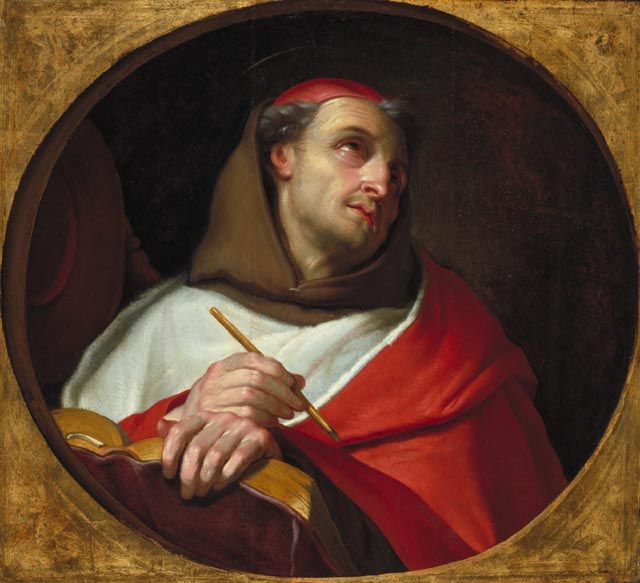
S. Bonaventura is usually represented with an angel communicating him. According to the legend, his humility was so great that he would not draw near to the altar, and an angel therefore visited him, and gave him the holy Sacrament.
Well in the Cathedral at Ratiebon Separation of the SS. Apostles.