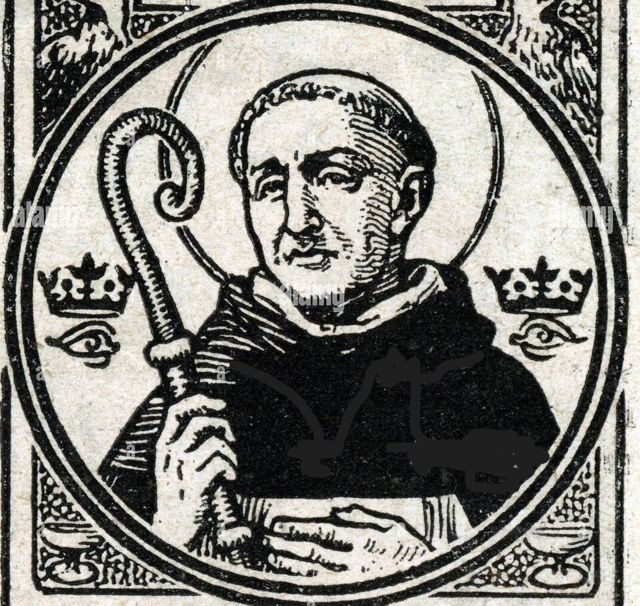
Baring-Gould’s sources: Usuardus, Wandelbert, Hrabanus Maurus, Notker, Gallican Martyrology. In French he is called S. Calais, or Calls, Authorities A life by S. Siviard, abbot of Aninsole, d. 687.] S. Carileff was monk at Menat, in the diocese of Clermont, when the restless S. Avitus, whose life has 1 After the erection of the famous abbey of S. Thietry, the miraculous eagle used to be seen circling in the clear blue sky above the abbey every year. July *J S. Carileff.
…already been related (June 17th), entered there. Avitus, dissatisfied with the house, the crowd of monks, the worldly concerns which the management of a large monastery with extensive lands forced upon the attention of the brethren, ran away, and persuaded the like-minded Carileff to accompany him. They boated across the Loire, 1 and attracted by the fame of S. Maximus at Miscy, near Orleans, placed themselves under his direction, and there S. Carileff was ordained priest But Avitus and Carileff longed for a more solitary life, and flying from Miscy, plunged into the great forest which covered La Perche. France was at that time covered with great forests which had encroached on land that had been in cultivation under the Roman rule. The devastations of barbarians had depopulated the country which had formerly sustained flourishing cities and villages, and the fertile soil was everywhere usurped by copse-wood, where the maple, the birch, the aspen, and the witch-elm, prepared the ground for a more imposing growth of trees, and, still worse, by thickets of thorn and brambles of formidable extent and depth, which arrested the steps, and tore the raiment and skin of the unfortunates who ventured there. But within this over-growth of copse were vast forests filled with magnificent trees, whose interlaced boughs and canopy of leaves flung a solemn twilight on the ground beneath, only here and there broken, where the winter storm had cast down a veteran oak, and through the gap in the leafy roof the sunlight fell warm and yellow on pink foxgloves and fluttering butterflies.
The intermediate regions between the old forests, occupied by copse and scrub, were with too much justice the Loire to reach Miscy is not obvious; probably, however, they went to Orleans before they retired to Miscy or S. Mesmin. Miscy is situated at the junction of the Loire and Loiret.
entitled deserts, because the population had abandoned them, till the hermits brought back fertility and life. In the east of France, occupied by the Burgundians, on the north of the Rhone alone, six great deserts existed at the end of the sixth century, — the desert of R£ome, between Tonnerre and Montbard; the desert of Morvan; the desert of Jura; the desert of the Vosges; the desert of Switzerland, between Bienne and Lucerne; and the desert of Gruyfere, between the Savine and the Aar. Advancing further north, the wooded regions became more extensive. Even in the provinces least depopulated and best cultivated, through the most favourable soils and climates, Ion? wooded lines extended from north to south, and from the rising to the setting sun, connecting the great masses of forests with each other, surrounding and enveloping Gaul [roughly modern France and Belgium] as in a vast network of shade and silence. We must imagine Gaul and all the neighbouring countries, the whole extent of France, Switzerland, Belgium, and both banks of the Rhine covered with forests. We must picture to ourselves these vast tracts of sombre and impenetrable wood, covering hills and valleys, the high tableland as well as the marshy bottoms; descending to the banks of the great rivers, and even to the sea; broken here and there by water-courses which laboriously forced a way for themselves across the roots and fallen trees, perpetually divided up by bogs and marshes, and swarming with game, and wolves, and bears.
Into such a region did the two friends retire, and there for a while they disappeared. In the deep forest of La Perche they found a glade clear of trees, where sprang up a pure fountain, and there they built their cell. But in course of time the fame of S. Avitus spread, and a monastery rose beside the fountain. The noise of the felling of trees alternated with the burst of melody from juiru] S. Carileff.
the chanting monks, a broad road was formed from the sunlit outer world through the green vault of forest to the oasis of S. Avitus, and the world flowed in through the opening made. At least so thought S. Carileff and one day he and a companion, Danmer, fled away to the desert near Le Mans, and finding in the rank copse the ruins of an old Roman villa, at the place since called Aninsole, he took up his abode among the relics [the bodily remains of a saint, or objects they used, kept with honor] of ancient civilization. A neglected vineyard remained, the vines had run wild, and yielded scanty fruit; Carileff pruned them and tied them up to stakes. One day whilst thus engaged, the weather being hot, — it was spring-tide, — he took off his hood and hung it on an oak, till his labour was ended. Then on returning to resume his hood, he found that a wren, the smallest of the woodland birds, had laid an egg in it The good hermit rejoiced, and left his hood to hang, and serve as a nest for the wren. Having satisfied himself that he had found a suitable spot in which to settle, Carileff returned with Daumer to Miscy to give to the venerable Avitus an account of what they had seen; and when the abbot heard of how little Jenny Wren had taken possession of the hermit's hood as her nest, he rejoiced and said, “That is no accident Return thither, and there shall a monastery arise some day.”
So Carileff returned to his ruins, and there abode unknown to men. The tenderness he had shown to the little wren was extended to other animals, especially to a noble buffalo which allowed him to pat it, and rub its shaggy neck, and returned every day to the cell to receive the caresses of the hermit It was a pleasure, says the biographer, to see the old man standing by the side of the monster, gently rubbing him between his horns or along his enormous dewlaps and the folds of flesh round his strong neck, after which the animal, grateful, but faithful to its instinct, regained at a gallop the depths of the forest King Childebert, son of Clovis, arriving in Maine, with Queen Ultrogotha, to hunt, heard with joy that a buffalo, an animal already become rare in the forests of Gaul, had been seen in the neighbourhood. All was arranged next day that this extraordinary chase might prove successful. The bows and arrows were prepared, the trail of the beast followed at break of day, the dogs were led forth in leash, and then slipped, and allowed to follow, giving voice with full mouth. The biographer of S. Carileff gives us the details with the enthusiasm of an old hunter. The terrified buffalo fled for refuge to the cell of his friend, and when the huntsmen approached, they saw the man of God standing beside the beast to protect it The king was told of it, and, hastening forward, cried in a furious tone, when he saw Carileff in prayer, and the buffalo tranquil beside him, “ How are you so bold, unknown wretches, as to invade thus an unconceded forest of my domains, and to trouble the success of my hunting ?” The monk attempted to calm him, and protested that he had come there only to serve God apart from men, and not to despise the sovereign authority, or to disturb the royal game.
“ I order thee,” answered the king, “ thee and thine, to leave this place instantly; woe to thee if thou art found here again !” Having said this he went away scornfully. But his temper speedily cooled down, and when the hermit produced some wine he had pressed from the vines of the old Roman vineyard, the king alighted, drank of the wine, and though he found it bad enough, kissed the venerable hand that offered it, and in return for his hospitable gift, promised to give the saint as much ground as he could ride round in a day, mounted on his ass. In this enclosure rose the abbey round which has sprung up the existing city of S. Calais.
Returning to the queen, Childebert told her his adventure. Ultrogotha, already much interested in the monks, was eager, in her turn, to see the holy recluse. She sent to ask his permission to visit him, promising, if he consented, to give him full possession of the entire domain of which he occupied only a part But Carileff obstinately refused her request “ As long as I live,” he said to the envoy of the queen, “I shall never see the face of a woman, and no woman shall ever enter my cell. And why should this queen be so desirous of seeing a man disfigured by fasts and rural toil, soiled and stained like a chameleon ? Say then to the queen that I will pray for her, but that it does not become a monk to sell the sight of his face to a woman, and that, as for her lands, she must give them to whom she will. Say to her that the monks have no need of great possessions, nor she of my blessing; all that she can hope to receive from us, her servants, she shall have, without leaving her house.” In turning over the soil around the ruins, S. Carileff found a pot of silver Roman coins, and used the money in the construction of a monastery, which rapidly filled with monks, and at the head of which he died, in or about the