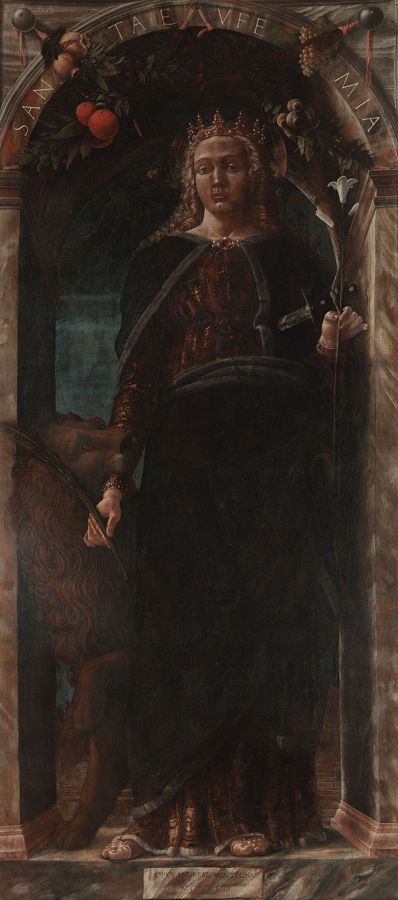
Building a community where women could live the Gospel together.
Read the essentials →Building a community where women could live the Gospel together.
September 16
Not verified yet
Abbess
The first of these three, the daughter of Ethelwulf, and sister of King Alfred, is the creation of the brains of Concubran and Capgrave, as has been shown elsewhere (July 6, p. 152, sg.) She never existed. The second is said by Matthew of Westminster to have been the sister of Athelstan, and daughter of Edward the Elder. William of Malmesbury’s account is somewhat different: — “ By Egwina, an illustrious lady, he (Edward the Elder) had Athelstan, his first-born, and a daughter, whose name I cannot particularize, but her brother gave her in marriage to Sithric, king of the Northumbrians ” (lib. ii. c. 5).
Learn from the kind of life it was. Building a community where women could live the Gospel together.
Keep their day. Remember them on September 16 with a short prayer, and ask for their help.
The first of these three, the daughter of Ethelwulf, and sister of King Alfred, is the creation of the brains of Concubran and Capgrave, as has been shown elsewhere (July 6, p. 152, sg.) She never existed. The second is said by Matthew of Westminster to have been the sister of Athelstan, and daughter of Edward the Elder. He says: — “Athelstan, king of England, married his sister, Eadgitha, in honourable matrimony, to Sithric, king of Northumberland, a prince descended from the Danish nation. And Sithric, forsaking paganism out of love for the virgin, embraced the faith of Christ; but not long afterwards he repudiated that blessed virgin, and rejected Christianity, and restored the worship of idols; and a short time after his apostasy he ended his life in a miserable manner. Then that holy damsel, who had always preserved her virginity, continued her time at Pollesbury in fastings, and vigils, and prayers, and the giving of alms, and persevered to the end of her life, being mighty in good works. And after the course of this praiseworthy life she passed from this world, on the 15th day of July, and to this very day divine miracles 1 By misprint in the Life of S. Modwenna, July, p. 152, the date of the death of S. Edith is placed as 954 instead of 964. are constantly celebrated at her tomb.” Matthew of Westminster gives this under the date a.d. 925, when she married Sithric. William of Malmesbury’s account is somewhat different: — “ By Egwina, an illustrious lady, he (Edward the Elder) had Athelstan, his first-born, and a daughter, whose name I cannot particularize, but her brother gave her in marriage to Sithric, king of the Northumbrians ” (lib. ii. c. 5). And further on, “ One Sithric presided over Northumbria [the Anglo-Saxon kingdom of northern England and south-east Scotland], a barbarian both by race and disposition, who, though he ridiculed the power of preceding kings, humbly solicited affinity with Athelstan, sending messengers expressly for the purpose; and himself, following speedily, confirmed the proposals of the ambassadors. In consequence, honoured by an union with his sister, and by various presents, he laid the basis of a perpetual treaty. But dying at the end of a year, he afforded Athelstan an opportunity for uniting Northumbria, which belonged to him both by ancient right and recent affinity to his sovereignty ” (c. 6). Florence of Worcester says much the same. It is certainly singular that neither Florence, nor William of Malmesbury, should have given the name of the sister of Athelstan. It is possible that after the death of her husband she may have come to Polesworth in Warwickshire, and become abbess of that convent, and, indeed, the life of S. Edith of Wilton, written by Gotschlin, mentions her as being one of the most famous abbesses of the time when Edith of Wilton was with her mother. The latter Edith was born in 962. If Edith, sister of Athelstan, was fifteen when married to Sithric, she would have been fifty-two when Edith of Wilton was born. To what age she lived is not known.
There is a S. Edith’s Well at Church-Eaton in Staffordshire, anciently visited by the infirm for its healing properties..S’. Edith of Wilton.
Feast: September 16
One short email a day for nine days. The day's prayer, a line from St. Edith of Polesworth's story, and a nudge to keep going.
From Sabine Baring-Gould, The Lives of the Saints, new edition in 16 vols. (London: John C. Nimmo, 1897–98); text from the Internet Archive scan (OCR, lightly cleaned; errors possible). Public domain.
From Sabine Baring-Gould, The Lives of the Saints, new edition in 16 vols. (London: John C. Nimmo, 1897–98); text from the Internet Archive scan (OCR, lightly cleaned; errors possible). Public domain in the United States. Reproduced unedited, except for short bracketed notes in grey that we added to explain names and terms (“S.” is the old abbreviation for Saint). Some history and judgments reflect 19th-century scholarship.