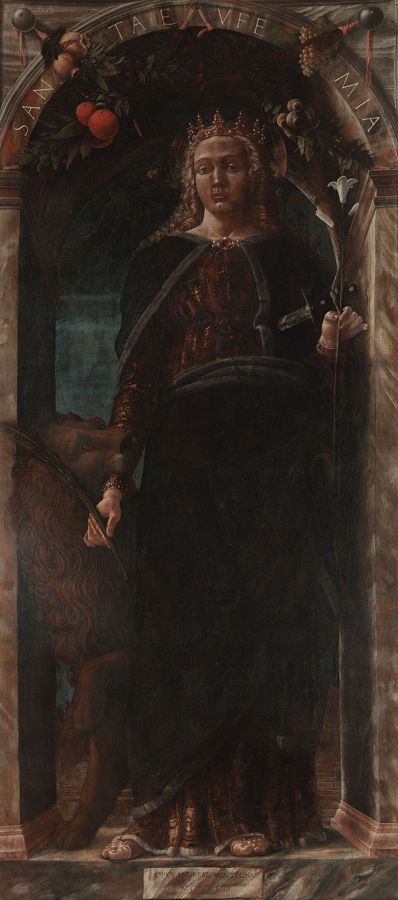
Baring-Gould’s sources: Greek Mensea and Me oologies, Russian Kalendar, Carthaginian Kalendar, Usuardus, Notker, Wandelbert, Roman Martyrologies; all on this day, some copies of the Martyrology of Jerome on the 17th. York, Sarum, Hereford, and Durham Kalendars. Another festival of S. Euphemia among the Greeks on July 11, in commemoration of a miracle wrought by the body of the saint during the session of the council of Chalcedon. Authority: — The Greek Acts, which existed before the 8th cent., when they are alluded to by S. Eunodius of Tunis. They are, however, so full of fabulous matter, that it is difficult to say how much of them is fact and how much fiction.] OUGH the Acts of S. Euphemia are undeserving of credit, the fact of such a martyr having existed and suffered at Chalcedon can hardly be doubted. as her body was preserved by the faithful, and a church built over it directly the persecution ceased through the accession of Constantine.
Euphemia was a maiden of Chalcedon, who was arrested by Priscus, Governor of Bithynia, because she had not attended one of the pagan festivals, instituted in honour of Ares, patron of the city. According to the legend, all 1 Some of the company of S. Ursula, left behind at Strasburg. 258 L ives of the Saints.
kinds of tortures were tried upon her by the governor in vain. “ I am but a girl,” she said, “ but the hand of my Saviour sustains me."
He placed her on a wheel set with knives, but it did not hurt her. He threw her into a furnace of blazing pitch, but she remained in the midst of the fire unhurt. He cast her into a pond full of fish, in hopes that they would eat her; but instead of that they carried her on their backs ashore.1 The governor dug a deep ditch, and filled it with water, and made her walk over it. She traversed the water without sinking; others following her, tumbled into the ditch, and were drowned.
All this nonsense is the addition of the composer of the romance of her martyrdom, who found the facts of her passion too simple for his taste. She was finally cast to wild beasts, and hugged to death by a bear. Her body was buried by her parents.
During the council of Chalcedon a profession of faith of the Orthodox, and another of the Eutychians [followers of Eutyches, who said Christ had only a divine nature; condemned at Chalcedon in 451], were placed in the dead hands of S. Euphemia, and the shrine was closed and sealed by both parties. After three days the seals were broken, and the Eutychian creed was found at the feet of the saint, that of the Catholics being still in her hand.
The church of S. Euphemia certainly existed before a.d. 399, for Arcadius met the Goth Gainas in it in that year, as Socrates, Sozomen, and Zosimus testify. The council of Chalcedon met in it in 451. Zonaras relates the story of the imposition of the two creeds in the hands of S. Euphemia, but earlier historians say nothing about it.
1 Euphemia standing on the back of a fish is taken from representations of Derccto. •S^S. Lucia and Gcminicinus. Relics of S. Euphemia are shown in various places in the West. Pope Gelasius dedicated a church to S. Euphemia at Rome about a.d. 490. Another church under her invocation was erected on the Appian Way, in a.d. 677, by Pope Donmus. The head is shown in Sa. Maria di Campitello; another head in the Lateran [St. John Lateran, the pope’s cathedral in Rome]; other relics [the bodily remains of a saint, or objects they used, kept with honor] in S. Bartolomeo, S. Maria Maggiore, S. Giovanne Baptista, S. Croce in Gerusalemme, S. Eustachio, S. Martha, S. Csecilia; all in Rome. At Milan the entire body; another entire body at Piacenza, where its invention took place in 1091, on April 13; other relics at Brescia; a fifth skull and third entire body at Valetta, in the island of Malta; an arm and hand with skin and flesh on it at Bologna; a sixth head at S. Euphemia in Calabria; some other relics at S. Maclou in Britanny; at Antequera near Granada; a fourth body in the Jesuit church at Madrid; an arm at Leon; a bone at Einsiedeln; another arm at Prag; a hand covered with skin in the Franciscan church at Vienna; and numerous other relics elsewhere.