St. Edith of Wilton

A whole life given to God with an undivided heart.

Read the essentials →
September 16 · Virgin

St. Edith of Wilton

St. Edith of Wilton

A whole life given to God with an undivided heart.

Traditional feast

September 16
1914 / pre-1969 calendar, per Baring-Gould (1897)

Current feast

September 16
Secondary source · Wikipedia

Represents

Virgin

Their story

Adapted in modern English from Baring-Gould (1897–98) · original text below

King Edgar, who ruled all the English from 959 to 975, carried off the young Wilfreda from Wilton Abbey, where she was being educated. She later escaped him, took refuge at Wilton and took the veil there, and there she raised their daughter Edith. Edith was trained in a convent from her mother's breast and may be said never to have known the world. She received the veil from St Ethelwold, Bishop of Winchester.

Edith wore fine clothes, since English nuns of that time seem to have had no set habit, and Ethelwold rebuked her for it. She answered, 'My father, the mind may be as modest and God-fearing under fine clothes as under a serge habit. The God I love looks to the heart and not to the dress.' When she was fifteen her father thought her old enough to be an abbess and gave her authority over Winchester, Barking and another house. But she could not bear to leave her mother, now abbess of Wilton, and stayed with her longer.

After Edgar's death his son Edward succeeded him. Edith dreamed that one of her eyes fell out and told the nuns it foretold Edward's death. He was murdered at Corfe Castle in 978. Edith built a church dedicated to St Dionysius. St Dunstan came to consecrate it, and noticing how often she made the sign of the cross, he took hold of her right thumb and said, 'Never shall this thumb decay.'

Edith died at Wilton on 16 September, around 984, in her twenty-third year. Legend says that as she lay dying, a nun at the church door saw angels standing in ranks and singing, and a shining figure told her, 'Go back; the angels await the good maiden.' When Dunstan raised her body in 987, the thumb was found incorrupt (not decayed after death), and it was enshrined separately for pilgrims.

Early life

Selected sentences from the original account, unaltered.

He carried off the young Wilfreda from Wilton Abbey, where she was being educated. The story of this unforflying from her ravisher, took refuge in Wilton Abbey, where she assumed the veil, and there brought up her daughter Edith, who was thus trained from her mother's breast in a convent, and may be said never to have known the world. As soon as she was fifteen, her father thought she was quite old enough to be an abbess, so lie gave her authority over Winchester, Barking, and another religious house.

What they represent

How they teach us to live

Drawn from themes in the original account

Learn from the kind of life it was. A whole life given to God with an undivided heart.

Keep their day. Remember them on September 16 with a short prayer, and ask for their help.

Read more

The full original · 566 words

Read Baring-Gould’s full account

Baring-Gould’s sources: Roman Martyrology. Sarum Kalendar, and proper office and lessons in the Breviary. Not in the York, Hereford, or Durham Kalendars. The Lubeck-Cologne Martyrology, Greven, Wyon; Wilson in his Anglican Martyrology of 1608, on Sept. 16, in his later edition of 1640, on Sept. 15; why changed does not transpire, as S. Edith died on Sept. 16, as stated in her life. Also on Nov. 3, the feast of the elevation of her body. Authority: — The Life of S. Edith attributed to Gotschlin, the French monk, brought to England by Edward the Confessor. He died in 1098.] S. Edith of Wilton, far more famous than S. Edith of Polesworth, with whom she is sometimes confounded, was the daughter of Edgar, son of Edmund, and brother of Edwy.

Edgar reigned over Mercia [the Anglo-Saxon kingdom of the English Midlands] during his brother's life, but on the death of Edwy he obtained the sovereignty over the whole people of the English, and reigned between 959-975. He carried off the young Wilfreda from Wilton Abbey, where she was being educated. The story of this unforflying from her ravisher, took refuge in Wilton Abbey, where she assumed the veil, and there brought up her daughter Edith, who was thus trained from her mother's breast in a convent, and may be said never to have known the world. She received the veil from the hands of S. Ethelwald, or Efhelwold, Bishop of Winchester (963-984). Edith wore gay clothing — nuns in those days in England seem not to have had an uniform — and was reproved for it by the bishop, Ethclwald. “ My father,” said the maiden, “ the mind may be as modest and God-fearing under fine clothes as under a serge habit. The God I love looks to the heart and not to the dress.”

As soon as she was fifteen, her father thought she was quite old enough to be an abbess, so lie gave her authority over Winchester, Barking, and another religious house. But the little girl could not bear to be torn from her mother, who was now abbess of Wilton, and she remained under her somewhat longer.

On the death of Edgar, Edward, his son, succeeded him. Thereupon S. Edith dreamt that one of her eyes fell out. On waking she told the nuns that her dream foretold the death of Edward, who was murdered at Corfe Castle in 978. Edith erected a church under the dedication of S. Dionysius. S. Dunstan was at the consecration, and when he noticed how continuously S. Edith crossed herself, he caught hold of her right thumb and said, “ Never shall this thumb decay.”

S. Edith died at Wilton on the 1 6 th of September, about the year 984, in the twenty-third year of her age. At the moment when she was dying a nun went to the door of the church, when, looking in, she saw angels standing in ranks and singing sweetly. Then one with a shining face came up to her and said, “ Go back; the angels await the good maiden.”

There was a noble lady at Winchester who had earnestly besought S. Edith to stand as godmother to her child, should she have one, and Edith had promised to do so. Three years after the death of the saintly virgin a little girl was born to the lady. The child was brought to the cathedral to be baptized, and S. Alphege, then Bishop of Winchester, performed the ceremony. As he took the taper and said, “Maiden, receive the lamp, with which (hou shalt enter into the marriage of the Lord,” he looked up and saw before him Edith, in all the bloom of Paradise, holding the infant on her arm, and extending her delicate hand to receive the candle. He placed the light in her hand, and S. Edith of Wilton.

she remained visible till after the baptism, when she vanished clean away. Her body was laid in the church of S. Dionysius, at Wilton, but was taken up by S. Dunstan on November 3, a.d. 987, and the thumb was found incorrupt. It was enshrined separately, and long exposed to the veneration of pilgrims.
Feast days

Feast: September 16

Nine days · Free

Pray the novena
with us.

One short email a day for nine days. The day's prayer, a line from St. Edith of Wilton's story, and a nudge to keep going.

Also on September 16
St. Euphemia

St. Euphemia

September 16 · Virgin, Martyr
L

Sts. Lucia and Geminianus

September 16 · Martyrs
A

Sts. Abundius

September 16 · Feast
← All 1727 saints in the library
Sources & notes

Feast-day sources

Story sources

Sources

Credits

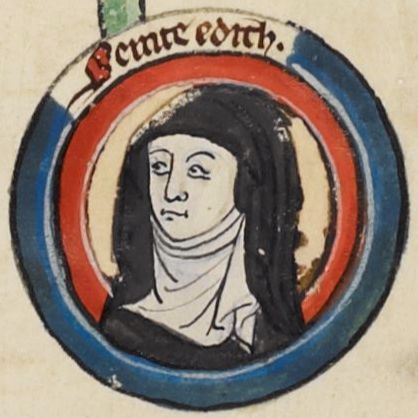
Image: Edith of Wilton.jpg · Unknown authorUnknown author · Public domain, via Wikimedia Commons

From Sabine Baring-Gould, The Lives of the Saints, new edition in 16 vols. (London: John C. Nimmo, 1897–98); text from the Internet Archive scan (OCR, lightly cleaned; errors possible). Public domain.

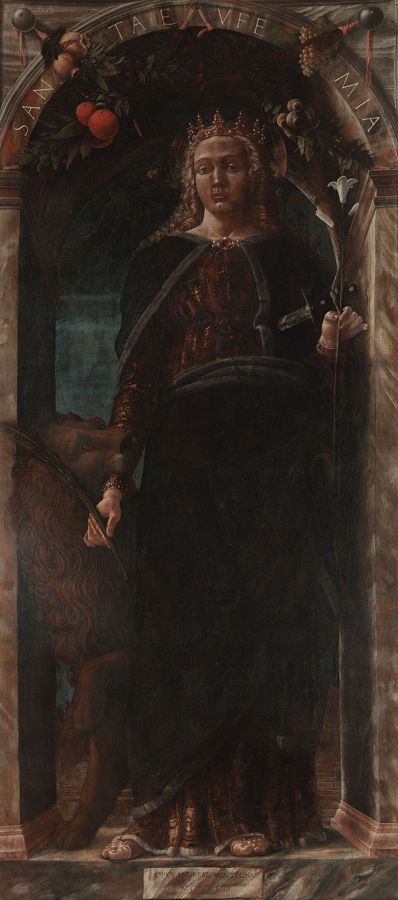
Image: Unknown authorUnknown author, Wikimedia Commons (Public domain)

From Sabine Baring-Gould, The Lives of the Saints, new edition in 16 vols. (London: John C. Nimmo, 1897–98); text from the Internet Archive scan (OCR, lightly cleaned; errors possible). Public domain in the United States. Reproduced unedited, except for short bracketed notes in grey that we added to explain names and terms (“S.” is the old abbreviation for Saint). Some history and judgments reflect 19th-century scholarship.