St. Ninian

A shepherd who stayed with his people through hard times.

Read the essentials →
September 16 · Bishop

St. Ninian

St. Ninian

A shepherd who stayed with his people through hard times.

Traditional feast

September 16
1914 / pre-1969 calendar, per Baring-Gould (1897)

Current feast

September 16
Secondary source · Wikipedia

Represents

Bishop

Their story

Adapted in modern English from the Catholic Encyclopedia (1913) · original text below · little is known

Ninian was the first apostle of Christianity in Scotland. Bede (the English monk-historian, d. 735) writes that the southern Picts (the ancient people of northern Scotland) received the faith through Bishop Ninias, a holy Briton trained at Rome. His see was named after St Martin and known for its church, where he was buried.

St Aelred's twelfth-century life contains much legend, but it says Ninian heard of St Martin's death while building his church at Candida Casa (Whithorn) and dedicated it to him. That would place his mission in the last years of the fourth century. His monastery at Whithorn became a famous school. He died about 432.

Early life

Selected sentences from the original account, unaltered.

This saint was educated in Scotland along with Henry, son of King David. S. Ninian, according to this authority, was the son of a Christian prince, and was born at Whithern, in Galloway. Baptized in his infancy, he spent a holy boyhood and youth, and grew up, says his Irish biographer, a head and shoulders taller than any other man in his father’s realm; wherefore his father wished to make him a man of war; but Ninian was filled with other hopes.

What they represent

How they teach us to live

Drawn from themes in the original account

Feed your mind with Scripture and good books. Learning and the Scriptures matter in this life.

Share your faith, in words and by example. Preaching and conversion are central here.

Learn from the kind of life it was. A shepherd who stayed with his people through hard times.

From the Catholic Encyclopedia

1913 · 353 words

Bishop and confessor [in old usage, a saint who was not martyred, or who suffered for the faith without being killed]; date of birth unknown; died about 432; the first Apostle of Christianity in Scotland. The earliest account of him is in Bede [English monk and historian (d. 735)] (Hist. Eccles., III, 4): "the southern Picts received the true faith by the preaching of Bishop Ninias, a most reverend and holy man of the British nation, who bad been regularly instructed at Rome in the faith and mysteries of the truth; whose episcopal see, named after St. Martin the Bishop, and famous for a church dedicated to him (wherein Ninias himself and many other saints rest in the body), is now in the possession of the English nation. The place belongs to the province of the Bernicians and is commonly called the White House [Candida Casa], because he there built a church of stone, which was not usual amongst the Britons". The facts given in this passage form practically all we know of St. Ninian's life and work.

The most important later life, compiled in the twelfth century by St. Aelred, professes to give a detailed account founded on Bede and also on a "liber de vita et miraculis eius" (sc. Niniani) "barbarice scriptus", but the legendary element is largely evident. He states, however, that while engaged in building his church at Candida Casa, Ninian heard of the death of St. Martin and decided to dedicate the building to him. Now St. Martin died about 397, so that the mission of Ninian to the southern Picts must have begun towards the end of the fourth century. St. Ninian founded at Whithorn a monastery which became famous as a school of monasticism within a century of his death; his work among the southern Picts seems to have had but a short lived success. St. Patrick, in his epistle to Coroticus, terms the Picts apostates", and references to Ninian's converts having abandoned Christianity are found in Sts. Columba and Kentigern. The body of St. Ninian was buried in the church at Whithorn (Wigtownshire), but no relics [the bodily remains of a saint, or objects they used, kept with honor] are now known to exist. The "Clogrinny", or bell of St. Ringan, of very rough workmanship, is in the Antiquarian Museum at Edinburgh.

Read more

The full original · 856 words

Read Baring-Gould’s full account

Baring-Gould’s sources: Roman, Scottish, and frish Martyrologies. Authorities: — A Life by S..^Elred of Rievaulx; Bede, Hist. Eccl. iii. 4; an Irish Life and a metrical Life by Barbour, in the University Library of Cambridge.] Bede says: — “ The Southern Piets, who dwelt on this side of these mountains, had long before, as it is reported, forsaken the errors of idolatry, and embraced the truth by the preaching of Nynias, a most reverend bishop and holy man of the British nation, who had been regularly instructed at Rome in the faith and mysteries of the truth; whose episcopal see, named after S. Martin the bishop, and famous for a stately church, wherein he and many other saints rest as to their bodies, is still existent among the English nation. The place belongs to the Bernicians, and is generally called Candida Casa, because he there built a church of stone, which was not usual among the Britons.

The Irish Martyrologies supply the next authentic records of S. Ninian, whom they call Monenn (i.e., Nenn, with an honorary prefix) of Cluain Conaire, in the county of Kildare../Engus the Culdee gives: — Moinend the shout of every mouth.

He is spoken of as Abbot of Rosnat, and S. Tigernach of Clones is said to have been his disciple. Rosnat is probably Candida Casa or Whithern, for in the life of S. Tigernach that saint is said to have studied under S. Ninian at Rosnat, otherwise called Alba, or white. The next authority for the life of S. Ninian is S. /Elred, who became a Cistercian [strict Benedictine reform begun at Cîteaux in 1098] monk in a.d. 11 66. This saint was educated in Scotland along with Henry, son of King David. A life, written seven hundred years after the death of its subject, in those uncritical times, and at the instance of the canons who profited by his fame, would be worthless, were it not that just as the Cistercian Joscelin, in his life of S. Kentigern, used “Codiculum stilo Scotico dictatum,” so the Cistercian /Elred had the assistance of “liber barbario (sic) scriptus.” In the superscription of the Bodleian copy, the life is said to have been translated from English into Latin.

S. Ninian, according to this authority, was the son of a Christian prince, and was born at Whithern, in Galloway. Baptized in his infancy, he spent a holy boyhood and youth, and grew up, says his Irish biographer, a head and shoulders taller than any other man in his father’s realm; wherefore his father wished to make him a man of war; but Ninian was filled with other hopes. He left Scotland, and went on a pilgrimage to Rome, crossing the British Sea, and, entering Italy by the Cottian Alps, he arrived, after a prosperous journey, at the capital of Christendom. He was taken notice of by the Pope, and devoted himself to study, “ intelligens nimirum ab imperitis doctoribus multa sanae doctrine adversa sibi et compatriotis suis fuisse persuasa.” After remaining many years in Rome, increasing in knowledge and grace, he was consecrated bishop, and sent to the western parts of Britain, to men who had not received the faith of our Saviour. On his way home he visited the great S. Martin of Tours, from whom he borrowed masons, that he might construct a church after the Roman model. He was well received in his diocese, and he selected the place called Whithern; “ which place, situated on the shore, while it runs far into the sea on the east, west, and south, is closed in thereby. From the north side alone it is approached from the land. There he built the first stone church in Britain, and, having heard of the death of S* Martin whilst building it, he dedicated it to him.” S. Martin [St. Martin of Tours (d. 397), soldier turned bishop] died in a.d. 397, which gives us the date of the foundation of this church. The place here described may be the Isle of Whithem, where there is still a chapel in ruins, but not a moulding remains to give any indication of its date. It is, however, more likely that the town of Whithern, where are to be seen the beautiful remains of the cathedral of Galloway some miles inland, is the actual site of the venerable Rosnat, or Candida Casa. The statement that this was the first stone church in Britain must be taken with some reservation.

S. Ninian now restored to sight a neighbouring king, on whom, in punishment for his pride and opposition to the saint, God had laid the burden of blindness. Being healed, he became a great supporter of S. Ninian. His name is by ^Elred called Tudwall, which seems to be the old Celtic Teutal — in Irish, Tuathal.

After vindicating the innocence of a priest falsely accused of incontinency, he undertook the conversion of the Piets. The southern Piets were idolaters. Ninian preached the Gospel among them, and was heard eagerly. Multitudes flocked to baptism, and he is said to have ordained priests, consecrated bishops, and divided the whole land into parishes. Having done all this, he returned to his own church, where he passed the rest of his holy life in great tranquillity.

The rest of S. HSlred’s biography is taken up with miracles, such as the sudden growth of leeks: the raising to life of a robber who had been gored by a bull at a place now termed Farreslast, or the bull's foot-mark; the shower that fell on the saint and his book as his mind wandered; and lastly, the protection afforded by his staff to a disciple, who, in memory of that event, planted the staff, and it became a tree, with a fountain gushing from its roots. S. Ludmilla.

His life mentions that he educated many young men, both of noble and of humble conditions, and that on the occasion of his death he was buried in the church which he had built.

S. Ninian is traditionally said to have occasionally inhabited a cave, which is still shown on the sea-shore of Glasserton, adjacent to the house of Physgill.1
Feast days

Feast: September 16

Nine days · Free

Pray the novena
with us.

One short email a day for nine days. The day's prayer, a line from St. Ninian's story, and a nudge to keep going.

Also on September 16
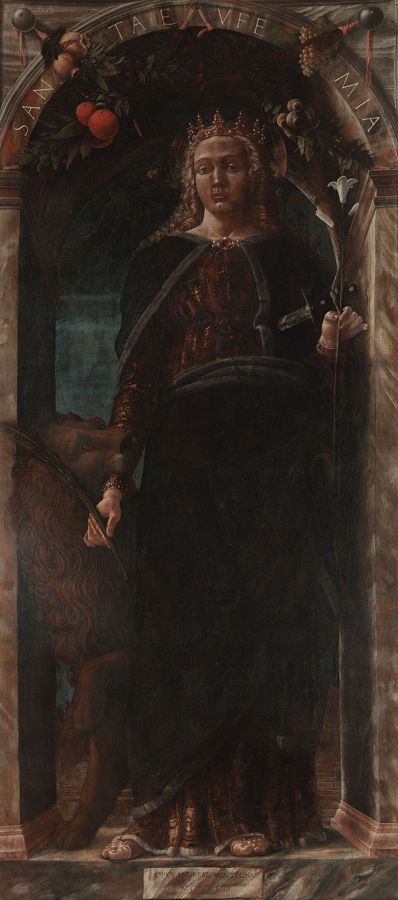
St. Euphemia

St. Euphemia

September 16 · Virgin, Martyr
L

Sts. Lucia and Geminianus

September 16 · Martyrs
A

Sts. Abundius

September 16 · Feast
← All 1726 saints in the library
Sources & notes

Feast-day sources

Story sources

Sources

Credits

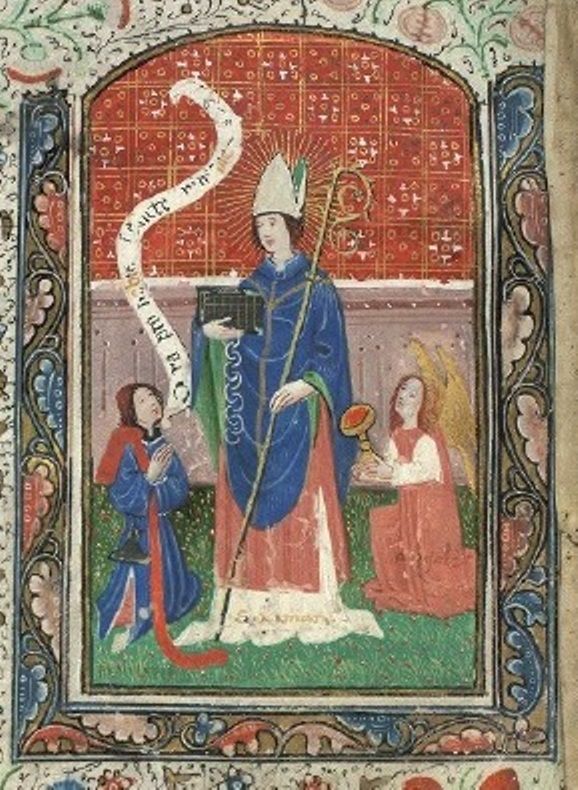
Image: Ninian of Whithorn.jpg · Unknown authorUnknown author · Public domain, via Wikimedia Commons

From Sabine Baring-Gould, The Lives of the Saints, new edition in 16 vols. (London: John C. Nimmo, 1897–98); text from the Internet Archive scan (OCR, lightly cleaned; errors possible). Public domain.

Image: Unknown authorUnknown author, Wikimedia Commons (Public domain)

From “Catholic Encyclopedia (1913)/St. Ninian,” The Catholic Encyclopedia (New York: Robert Appleton Company, 1907–1914), via Wikisource. Public domain. Matched by name and feast date; text unedited except for our bracketed notes in grey.

From Sabine Baring-Gould, The Lives of the Saints, new edition in 16 vols. (London: John C. Nimmo, 1897–98); text from the Internet Archive scan (OCR, lightly cleaned; errors possible). Public domain in the United States. Reproduced unedited, except for short bracketed notes in grey that we added to explain names and terms (“S.” is the old abbreviation for Saint). Some history and judgments reflect 19th-century scholarship.