St. Eusebius of Samosata

Eusebius (bishop of Caesarea, d. c. 339, the first historian of the Church) first appears in 361 as Bishop of Samosata, helping to consecrate Meletius as Patriarch of Antioch.

Read the essentials →
June 21 · Bishop

St. Eusebius of Samosata

St. Eusebius of Samosata

Eusebius (bishop of Caesarea, d. c. 339, the first historian of the Church) first appears in 361 as Bishop of Samosata, helping to consecrate Meletius as Patriarch of Antioch.

Traditional feast

June 21
1914 / pre-1969 calendar, per Baring-Gould (1897)

Current feast

June 21 (also listed: May 30, February 29)
Secondary source · Wikipedia

Represents

Bishop

Their story

Adapted in modern English from the Catholic Encyclopedia (1913) · original text below

Eusebius (bishop of Caesarea, d. c. 339, the first historian of the Church) first appears in 361 as Bishop of Samosata, helping to consecrate Meletius as Patriarch of Antioch. When the Arians (followers of Arius's teaching that the Son is a created being, not fully God) found that Meletius held the Nicene faith, they wanted the election record back from Eusebius. Emperor Constantius threatened to cut off his right hand if he did not hand it over. Eusebius held out both hands and said they could cut off both, but he would not give up the record. The emperor gave in.

With St Gregory Nazianzen he secured St Basil's election as Archbishop of Caesarea in 370, and he and Basil became close friends. Under the Arian emperor Valens he went disguised as a soldier through Syria, Phoenicia and Palestine. He encouraged Catholics and ordained orthodox priests. Gregory called him 'a pillar of the Church'.

Valens banished him to Thrace. After Valens died in 378 he came home and appointed orthodox bishops along the way. He died in 379 or 380.

Early life

The book says little or nothing about early life. This is how the account begins.

When the persecution of Valens broke out, S. Eusebius was not satisfied with confirming his own flock against the assaults of heresy, but he visited the afflicted churches in Syria, Phoenicia, and Palestine, disguised in the dress of an officer, encouraging the faithful, ordaining priests where needful, assisting the orthodox bishops in filling vacant sees with worthy pastors. His activity incensed the Arians, and in 374 Valens sent an order for his banishment. The officer who came to execute the order appeared before Eusebius.

What they represent

How they teach us to live

Drawn from themes in the original account

Stay faithful when it costs you. This account is about holding firm under pressure.

Keep their day. Remember them on June 21 with a short prayer, and ask for their help.

From the Catholic Encyclopedia

1913 · 585 words

Eusebius [Eusebius of Caesarea (d. c. 339), the first historian of the Church], Saint, Bishop of Samosata (now Samsat), in Syria; date of birth unknown; d. in 379 or 380. History makes no mention of him before the year 361, when, as Bishop of Samosata, he took part in the consecration of St. Meletius, the newly elected Patriarch of Antioch. Just then the Eastern Church was rent by Arianism [followers of Arius, who taught that the Son is a created being, not fully God] and its affiliated heresies. Most of the episcopal sees were occupied by Arian bishops, and Meletius himself was elected Patriarch of Antioch only because the Arians believed him to be a supporter of their heresy. Tillemont and a few other historians even maintain that Eusebius was at that time leaning towards Arianism. Whatever may have been the faith of Eusebius previously, it is certain that at a synod held in Antioch in 363 the Nicene formula, with express mention of the term homoousios, was accepted, and the document was signed by Eusebius and twenty-four other bishops.

When the Arians discovered that Meletius upheld the doctrine of the Nicene Council, they declared his election invalid and attempted to obtain from Eusebius, to whom they had been entrusted, the synodal acts proving the lawfulness of the election. The Emperor Constantius, who supported the Arians, ordered Eusebius to surrender the document, but without success. Thereupon Constantius threatened Eusebius with the loss of his right hand, but the bishop calmly presented both his hands to the bearer of the imperial message, saying: "Strike them both off. I will not surrender the document by which the injustice of the Arians can be proved." The emperor was struck by the constancy of Eusebius and left the document in his possession.

It was chiefly due to the concerted efforts of St. Eusebius and St. Gregory Nazianzen that, in 370, St. Basil was elected Archbishop of Caesarea in Cappadocia [a region of central Turkey]. From this time also dates the tender friendship between St. Eusebius and the last-named Father, which is attested by some still extant letters written by St. Basil to the Bishop of Samosata. Eusebius displayed his greatest activity during the persecution of the Catholics by the Arian Emperor Valens. Disguised as a military officer, he visited the persecuted Churches of Syria, Phoenicia, and Palestine, exhorting the afflicted Catholics to remain loyal to their faith, ordaining orthodox priests where they were needed, and in many other ways assisting the Catholic bishops in the difficult exercise of their duties during those troublous times. It is on account of this untiring zeal of Eusebius that St. Gregory Nazianzen calls him "a pillar of the Church", "a gift of God", "a rule of faith", etc. (Migne, P.G., XXI, 57). Incensed at the great success of Eusebius, the Arians prevailed upon the Emperor Valens to banish him into Thrace. After the death of Valens, in 378, he was allowed to return to his see. On his journey from Thrace to Samosata he was instrumental in the appointment of numerous orthodox bishops, among whom were Acacius at Bercea, Theodotus at Hierapolis, Isidore at Cyrrhus, and Eulogius at Edessa. Having returned to his see, he resumed his former activity against the Arians, both in his own diocese and in the neighboring churches. While he was taking part in the consecration of Bishop Marls, at the little town of Dolicha, near Samosata, an Arian woman struck him on the head with a tile thrown from the roof of her house. He died of this wound a few days later. The Greeks honor him as a martyr on the 21st of June, the Latins on the 22d.

Read more

The full original · 612 words

Read Baring-Gould’s full account

Baring-Gould’s sources: Roman Martyrology. Greek Mensea on June 22nd. Authorities: — Theodoret, S. Greg. Naz. Oral., Ac.] The see of Antioch was vacant in the beginning of 361, and Constantius assembled a council there to compose the religious controversies which distracted the East. The bishops assembled urged the immediate appointment of a prelate to this important see. After some dispute, S. Meletius (Feb. 12th), was chosen. His gentleness and piety had won the respect of all, and the Arians expected that his gentleness would prove compliant to false doctrine, as it was tender towards sinners. They were mistaken, he preached daily the doctrine of the co-equal divinity of the Son with the Father. The Arians were furious, and desired to cancel his appointment. But this could only be effected by obtaining the decree of appointment drawn up and signed at the time of his instalment, which had been placed in the hands of S. Eusebius, bishop of Samosata. After the council, S. Eusebius had retired to his bishopric, carrying the document away with him, as the guardian of it The emperor, at the request of the Arians, sent a message to Eusebius to give it up. The bishop replied, 11 1 cannot surrender a public deposit without the consent of all those who entrusted it to me.” Constantius, irritated at this reply, wrote to him again, insisting on the surrender, and threatening, if he refused, to have his right hand cut off.” Eusebius calmly presented both his hands to the bearer of the letter, and said, 11 Strike them both off, I will not surrender the document.” But the officer had not received orders to fulfil the threat, and he returned to Constantius.

[lane Eusebius [Eusebius of Caesarea (d. c. 339), the first historian of the Church], bishop of Caesarea, in Cappadocia [a region of central Turkey], died in 370, when Valens, the Arian [followers of Arius, who taught that the Son is a created being, not fully God] emperor, was persecuting the Church. The see of Caesarea [a bishop’s “see” is his diocese, named from his seat (Latin sedes)] was one of the most important in Asia Minor, it was the capital of Cappadocia, and perhaps of all the so-called diocese of Pontus [a region on the Black Sea coast of Turkey], half Asia Minor. The clergy of Caesarea, according to custom, wrote to the bishops of the province, and they arrived to conduct the election of a successor. The aged Gregory of Nazianzus (the father of S. Gregory Nazianzen), wrote to S. Eusebius of Samosata, to implore his succour in the matter, although he did not belong to the province, and represented to him the peril of the church of Caesarea, which ran the risk of receiving a heretic as its chief pastor. S. Eusebius hastened to Caesarea, and his presence was efficacious in sustaining the cause of the Catholics, and his influence led in a measure to the election of S. Basil (see p. 196.) S. Gregory of Nazianzus was so well satisfied with the zeal of the Bishop of Samosata in this most trying time, that in a letter written at the time, he styles him the pillar of the truth, the light of the world, the vehicle of the favours of God towards His people, and the support and glory of all the orthodox.

When the persecution of Valens broke out, S. Eusebius was not satisfied with confirming his own flock against the assaults of heresy, but he visited the afflicted churches in Syria, Phoenicia, and Palestine, disguised in the dress of an officer, encouraging the faithful, ordaining priests where needful, assisting the orthodox bishops in filling vacant sees with worthy pastors. His activity incensed the Arians, and in 374 Valens sent an order for his banishment. The officer who came to execute the order appeared before Eusebius. The bishop quietly bade him conceal his errand, 14 lest the people in their June ax.] S. Eusebius.

zeal should drown you.” He then said the evening service, took one domestic with him, and crossed the Euphrates at night. Some of his flock overtook him; he recited to them texts about obedience to rulers, accepted a few gifts from his dearest friends, prayed for them all, exhorted them to steadfastness in the faith, and went his way. His people would not speak to or visit the Arian bishop who was appointed his successor. After he had been at the public bath, they let out the water as impure. The new bishop, a gentle-spirited man, could not bear to be under the ban of his nominal flock, and resigned the see. The next Arian bishop was of sterner stuff, and punished abhorrence with sentence of exile. Zeal for the truth sometimes degenerated into fanaticism. Some boys were playing ball in the street and the ball bounded between the legs of the ass on which the Arian prelate ambled along. They uttered a cry, and passed the ball through a fire to remove the infection. The bishop was angry, and revenged himself by punishing the priest Antioch us, nephew of S. Eusebius, and the deacon Evolcius, both zealous Catholics. Valens was killed in the battle of Hadrianople, August 9th, 378, and was succeeded by Gratian, who recalled the exiles. Eusebius returned to Samosata, and with his customary energy, went about various cities, establishing Catholic bishops. He lost his life in this pious labour. In a little city of Syria, an Arian woman flung down a tile from the roof of her house on the head of Eusebius, who died shortly afterwards, having, before he died, exacted a promise from his friends never to search for the woman.
Feast days

Feast: June 21

Nine days · Free

Pray the novena
with us.

One short email a day for nine days. The day's prayer, a line from St. Eusebius of Samosata's story, and a nudge to keep going.

Also on June 21
St. Alban

St. Alban

June 21 · Martyr
M

St. Maen

June 21 · Abbot
L

St. Leutfried

June 21 · Abbot
← All 1726 saints in the library
Sources & notes

Feast-day sources

Story sources

Sources

Credits

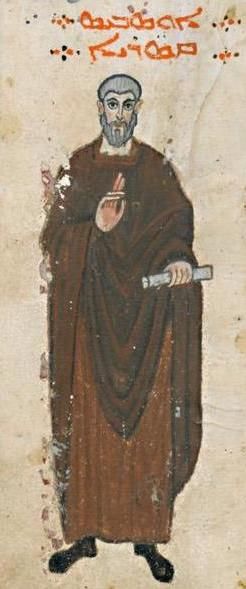
Image: Eusebius of Caesarea Rabbula Gospels Icon.jpg · Unknown, the art is from the 6th Century AD · Public domain, via Wikimedia Commons

From Sabine Baring-Gould, The Lives of the Saints, new edition in 16 vols. (London: John C. Nimmo, 1897–98); text from the Internet Archive scan (OCR, lightly cleaned; errors possible). Public domain.

Image: Unknown, the art is from the 6th Century AD, Wikimedia Commons (Public domain)

From “Catholic Encyclopedia (1913)/St. Eusebius, Bishop of Samosata,” The Catholic Encyclopedia (New York: Robert Appleton Company, 1907–1914), via Wikisource. Public domain. Matched by name and feast date; text unedited except for our bracketed notes in grey.

From Sabine Baring-Gould, The Lives of the Saints, new edition in 16 vols. (London: John C. Nimmo, 1897–98); text from the Internet Archive scan (OCR, lightly cleaned; errors possible). Public domain in the United States. Reproduced unedited, except for short bracketed notes in grey that we added to explain names and terms (“S.” is the old abbreviation for Saint). Some history and judgments reflect 19th-century scholarship.