St. Ghislain

Witnessing to Christ by the way of life, not by death.

Read the essentials →
October 9 · Confessor

St. Ghislain

St. Ghislain

Witnessing to Christ by the way of life, not by death.

Traditional feast

October 9
1914 / pre-1969 calendar, per Baring-Gould (1897)

Current feast

October 9
Secondary source · Wikipedia

Represents

Confessor

Their story

Adapted in modern English from the Catholic Encyclopedia (1913) · original text below · little is known

Ghislain, probably of German origin, lived as a hermit in Hainault in the seventh century. He made a clearing near what is now Mons, then built an oratory to Sts. Peter and Paul at Ursidongus. Aubert, Bishop of Cambrai, questioned the unknown hermit and then protected him.

He guided St. Waudru to found a monastery, and probably influenced the vocations of St. Aldegonde and her family. He died at Ursidongus, now Saint-Ghislain, about 680.

Legend: a bear fleeing King Dagobert's hunt took refuge with him and later showed him where to build his monastery. That is why he is shown with a bear, and the place was called 'bear's den'. Mothers ask his help against convulsions in children.

Early life

The book says little or nothing about early life. This is how the account begins.

One day, King Dagobert was out hunting, when the dogs roused a bear, which took to flight and sought refuge under the mantle of Ghislain, which was hanging from the branch of a tree whilst the saint was engaged in gardening. There the bear stood at bay and the dogs would not touch her. The huntsmen, thinking that Ghislain and his disciples had bewitched the hounds, fell on them and beat them, till the king, galloping up, bade them desist.

What they represent

How they teach us to live

Drawn from themes in the original account

Build up the community you belong to. This life was lived with and for a community.

Learn from the kind of life it was. Witnessing to Christ by the way of life, not by death.

From the Catholic Encyclopedia

1913 · 475 words

Confessor and anchorite [a hermit, sometimes walled into a cell beside a church] in Belgium; b. in the first half of the seventh century; d. at Saint-Ghislain (Ursidongus), 9 October, c. 680. He was probably of German origin. Ghislain lived in the province of Hainault (Belgium) in the time of St. Amand ((d. 679) and Saints Waudru, Aldegonde, and Madelberte. With two unknown disciples he made a clearing in the vicinity of Castrilocus (now Mons, in Hainault), taking up later his abode at a place called Ursidongus, where he built an oratory or chapel dedicated to Saints Peter and Paul. Aubert, Bishop of Cambrai, summoned him to the episcopal presence in order to sound the intentions of this almost unknown hermit, but he afterwards accorded him efficient protection. During his visit to Cambrai Ghislain spent some time in the villa of Roisin and received as a gift the estates of Celles and Hornu. He soon entered into relations with St. Waudru, who was induced by him to build a monastery at Castrilocus, his former place of refuge. It is probable that Ghislain influenced the religious vocation of St. Aldegonde, Abbess of Maubeuge, also of St. Madelberte and St.Aldetrude, of whom the first was the sister and the last two the daughters of St. Waudru. One day Aldegonde in her monastery of Maubeuge, had a vision in which, according to her biographer, the death of St. Amand, Bishop of Tongres, was revealed to her. Ghislain visited the saint in her villa of Mairieu, near Mabeuge, and explained to her that the vision was an announcement of her own approaching death. The intercourse between Ghislain and Aldegonde brought about a perfect understanding between Maubeuge and the monastery founded at Ursidongus under Ghislain's direction. St. Waudru rewarded her counsellor with a portion of the villa of Frameries and of the oratory of St-Quentin, comprised within the boundaries of the villa of Quaregnon. Ghislain died at Ursidongus, and the monastery which he had founded took his name. The relics [the bodily remains of a saint, or objects they used, kept with honor] of the saint were first disinterred c. 929. They were transferred to Grandlieu, near Quaregnon, about the end of the tenth century or the begining of the eleventh, and in 1025 Gerard I, Bishop of Cambrai, removed them to Cateau-Cambresis. They were visited several times in the course of the Middle Ages by the Bishops of Cambrai. In 1647 they were removed to St-Ghislain of which place our saint is patron. His feast is celebrated 9 October and his intercession is sought to ward off convulsions from children. In iconography he is frequently represented with a bear or bear's cub beside him. This is an allusion to the popular legend which relates that a bear, pursued in the chase by King Dagobert, sought refuge with Ghislain and later showed him the place where he should establish a monastery. Moreover, the site of the saint's cella was called Ursidongus, "bear's den".

Read more

The full original · 569 words

Read Baring-Gould’s full account

Baring-Gould’s sources: Roman, Gailican, and Belgian Martyrologies. Authorities: — a lif written at the end of the 9th or 10th cent, from documents, “ Cartulis antiquissimis.”] The name of this Saint, Gisel, Ghysel, or Ghyselen, in Flemish means “ a hostage,” and according to his biographer, he was bom in Athens, not, however, of Greek parents, perhaps, but possibly of Frank ones. He entered a monastery of the Order of S. Basil and was ordained priest. He afterwards came to Rome, and thence rambled north till he reached Hainault, and there settled in an old ruined Roman fort, along with two disciples, Lantebert and Bellirius.

One day, King Dagobert was out hunting, when the dogs roused a bear, which took to flight and sought refuge under the mantle of Ghislain, which was hanging from the branch of a tree whilst the saint was engaged in gardening. There the bear stood at bay and the dogs would not touch her. The huntsmen, thinking that Ghislain and his disciples had bewitched the hounds, fell on them and beat them, till the king, galloping up, bade them desist. “Why have you arrested my dogs and deprived them of their prey?” asked the king.

“Sire,” answered Ghislain, “the bear came here, I did not call her, and she took refuge under the shadow of my mantle. Take her, I need her not.”

But Dagobert would not hurt the bear; he called off his dogs and retired. Now when Ghislain had done his work, he arose and put on his mantle; then the bear got up, and took the hermit's ft * “ basket, in which was his mystery, which he used at the sacred solemnity of the mass/* 1 and walked forward, carrying it in her mouth. Then Ghislain cried out, “ O God of infinite mercy ! assist me to recover what I have lost.” Then he and his companions ran after the bear. And an eagle came and flew before them to show the way. Presently they came on some shepherds watching their (locks, and Ghislain asked, “ Have ye seen a bear pass this way, my masters, carrying something ?” They answered him, “ VVe did see a she-bear go by, with something like a garment in her mouth, and she went yonder to her lair.” Then Ghislain pushed through the branches and found where the bear had her lair, and there were cubs in it, and they were playing with their paws and mouths with the vestment. And Ghislain adjured the bears to surrender what they had got, and not to trouble him any more. Then he snatched his chasuble from the cubs and ran away with it. Afterwards he built a monastery on the spot where the bear’s lair had been, and called it Ursidongus, but after his death it took his name. At the old fort where he had first lived he was the means of founding a nunnery which he dedicated to SS. Peter and Paul, for S. Waldetrude, the wife of S. Vincent Madelgar. Waldetrude was a kinswoman of Dagobert. Vincent Madelgar had deserted her in order to become a monk, and had been shorn by S. Authbert at Hautmont. Waldetrude lived at home with her children and trained them carefully. But Ghislain sought her out and urged her to leave the world, its obligations and responsibilities, and take refuge in a nunnery. At his instigation also, she placed her daughter, Aldegund, then a little child, in the nunnery of Maubeuge. The old Roman fort where Ghislain had settled belonged to that Hildulf, Duke of Lobbes, whose wife Aia was a relation of Waldetrude. By 1 His sacred vestment, as appears from what follows. the advice of Ghislain, Waldetrude bought the land and founded on it according to his instructions the house of canonesses, which became the nucleus afterwards of the town of Mons. She is commemorated on April 9th. In remembrance of the origin of their monastery, the monks of S. Ghislain always keep a bear and an eagle.

Feast days

Feast: October 9

Nine days · Free

Pray the novena
with us.

One short email a day for nine days. The day's prayer, a line from St. Ghislain's story, and a nudge to keep going.

Also on October 9
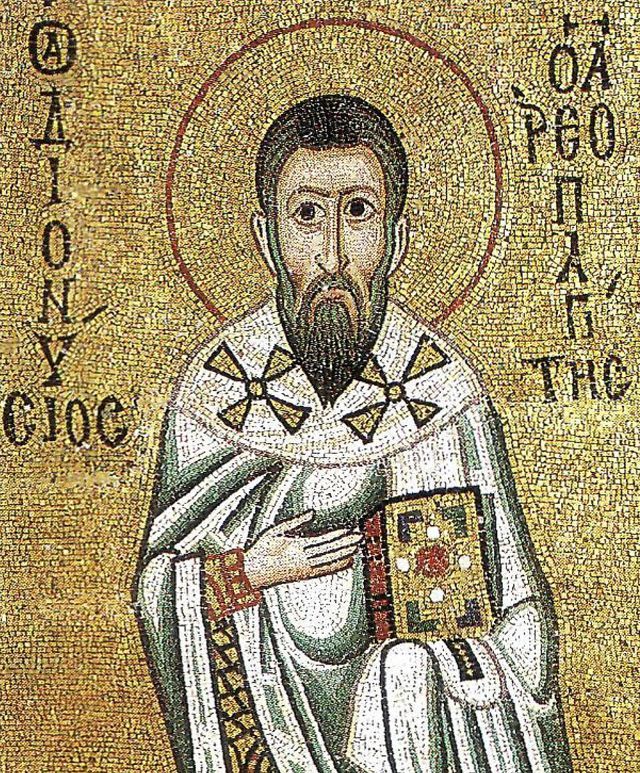
St. Dionysius the Areopagite

St. Dionysius the…

October 9 · Bishop, Martyr
D

Sts. Dionysius

October 9 · Bishop, Martyr
A

Sts. Andronicus and…

October 9 · Feast
← All 1726 saints in the library
Sources & notes

Feast-day sources

Story sources

Sources

Credits

Image: Saints withtheiremblems.jpg · Unknown authorUnknown author · Public domain, via Wikimedia Commons

From Sabine Baring-Gould, The Lives of the Saints, new edition in 16 vols. (London: John C. Nimmo, 1897–98); text from the Internet Archive scan (OCR, lightly cleaned; errors possible). Public domain.

Image: Unknown authorUnknown author, Wikimedia Commons (Public domain)

From “Catholic Encyclopedia (1913)/St. Ghislain,” The Catholic Encyclopedia (New York: Robert Appleton Company, 1907–1914), via Wikisource. Public domain. Matched by name and feast date; text unedited except for our bracketed notes in grey.

From Sabine Baring-Gould, The Lives of the Saints, new edition in 16 vols. (London: John C. Nimmo, 1897–98); text from the Internet Archive scan (OCR, lightly cleaned; errors possible). Public domain in the United States. Reproduced unedited, except for short bracketed notes in grey that we added to explain names and terms (“S.” is the old abbreviation for Saint). Some history and judgments reflect 19th-century scholarship.