Baring-Gould’s sources: Roman Martyrology. Authority:—His Life, written twenty-five years after his death.
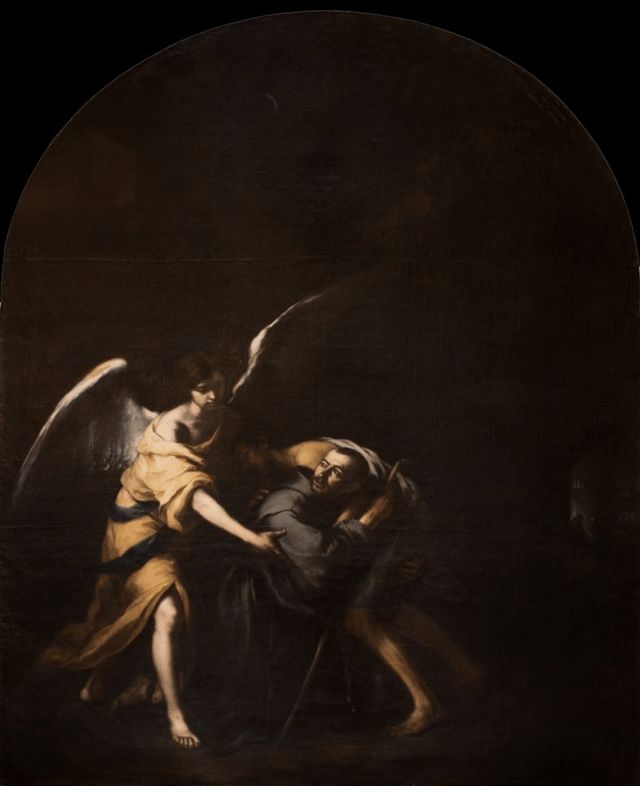
S. John, surnamed of God, was born in Portugal, in 1495. His parents were of the lowest rank, but good and pious people. John spent a considerable part of his youth in service, under the chief shepherd of the count of Oropeusa, in Castile, and in great innocence and virtue. In 1522, he enlisted himself in a company of foot soldiers, raised by the count, and served in the wars between the French and Spaniards; and afterwards in Hungary, against the Turks, whilst the emperor Charles V. was king of Spain. By the licentiousness of his companions, he by degrees lost his fear of offending God, grew careless, and fell into many grievous sins. The troop to which he belonged having been disbanded, he went into Andalusia in 1536, where he entered the service of a rich lady near Seville, as a shepherd. He was now about forty years of age, and being stung with remorse for his past misconduct, he resolved to amend his life and do penance for his sins. He accordingly employed the greatest part of his time, both by day and night, in the exercises of prayer and mortification; bewailing his ingratitude towards God, and deliberating how he could best dedicate himself to His service. His compassion for the distressed moved him to pass into Africa, that he might there comfort and succour the slaves, not without hopes of meeting with the crown of martyrdom. At Gibraltar he met a Portuguese gentleman condemned to banishment, whose estate had been confiscated by king John III. He was then in the hands of the king's officers, together with his wife and children, and was on his way to Ceuta in Barbary, the place of his exile. John, out of compassion, served him without wages. At Ceuta the gentleman fell sick, and was reduced to dispose of the small remains of his shattered fortune for the support of his wife and children, who were with him in exile. John, not content to sell what little stock he had to relieve them, hired himself as a day labourer at the public works to earn all he could for their subsistence. The apostasy of one of his companions alarmed him, and his confessor [in old usage, a saint who was not martyred, or who suffered for the faith without being killed] telling him that his going in quest of martyrdom was an illusion, he determined to return to Spain. Coming back to Gibraltar, his piety suggested to him to turn pedler, and sell little sacred pictures and books of devotion, which might furnish him with opportunities of exhorting his customers to virtue. His stock increasing considerably, he settled in Granada, where he opened a shop in 1538, being then forty-three years of age.
The great preacher and servant of God, John D'Avila, surnamed the Apostle of Andalusia, preached that year at Granada, on S. Sebastian's day, which is there kept as a great festival. John having heard his sermon, was so affected with it, that, melting into tears, he filled the whole church with his cries, beating his breast, and calling aloud for mercy. Then, frenzied with compunction, he ran about the streets, tearing his hair, and behaving in such a manner that he was followed by the rabble with sticks and stones, and came home besmeared with dirt and blood. He then gave away all that he had in the world, and having thus reduced himself to absolute poverty, continued his frantic racing about the streets as before, till some had the charity to take him to the venerable John D'Avila, covered with dirt and blood. The holy man spoke to him in private, heard his general confession, gave him proper advice, and promised his assistance. John returned soon after to his extravagances. He was, thereupon, taken up and put into a madhouse, on supposition of his being disordered in his senses, where, according to the barbarous practice of the time, the severest methods were employed to bring him to himself. He underwent all the pains inflicted on him as an atonement for the sins of his past life. D'Avila being informed of his conduct, came to visit him, and found him reduced almost to the grave by weakness; and his body covered with wounds and sores; but his soul was still vigorous, and thirsting after new sufferings and humiliations. D'Avila, however, told him that being sufficiently exercised in so singular a method of penance and humiliation, he had better employ himself for the time to come in something more conducive to his own and the public good. His exhortation had its desired effect; and John became at once calm, to the great astonishment of his keepers. He continued, however, some time longer in the hospital serving the sick, but left it entirely on S. Ursula's day, in 1539. He then thought of executing his design of doing something for the relief of the poor; and, after a pilgrimage to Our Lady of Guadalupe, to recommend himself and his undertaking to her intercession, he began to sell wood in the market-place, and expend the proceeds in feeding the poor. Soon after he hired a house in which to shelter poor sick persons, whom he served and provided for with such ardour, prudence, and economy, that it surprised the whole city. This was the foundation of the Order of Charity, in 1540, which, by the benediction of heaven, has since been spread all over Christendom. John was occupied all day in serving his patients; in the night he went out to find new objects of charity, rather than to seek provisions for them; for people of their own accord brought him in all necessaries for his little hospital. The archbishop of Granada, highly pleased with the discipline and order maintained in the establishment, gave largely towards its support, and his example was followed by others. Indeed, the charity, patience, and modesty of S. John, and his wonderful care and foresight, made every one admire and favour the institution. The bishop of Tuy, president of the royal court of judicature in Granada, having invited the holy man to dinner, put several questions to him, to all of which he answered in such a manner, as gave the bishop the highest opinion of his prudence and good sense. It was this prelate who gave him the name of John of God, and prescribed him a kind of habit, though S. John never thought of founding a religious order; for the rules which bear his name were drawn up only in 1556, six years after his death; and religious vows were not introduced among his brethren before the year 1570.
March 8.
To make trial of the saint's disinterestedness, the marquis of Tarifa came to him in disguise to beg an alms, on pretence of a necessary law-suit, and received from his hands twenty-five ducats, which was all he had. The marquis was so much edified by his charity, that, besides returning the sum, he bestowed on him one hundred and fifty crowns of gold, and sent to his hospital every day, during his stay at Granada, one hundred and fifty loaves, four sheep, and six pullets. But the holy man gave a still more illustrious proof of his charity when the hospital was on fire; for he carried out most of the sick on his own back; and though he passed and repassed through the flames, and staid in the midst of them a considerable time, he received no hurt. But his charity was not confined to his own hospital; he looked upon it as his own misfortune if the necessities of any distressed person in the country remained unrelieved. He, therefore, made strict inquiry into the wants of the poor over the whole province, relieved many in their own houses, found employment for those that were able to work, and with wonderful sagacity laid himself out in every way to comfort and assist the afflicted members of Christ. He was particularly active and vigilant in providing for young maidens in distress, to prevent the dangers to which they are often exposed. He also reclaimed many who were already leading a course of sin, seeking them out, crucifix in hand, and with many tears exhorting them to repentance. Though his life seemed to be taken up in continual action, he accompanied it with perpetual prayer and incredible corporal austerities. And his tears of devotion, his frequent raptures, and his eminent spirit of contemplation, gave a lustre to his other virtues. But his sincere humility appeared most admirable in all his actions, even amidst the honours which he received at the court of Valladolid, whither business called him. The king and princes seemed to vie with each other who should show him the greatest courtesy, or put the largest alms in his hands. Only the most tried virtue could stand the test of honours, but John remained the same retiring, modest man he was before, preferring humiliation to honour. One day, when a woman called him a hypocrite, and loaded him with invectives, he gave her a piece of money, and desired her to repeat all she had said in the market-place.
Worn out at last by ten years' hard service in his hospital, he fell sick. The immediate occasion was excess of fatigue in saving wood and other such things for the poor, in a great flood. He at first concealed his sickness, that he might not be obliged to diminish his labours, but in the meantime he carefully went over the inventories of all things belonging to his hospital, and inspected all the accounts. He also revised the rules he had made for its administration, the distribution of time, and the exercises of piety to be observed in it. Upon a complaint that he harboured idle strollers and bad women, the archbishop sent for him. The man of God threw himself at his feet, and said, "The Son of God came for sinners, and we are obliged to seek their conversion. I am unfaithful to my vocation because I neglect this; and I confess that I know no other bad person in my hospital but myself." This he spoke with go much humility that all present were moved, and the archbishop dismissed him with respect, leaving all things to his discretion. His illness increasing, the news of it spread. The lady Anne Ossorio was no sooner informed of his condition, than she came in her carriage to the hospital to see him. The servant of God lay in his habit in his little cell, covered with a piece of an old coat instead of a blanket, and having under his head the basket in which he was wont to collect alms for his hospital. The poor and sick stood weeping round him. The lady, moved with compassion, despatched secretly a message to the archbishop, who sent immediately an order to S. John to obey her as he would himself, during his illness. By virtue of this authority she obliged him to leave his hospital. In going out, he visited the Blessed Sacrament, and poured forth his heart before It with fervour; remaining there absorbed in his devotions so long, that the lady Anne Ossorio caused him to be taken up and carried into her carriage, in which she conveyed him to her own house. She herself prepared, with the help of her maids, and gave him with her own hands, broth and medicine, and often read to him the history of the passion of our Divine Redeemer. The whole city was in tears; all the nobility visited him; and the magistrates came to beg he would give his benediction to the city. He answered, that his sins rendered him the scandal and reproach of their country, but recommended to them his brethren the poor, and his religious that served them. At last, by order of the archbishop, he gave the city his dying blessing. The archbishop said Mass in his chamber, heard his confession, gave him the viaticum and extreme unction, and promised to pay all his debts and to provide for all his poor.
The saint expired on his knees, before the altar, on the 8th of March, in 1550, at the age of fifty-five. He was buried by the archbishop, and all the clergy, both secular and regular, accompanied by the court, the nobles, and the whole city, with the utmost pomp. He was honoured by many miracles, beatified by Urban VIII., in 1630, and canonized by Alexander VIII., in 1690. His relics [the bodily remains of a saint, or objects they used, kept with honor] were translated into the church of his brethren in 1664. His Order of Charity to serve the sick was approved of by pope Pius V.