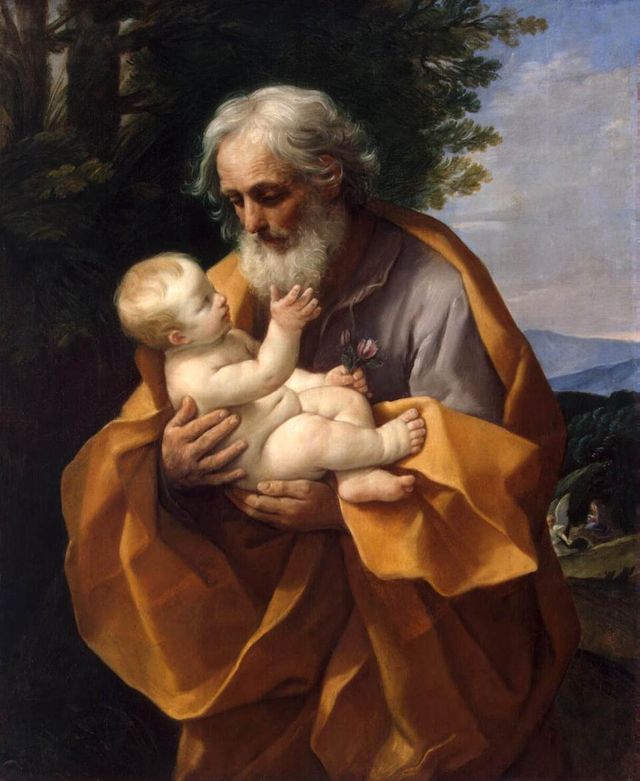
St. Joseph

All we know for certain concerning S. Joseph, the husband of Mary the mother of God, is derived from the Holy Gospels.

Read the essentials →
March 19 · —

St. Joseph

St. Joseph

All we know for certain concerning S. Joseph, the husband of Mary the mother of God, is derived from the Holy Gospels.

Traditional feast

March 19
1914 / pre-1969 calendar, per Baring-Gould (1897)

Current feast

March 19
Verified · General Roman Calendar

Represents

Feast

Their story

Adapted in modern English from Baring-Gould (1897) · original text below

All that is known for certain about Joseph, husband of Mary the mother of God, comes from the Gospels. He was given the most precious charge ever entrusted to a man, the care of Mary and Jesus, and from that his great holiness may be inferred.

He was of the line of David, and so of royal descent, but he was poor and earned his living as a carpenter. Matthew gives his father's name as Jacob and Luke as Heli. This is explained by supposing that one genealogy traces natural descent and the other the legal line of royal inheritance. Scripture calls him a just man. When he found that his virgin wife was with child, knowing the child was not his, he resolved to put her away quietly to spare her scandal. God warned him in a dream that she was innocent and would be the mother of the Son of God.

When Herod sought the child's life, Joseph took Jesus and His mother by night and fled into Egypt. When an angel told him Herod was dead, he came back. Finding Herod's son Archelaus ruling Judea, he thought it unwise to go there and settled at Nazareth. Every year he and Mary went up to Jerusalem to offer sacrifice as the Law required, and once Jesus went with them. Jesus grew up in Joseph's care and helped him in his workshop. It is believed that Joseph died before the Lord began His ministry, since the Gospels say no more of him.

Early life

Selected sentences from the original account, unaltered.

To him was confided the most precious treasure ever entrusted to man, the guardianship of Mary and Jesus, of the Mother and the Son of God; whence we may infer the great sanctity and merit of S. Joseph. According to S. Matthew his father's name was Jacob, according to S. Luke it was Heli, this discrepancy in the accounts is explained by the supposition that one of the genealogies represents the direct line of natural generation, the other the legal descent of royal prerogative.

What they represent

How they teach us to live

Drawn from themes in the original account

Keep their day. Remember them on March 19 with a short prayer, and ask for their help.

Read more

The full original · 399 words

Read Baring-Gould’s full account

Baring-Gould’s sources: Roman Martyrology. His festival was ordered by pope Sixtus IV. to be observed as a double; Gregory XV. recommended its general observance by the faithful, and this recommendation was confirmed by Urban XIII., by bull in 1642.

All we know for certain concerning S. Joseph, the husband of Mary the mother of God, is derived from the Holy Gospels. To him was confided the most precious treasure ever entrusted to man, the guardianship of Mary and Jesus, of the Mother and the Son of God; whence we may infer the great sanctity and merit of S. Joseph.

He was of the lineage of David, and therefore of royal race, but was poor, and gained his livelihood as a carpenter. According to S. Matthew his father's name was Jacob, according to S. Luke it was Heli, this discrepancy in the accounts is explained by the supposition that one of the genealogies represents the direct line of natural generation, the other the legal descent of royal prerogative. We are expressly told that he was a just man. On perceiving that his virgin wife was with child, he resolved secretly to put her away, for having lived with her in the purest relations, he knew that the child could be none of his; and by secretly divorcing her, he would spare her the scandal which would attach itself to her, for the world would regard her offspring as his son, and he alone would know that this was not the case.

But he was warned by God in a dream to believe in the innocence of his wife, and was told that she was to become the mother of the Son of God. Afterwards, when Herod sought the life of the young child, he took Him and His mother by night and fled with them into Egypt, till hearing that Herod was dead, in obedience to an angelic order, he returned to Palestine; but finding that Archelaus the son of Herod was reigning in Judea, he thought it imprudent to enter his dominions, and therefore settled at Nazareth. He and Mary went once every year to Jerusalem to offer their sacrifice in the temple, in obedience to the requirements of the law, and on one of these occasions Jesus accompanied them. The child Jesus grew up under the care of Joseph, assisting him in his shop. It is believed that Joseph died before our Lord began his ministry; for we hear of him no more.

The girdle of S. Joseph is said to be preserved among the sacred treasures of the church of Joinville, in the diocese of Langres.

Feast days

Feast: March 19

Nine days · Free

Pray the novena
with us.

One short email a day for nine days. The day's prayer, a line from St. Joseph's story, and a nudge to keep going.

Also on March 19
P

St. Pancharius

March 19 · Martyr
J

St. John at…

March 19 · Abbot
L

St. Lactean of Clon-Fert

March 19 · Abbot
← All 1727 saints in the library
Sources & notes

Feast-day sources

Story sources

Sources

Credits

Image: Guido Reni - St Joseph with the Infant Jesus - WGA19304.jpg · Guido Reni · Public domain, via Wikimedia Commons

From Sabine Baring-Gould, The Lives of the Saints, new edition in 16 vols. (London: John C. Nimmo, 1897), digitized text from Project Gutenberg. Public domain.

Image: Guido Reni, Wikimedia Commons (Public domain)

From Sabine Baring-Gould, The Lives of the Saints, new edition in 16 vols. (London: John C. Nimmo, 1897), digitized text from Project Gutenberg. Public domain in the United States. Reproduced unedited, except for short bracketed notes in grey that we added to explain names and terms (“S.” is the old abbreviation for Saint). Some history and judgments reflect 19th-century scholarship.