Baring-Gould’s sources: The life of S. Maurus, professing to be by S. Faustus, is not of the date it pretends to. It was written by Odo of Glanfeuil ( D. 868); it is, however, probable that he used a previous composition of S. Faustus, monk of Cassino ( D. 620), amplifying and altering in style. Other authorities are S. Gregory the Great, Dialog. II., and a metrical life, falsely attributed to Paulus Diaconus.
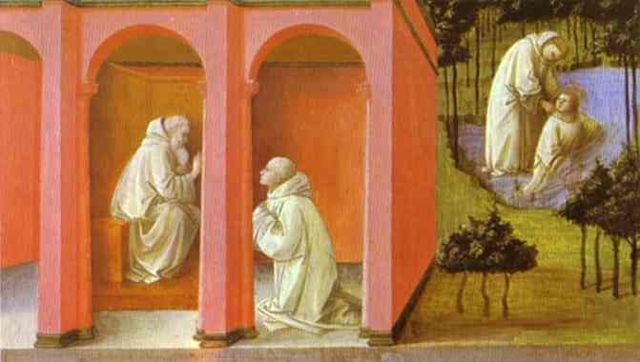
A nobleman, named Eguitius, gave his little son Maurus, aged twelve, to the holy patriarch [the title of the bishops of the great ancient sees: Rome, Constantinople, Alexandria, Antioch, Jerusalem] Benedict, to be by him educated. The youth surpassed all his fellow monks in the discharge of his monastic duties, and when he was grown up, S. Benedict [father of Western monks (d. c. 547), author of the Rule] made him his coadjutor [an assistant bishop who will succeed the current one] in the government of Subiaco. Placidus, a fellow-monk, going one day to fetch water, fell into the lake, and was carried about a bow-shot from the bank. S. Benedict seeing this from his cell, sent Maurus to run and draw him out. Maurus obeyed, walked upon the water, without perceiving it, and pulled out Placidus by the hair, without himself sinking.
The fame of Benedict and his work had not been slow to cross the frontiers of Italy; it resounded especially in Gaul [roughly modern France and Belgium]. A year before the death of the patriarch, two envoys arrived at Monte Cassino, from Innocent, Bishop of Mans, who, not content with forty monasteries which had arisen during his episcopate in the country over which he ruled, still desired to see his diocese enriched by a colony formed by the disciples of the new head and law-giver of the cenobites in Italy. Benedict confided this mission to the dearest and most fervent of his disciples, the young deacon Maurus. He gave him four companions, one of whom, Faustus, is the supposed author of the history of the mission; and bestowed on him a copy of the rule, written with his own hand, together with the weights for the bread, and the measure for the wine, which should be allotted to each monk every day, to serve as unchanging types of that abstinence which was to be one of the strongest points of the new institution.
At the head of this handful of missionaries, who went to sow afar the seed destined to produce so great a harvest, Maurus came down from Monte Cassino, crossed Italy and the Alps, paused beneath the precipices which overhang the monastery of Agaunum now S. Maurice in the Valais, beside the foaming Rhone, which the Burgundian king, Sigismund, had just raised over the relics [the bodily remains of a saint, or objects they used, kept with honor] of the Theban Legion; then went into the Jura to visit the colonies of Condate. Arrived upon the banks of the Loire, and repulsed by the successor of the Bishop who had called him, he stopped in Anjou, which was then governed by a viscount called Florus, in the name of Theodebert, King of Austrasia. This viscount offered one of his estates to the disciple of Benedict, that he might establish his colony there, besides giving one of his sons to become a monk, and announcing his own intention of consecrating himself to God. On this estate, bathed by the waters of the Loire, Maurus founded the monastery of Glanfeuil, which afterwards took his own name. The site of this monastery, now lost among the vineyards of Anjou, merits the grateful glance of every traveller who is not insensible to the advantages which flowed from that first Benedictine [monks following the Rule of St. Benedict] colony over the whole of France.
The beloved son of S. Benedict spent forty years at the head of his French colony; he saw as many as a hundred and forty monks officiate there; and when he died, after having lived apart for two years in an isolated cell, to prepare himself in silence for appearing before God, he had dropped into the soil of Gaul, a germ which could neither perish nor be exhausted.
In art, S. Maurus is represented holding the weights and measures given him by S. Benedict.