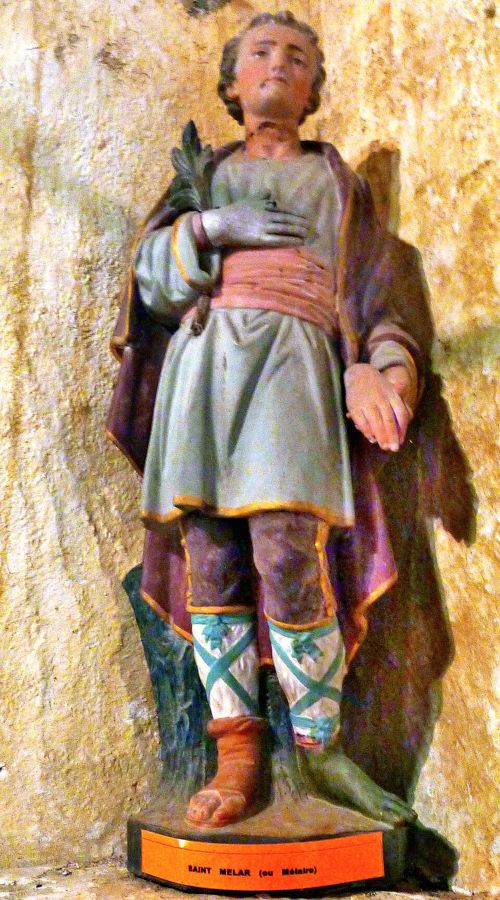
St. Melor

Faithfulness to Christ when it cost everything.

Read the essentials →
January 3 · Martyr

St. Melor

St. Melor

Faithfulness to Christ when it cost everything.

Traditional feast

January 3
1914 / pre-1969 calendar, per Baring-Gould (1914)

Current feast

January 3 (also listed: October 1, August 28, October 25, December 4)
Secondary source · Wikipedia

Represents

Martyr

Their story

Adapted in modern English from Baring-Gould (1914) · original text below

The legend of Melor comes from the early Celtic Church of Cornwall and Brittany. Melian, a prince of Cornwall, was murdered by his brother Rivold. Rivold spared Melian's young son Melor only at the pleading of the bishops and clergy, but he cut off the boy's right hand and left foot and sent him to a monastery.

Melor was given a silver hand and a bronze foot. At fourteen, out gathering nuts with his abbot, he was seen gripping the branches with the silver hand as if it were flesh. A stone he threw sank into the ground, and a spring burst out. Afraid the boy would overthrow him, Rivold bribed his guardian Cerialtan to kill him. Cerialtan cut off Melor's head and carried it to the duke, while angels stood guard with lights around the body. On the way, dying of thirst, Cerialtan heard the head tell him to strike the ground with his rod, and water sprang up. Rivold touched the head, fell sick, and died three days later. The head was reunited with the body, and the relics were later taken to Amesbury in Wiltshire.

Baring-Gould warns that the lives of the early British and Irish saints were written down centuries after their deaths. Their facts are wrapped in so much fable that truth can no longer be separated from it.
Why they’re the patron of…

  • Amesbury · Tradition
    His relics were enshrined there in the Middle Ages.

Early life

Selected sentences from the original account, unaltered.

He, however, cut off his right hand and left foot, and sent him into one of the Cornish monasteries to be brought up.

What they represent

How they teach us to live

Drawn from themes in the original account

Learn from the kind of life it was. Faithfulness to Christ when it cost everything.

Keep their day. Remember them on January 3 with a short prayer, and ask for their help.

Read more

The full original · 391 words

Read Baring-Gould’s full account

Baring-Gould’s sources: English Martyrologies on this day, though he died on Oct. 1st, on which day he is mentioned in Usuardus. His life in Capgrave is of no historical value—a composition of the 11th cent. "incertum" even to William of Malmesbury.

When first Christianity penetrated Britain, a great number of Saints existed, especially in Wales and Cornwall. At this time there was a duke, or prince, of Cornwall, named Melian , whose brother, Rivold, revolted against him, and put him to death. Melian left a son, Melor, and the usurper only spared his life at the intercession of the bishops and clergy. He, however, cut off his right hand and left foot, and sent him into one of the Cornish monasteries to be brought up.

The legend goes on to relate that the boy was provided with a silver hand and a brazen foot, and that one day, when he was aged fourteen, he and the abbot were nutting together in a wood, when the abbot saw the boy use his silver hand to clasp the boughs and pick the nuts, just as though it were of flesh and blood. Also, that one day he threw a stone, which sank into the earth, and from the spot gushed forth a fountain of pure water.

Rivold, fearing lest the boy should depose him, bribed his guardian, Cerialtan, to murder him. This Cerialtan performed. He cut off the head of Melor, and carried it to the duke; but angels with lights stood around the body and guarded it.

On his way to the duke, Cerialtan was parched with thirst, and exclaimed, "Wretched man that I am! I am dying for a drop of water." Then the head of the murdered boy said, "Cerialtan, strike the ground with thy rod, and a fountain will spring up." He did so, and quenched his thirst at the miraculous well, and pursued his way. When Rivold saw the head, he touched it, and instantly sickened, and died three days after. The head was then taken back to the body, and was buried with it. But the relics [the bodily remains of a saint, or objects they used, kept with honor] were afterwards taken to Amesbury, in Wiltshire.

It must be remembered, in reading the legends of the British and Irish Saints of the first period, that we have nothing like contemporary histories of their lives, and that these legends were committed to writing many hundreds of years after their death, so that the original facts became surrounded with an accretion of fable so dense that it is impossible to distinguish truth from falsehood in the legends as they have reached us.

Feast days

Feast: January 3

Nine days · Free

Pray the novena
with us.

One short email a day for nine days. The day's prayer, a line from St. Melor's story, and a nudge to keep going.

Also on January 3
St. Anteros

St. Anteros

January 3 · Priest, Martyr
Z

Sts. Zosimus and…

January 3 · Martyrs
P

St. Peter Balsam

January 3 · Martyr
← All 1726 saints in the library
Sources & notes

Feast-day sources

Story sources

Sources

Credits

Image: 017 Plonivel Saint Mélar.JPG · Moreau.henri · CC BY-SA 4.0, via Wikimedia Commons

From Sabine Baring-Gould, The Lives of the Saints, new and revised edition (Edinburgh: John Grant, 1914; first edition 1872). Public domain.

Image: Moreau.henri, Wikimedia Commons (CC BY-SA 4.0)

From Sabine Baring-Gould, The Lives of the Saints, new and revised edition (Edinburgh: John Grant, 1914; first edition 1872). Public domain in the United States. Reproduced unedited, except for short bracketed notes in grey that we added to explain names and terms (“S.” is the old abbreviation for Saint). Some history and judgments reflect 19th-century scholarship.