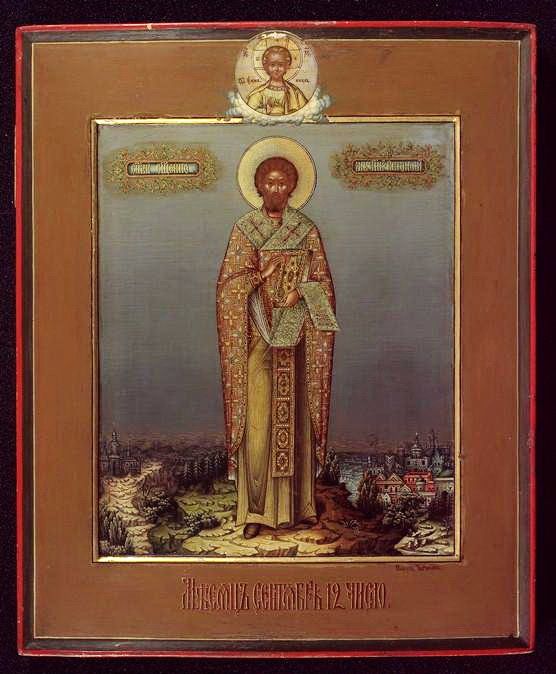
Their story
(The surviving account on this page begins partway through the story.)
These Acts (the written account of a martyr's trial and death) are wild legend, and Baring-Gould tells them with open scorn. In them, the emperor Maximinus has his own son Nicetas cut into five thousand pieces, but the pieces rejoin and the five thousand executioners are converted.
He survives a red-hot skewer, being tarred and burned, and a well, from which St. Michael pulls him. He raises the dead and baptizes them. When the emperor has him beaten, the empress protests, a rising breaks out and Maximinus is killed; Nicetas baptizes the crowd and dies peacefully. His body is shown at S. Raphael's in Venice, and Clement VIII approved an office using these Acts.
Baring-Gould mocks the detail that the five thousand returned to the emperor without the expected scraps of flesh, and that the empress, who had borne the cutting and skewering patiently, objected only to a beating. St. Michael announces that anyone invoking Nicetas will obtain whatever he asks.