St. Symmachus, Pope

Symmachus, a Sardinian, was elected pope on 22 November 498.

Read the essentials →
July 19 · —

St. Symmachus

St. Symmachus, Pope

Symmachus, a Sardinian, was elected pope on 22 November 498.

Traditional feast

July 19
1914 / pre-1969 calendar, per Baring-Gould (1897)

Current feast

July 19
Secondary source · Wikipedia

Represents

Feast

Their story

Adapted in modern English from the Catholic Encyclopedia (1913) · original text below · little is known

Symmachus, a Sardinian, was elected pope on 22 November 498. The same day a rival faction chose Laurentius. Both sides agreed to let King Theodoric decide, and he ruled for Symmachus as the first chosen and by the majority. Symmachus then made Laurentius a bishop, and a synod in 499 forbade canvassing for the papacy during a pope's lifetime. He died on 19 July 514.

Early life

The book says little or nothing about early life. This is how the account begins.

The death of Anastasius was the signal for a collision of these rival parties in Rome; each elected a pope, the former chose the archpriest Laurence, the latter the deacon Symmachus, a Sardinian, and a convert from paganism. 2 The rival pontiffs were consecrated the same day, Symmachus in the Lateran Church, Laurence in the basilica of S. Maria. At the head of the party of Laurence stood 1 u Namque et predecessor noster Papa Felix, et etiam Acacius illic proculdubio sunt: ubi unusquisque sub tanto judice non potest perdere sui meriti qualitatem.' J 3 "Catholica tides, quam in sede beati Petri, veniens ex paganitate, snscepi.,J — Epist. ad Anastat.

What they represent

How they teach us to live

Drawn from themes in the original account

Give to people in need. The account records care for the poor.

Keep their day. Remember them on July 19 with a short prayer, and ask for their help.

From the Catholic Encyclopedia

1913 · 2256 words

Date of birth unknown; d. 19, July, 514. According to the "Liber pontificalis" (ed. Duchesne, I, 260) he was a native of Sardinia and his father was named Fortunatus. Symmachus was baptized at Rome (Thiel, "Epist. pont. rom.", I, 702), entered the ranks of the clergy of Rome, and was ordained deacon. Directly after the death of Pope Anastasius II, Symmachus was elected his successor by a majority of the Roman clergy at the Lateran [St. John Lateran, the pope’s cathedral in Rome] Basilica on 22 November, 498. The election was approved by a part of the Roman senate and he was at once consecrated Bishop of Rome. Later on the same day a minority of the clergy who were friendly to the Byzantines and were supported by a party in the Senate met in the Basilica of Santa Maria Maggiore and elected the Roman archpresbyter Laurentius as antipope. According to Theodorus Lector (P.G., LXXXVI, 193), the Laurentian party was aided with money supplied chiefly by the rich Senator Festus, who hoped that Laurentius would be influenced by this to sign the "Henotikon", the edict of faith of the Emperor Zeno. The other authorities do not speak of such motives, which are very probable, and the testimony of Theodorus can very readily be accepted. Both parties, however, agreed that the two candidates should appear at Ravenna before the Gothic king Theodoric, the ruler of Italy, and abide by his decision. Theodoric pronouncing in favour of Symmachus on the ground that he was elected first and by the majority of the clergy, Laurentius submitted to the decision. At a synod held at Rome on 1 March, 499, the Acts of which have been preserved, Symmachus, who was now universally acknowledged, bestowed on Laurentius the Diocese of Nocera in Campania. The synod ordained that any Roman cleric who sought to gain votes for a successor to the papacy during the lifetime of the pope, or who called conferences and held consultations for that purpose, should be deposed. King Theodoric was given a vote of thanks by acclamation for his unpartizan decision. When the king came to Rome in the following year he had a brilliant reception both from the pope and the people. However, the Byzantine party, headed by the two senators Festus and Probinus, did not abandon its hostility and hope of overthrowing the pope and gaining the papal see for Laurentius. The opportunity occurred in the following year, 501. Pope Symmachus celebrated Easter on 25 March, following the old Roman cycle, while the Byzantines and others observed the feast on 22 April, according to a new reckoning. The Laurentian party appealed to King Theodoric against the pope, making other accusations besides this digression in the celebration of Easter. Theodoric summoned the pope and Symmachus set out to meet him. At Rimini Symmachus learned the contents of the indictment and, refusing to acknowledge the king as his judge, returned home. The opposing party now accused him of squandering the property of the Church and other matters. It gained in strength and occupied the Lateran palace, so that the pope was obliged to live near the Church of St. Peter outside the city walls. His opponents requested the king to call a synod for the investigation of the accusations and to appoint a visitor for Rome. Symmachus agreed to the calling of a synod, but he and his adherents protested against the sending of a visitor. Theodoric, however, sent as visitor Bishop Peter of Altinum in upper Italy, who was to administer the Roman Church in the place of the accused pope. Peter came to Rome and, contrary to the commands of king, allowed himself to be won over by the adherents of Laurentius, so that Theodoric at a later date dismissed him. Not long after Easter, between May and July, 502, the synod met in the basilica of Julius (Santa Maria in Trastevere). The pope declared before the synod that it had been called with his consent and that he was ready to answer the accusations before it, if the visitor were removed and he were re-established as the administrator of the Church. To this the majority of the bishops agreed and sent an embassy to the king to demand the execution of these conditions. Theodoric, however, refused, and demanded, first of all, an investigation of the accusations against the pope. A second session of the synod was held, therefore, on 1 September, 502, in the Sessorian basilica (Santa Croce in Gerusalemme), and the minority had the indictment made by the Laurentian party read aloud. Symmachus desired to go from St. Peter's to the synod in order to defend himself, but on the way there he was attacked by his opponents and maltreated, and, escaping only with great difficulty, returned to St. Peter's; several priests who were with him were killed or severely wounded. The Goths [Germanic peoples who invaded the Roman Empire, many of them Arian Christians] sent by Theodoric promised him a reliable escort but the pope now refused to appear before the synod, although invited three times. Consequently the assembled bishops declared at the third session, held about the middle of September, they could not pass judgment upon the pope, because he had appeared twice before his judges, and because there was no precedent showing that an occupant of the Roman See had been subjected to the judgment of other bishops. They called upon the opposing clergy to submit to the pope, and requested the king to permit the bishops to return to their dioceses. All these steps were in vain; the majority of the clergy and people sided indeed with Symmachus, but a minority of the clergy and a majority of the Senators were at that time partizans of Laurentius. A fourth session, therefore, was held on 23 October, 502, called the "Synodus Palmaris" (Palmary synod) either from the place where it was held (ad Palmata, Palma), or because it was the most important session (palmaris). At this session it was decided that on account of the reasons given earlier the decision must be left to the judgment of God; Symmachus was to be regarded as free from all the crimes of which he was accused, and therefore entitled to the full exercise of his episcopal office; the whole property of the church was to be transferred to him; whoever returned to his obedience should escape punishment, but whoever undertook ecclesiastical functions at Rome without papal permission was to be regarded as a schismatic. The decision was signed by seventy-five bishops, among them the bishops of Milan and Ravenna. Many bishops now returned to their dioceses. The majority, however, met with the Roman priests in St. Peter's for a fifth session under the presidency of Symmachus on 6 November, 502. The edict issued by the prefect Basilius, in 483, regulating the administration of the possessions of the Church was declared invalid and Symmachus issued a new edict respecting the administration of this property, and especially in regard to its sale.

King Theodoric, not satisfied with the decision of the synod, although the great majority of the Italian episcopate was on the side of the rightful pope, did nothing to carry out the new ordinances. Consequently the opposition called its candidate Laurentius again to Rome. He resided in the Lateran palace, which was in the hands of his adherents, while Symmachus retained the house of the bishop (episcopium) near St. Peter's. The division continued for four years, during which both parties carried on a furious quarrel at Rome. Laurentius had his portrait added to the series of popes in the Church of Saint Paul Without the Walls. However, certain prominent persons exerted their influence in favour of Symmachus, as Bishop Avitus of Vienne, who, at the request of the Gallican bishops, addressed an urgent letter to the Senate on behalf of the rightful pope and for the restoration of unity. Symmachus gradually won over a number of adherents of the opposition. The greatest factor in the healing of the schism was the interposition of Deacon Dioscurus of Alexandria, who had come to Rome. He was commissioned by Symmachus to go to Theodoric, and won the king over to the side of the rightful pope. Apparently political motives were involved, as the king wished to take action against the Laurentian party, which inclined to Constantinople. He commanded Senator Festus, the head of the hostile party, to return all Roman churches to Symmachus. Laurentius having lost many adherents among the senators the king's command was executed without difficulty. The antipope, obliged to leave Rome, retired to a farm belonging to his protector Festus. Only a small party still held to Laurentius and refused to recognize Symmachus as Bishop of Rome; but it was insignificant and was reconciled later to Hormisdas, the successor of Symmachus. During the schism a number of polemical writings appeared, as from the party of Laurentius the treatise "Contra Synodum absolutionis incongruae", to which Deacon Ennodius replied in "Libellus adversus eos qui contra Synodum scribere praseumpserunt" ("Mon. Germ. Hist.: Auct. ant.", VII, 48 sq.). While the author of the life of Symmachus in the completely preserved text of the "Liber pontificalis" is very favourable to the pope, the writer of another continuation of the papal biographies supports the cause of Laurentius ("Fragment Laurentine", ed. Duchesne in "Liber pontificalis", I, 44-46). During the dispute the adherents of Symmachus drew up four apocryphal writings called the "Symmachian Forgeries"; these were: "Gesta synodi Sinuessanae de Marcellino"; "Constitutum Silvestri", "Gesta Liberii"; "Gesta de purgatione Xysti et Polychronii accusatione". These four works are to be found in Coustant, "Epist. rom. pontif." (Paris, 1721), appendix, 29 sq.; cf. Duchesne, "Liber pontificalis", I, introduction, CXXXIII sq.: "Histoire littéraire des apocryphes symmachiens". The object of these forgeries was to produce alleged instances from earlier times to support the whole procedure of the adherents of Symmachus, and, in particular, the position that the Roman bishop could not be judged by any court composed of other bishops. Still these forgeries are not the first documents to maintain this latter tenet.

Symmachus zealously defended the supporters of orthodoxy during the disorders of the Acacian schism. He defends, although without success, the opponents of the "Henotikon" in a letter to Emperor Anastasius I (491-518). At a later date many of the persecuted oriental bishops addressed themselves to the pope to whom they sent a confession of faith. Shortly after 506 the emperor sent him a letter full of invectives, to which the pope sent a firm answer, maintaining forcibly the rights and liberty of the Church (Thiel, "Epist. rom. pont.", I, 700 sq.). In a letter of 8 October, 512, addressed to the bishops of Illyria, the pope warned the clergy of that province not to hold communion with heretics. Soon after the beginning of his pontificate Symmachus interposed in the quarrel between the Archbishops of Arles and Vienne as to the boundaries of their respective territories. He annulled the edict issued by Anastasius II in favour of the Archbishop of Vienne and later (6 November, 513) confirmed the metropolitan [the archbishop who heads a group of dioceses] rights of archbishop Caesarius of Arles, as these had been fixed by Leo I. Moreover, he granted Caesarius the privilege of wearing the pallium [a woolen band the pope gives to archbishops as a sign of their authority], the first-known instance of such a grant by the Holy See to a bishop outside of Italy. In a letter of 11 June, 514, he appointed Caesarius to represent the interests of the Church both in Gaul [roughly modern France and Belgium] and Spain, to hold synods of the bishops in certain cases, to give letters of recommendation to clergy who journeyed to Rome. More important matters were to be laid before the Holy See. In the city of Rome, according to the "Liber pontificalis", the pope took severe measures against the Manichaeans, ordered the burning of their books, and expelled them from the city. He erected or restored and adorned various churches. Thus he built a Church of St. Andrew near St. Peter's, a Basilica of St. Agnes on the Via Aurelia, adorned the Church of St. Peter's, completely rebuilt the Basilica of Sts. Sylvester and Martinus, and made improvements over the Catacomb of the Jordani on the Via Salaria. He built episcopal houses (episcopia) to the right and left of the parvis of St. Peter's. These buildings were evidently connected with the residence of the pope for several years near St. Peter's during the disorders of the Laurentian schism. He also built asylums for the poor near the three churches of St. Peter, St. Paul, and St. Laurence that were outside the city walls. The pope contributed large sums for the support of the Catholic bishops of Africa who were persecuted by the rulers of the Arian [followers of Arius, who taught that the Son is a created being, not fully God] Vandals. He also aided the inhabitants of the provinces of upper Italy who suffered so sorely from the invasion of the barbarians. After his death he was buried at St. Peter's. Symmachus is venerated in the Roman Church as a saint.

Read the rest of the article

Liber pontificalis, ed. DUCHESNE, I, 260-268; JAFFE, Regesta pont. rom. (2nd ed.), I, 96 sq.; THIEL, Epist. rom. pontif., 639 sq.; Acta synodorum Romae habit. a. 499, 501, 502 in Mon. Germ. Hist.: Auct. ant., XII, 393 sq.; GRISAR, Gesch. Roms under der Papste, I, 460 sqq.; LANGEN, Gesch. der römischen Kirche, II, 219 sqq.; HEFELE, Hist. of the Councils of the Church, tr. CLARK, IV (Edinburgh, 1895), 49 sqq., 58-75; STOBER, Quallenstudien zum laurentianischen Schisma in Sitzungsber. der Wiener Akademie, CXII (1886), 269 sqq.; MAASSEN, Gesch. der Quellen des Kirchenrechtes, I, 411 sqq.; PFEILSCHIFTER, Theoderich der Grosse in Weltgeschichte in Karakterbildern (Mainz, 1910), 44 sqq.; HARTMANN, Gesch. Italiens im Mittellter, I (Leipzig, 1897), 142 sqq.
Read more

The full original · 1598 words

Read Baring-Gould’s full account

Baring-Gould’s sources: Roman Martyrology. Not found in any Marty rologies prior to the i6th cent. Authorities: — Anastasius Bibliothecarius, his own letters, and writers of the period in Muratori.] The Eastern and Western Churches had been estranged since Felix III,, Pope of Rome, and Acacius, patriarch of Constantinople, had mutually excommunicated each other in 484. Felix died, Acacius died; but the two Churches remained separate. Felix would not be reconciled till the name of Acacius was struck out of the diptychs, when Acacius died in 489. To pray for him, to commemorate him at the altar, was to doubt the damnation of the man who had dared to fulminate excommunication against the successor of S. Peter. Felix was succeeded, in 492, by Gelasius I., and the schism remained unhealed; the Churches of the East persisted in mentioning Acacius in their eucharistic supplications. Gelasius died in 496, and Anastasius II. succeeded him. “ Felix and Acacius T^y xg.] S. Symmachiis. 449 are now before a higher tribunal than ours/' said the gentle pope; “ leave them to that unerring judgment.” 1 He made overtures of reconciliation, and even, it is asserted, admitted to communion a deacon of Thessalonica who had kept up communion with Acacius. His sudden death, after a brief pontificate of two years, cut short all prospect of reconciliation of the schism. The mild measures of Anastasius seem to have given rise to a party in Rome, headed by the senator, Festus Niger, which was desirous to see the wretched schism healed, and the terms of compromise approved by Pope Anastasius made a basis for general reconciliation. On the other side there was a party opposed to every compromise, demanding the erasure of the name of Acacius, now dead fourteen years, from the diptychs, as one damned beyond redemption, and the rejection of the Henoticon of Zeno, which had been accepted by the greater part of the Eastern Church as terms of mutual forbearance, without compromise of principle. But the Henoticon did not formally accept as final the ruling of the Council of Chalcedon, and without the enunciation of heresy it evaded stigmatizing as heretical the views held by the Euty chians.

The death of Anastasius was the signal for a collision of these rival parties in Rome; each elected a pope, the former chose the archpriest Laurence, the latter the deacon Symmachus, a Sardinian, and a convert from paganism. 2 The rival pontiffs were consecrated the same day, Symmachus in the Lateran [St. John Lateran, the pope’s cathedral in Rome] Church, Laurence in the basilica of S. Maria. At the head of the party of Laurence stood 1 u Namque et predecessor noster Papa Felix, et etiam Acacius illic proculdubio sunt: ubi unusquisque sub tanto judice non potest perdere sui meriti qualitatem.' J 3 "Catholica tides, quam in sede beati Petri, veniens ex paganitate, snscepi.,J — Epist. ad Anastat.

the senator Festus and the saintly deacon Pascasius, noted ‘ for his love of the poor, his self-denial, and meekness. Pascasius, till his death, clave to the party of Laurence; he has left two books on the divinity of the Holy Ghost, which are still extant.

The two factions encountered one another with the fiercest hostility; the clergy, the senate, the populace were divided; the streets of' the Christian city ran with blood, as in the days of republican strife; and each party laid the blame of these atrocities on the other, 1 To terminate the schism it was resolved to appeal to the judgment of the Gothic Arian [followers of Arius, who taught that the Son is a created being, not fully God] king, Theodoric. He decided, with rough common sense, that he was pope who. counted the largest number of votes. Symmachus fulfilled this requisite, and was therefore acknowledged by the Gothic king as the legitimate pope. He at once summoned a council to lay down rules to restrain the contests and violence which too often desecrated the. election of a pope.

Theodoric visited Rome in order to lend the weight of his presence towards establishing Symmachus firmly on his contested throne. He was met by the pope at the head of his clergy, and by the senate, and he was conducted to S. Peter’s, where he performed his devotions with the fervour of a Catholic.

For a while the party of Laurence was overawed; but when the king withdrew it raised its head again. Strange • rumours of crimes laid to the charge of Symmachus circulated in Rome and Italy. It was breathed in the ear that he had fallen into adultery. Some of the Roman clergy and senators took the charge up, and denounced him to 1 The author of the Hist. Miscell. asserts that the adherents of Laurence slew their opponents. A fragment of a writer on the other side, published by Muratov, ascribes these acts of violence, slaughter, and pillage, to Symmachus. July i the Gothic king. Theodoric sent Peter, bishop of Altino, to Rome, to investigate the truth of these accusations, ordering him to require Symmachus to surrender to him his slaves to be examined by him, but not to be tortured into giving evidence against their master. The bishop of Altino, it is said, did not follow out exactly his instructions; he sided with the enemies of the pope. Symmachus was summoned to Ravenna, and confined in Rimini. But finding that prejudices were darkening against him in the court of the Gothic king, where some ladies of rank had appeared and borne witness against him, he escaped to Rome. Again sanguinary tumults broke out between the factions; priests were slain, monasteries burnt, and even sacred virgins treated with the utmost indignity* Theodoric then summoned a Council of Italian prelates to meet at Rome and hear the charges laid against the pope. The Italian bishops protested against the right of the king to convene a council, but did not refuse to attend. At the first session Symmachus set forth to attend the Council, but was assailed on the way by the mob, which pelted him with stones. Many of the priests who attended him were knocked down, their heads cut open and bruised, and the pope only escaped under shelter of the shields of his Gothic guard.

The final, named the Palmary, synod was most numerously attended. It passed judgment on the matter in somewhat vague terms: “ We declare that Pope Symmachus, as to men, is innocent of the charges laid against! him, and must be left to the judgment of God. 1 We order that he shall minister in sacred things in all the churches depending on his see. We exhort all the faithful to receive the Holy Communion from him, under pain of giving account before the judgment seat of God. Those clerks who have made a schism shall be restored to their functions when they have asked pardon of the pope; but whosoever after this shall offer sacrifice without the consent of pope Symmachus, shall be punished as a schismatic. It was a verdict of Not Proven, rather than a full acquittal; yet the finding was impeached by the enemies of Symmachus, and S. Ennodius was obliged to defend it in a lengthy apology. 1 The decree of the Council when it reached Gaul [roughly modern France and Belgium] alarmed the bishops, and S. Avitus of Vienne, in their name, wrote to the senate, to Faustus and Symmachus, patricians and princely consuls, to remonstrate against bishops assembling under the authority of a king to judge a pope. This they deemed a dangerous innovation.

Pope Symmachus also wrote an apology for himself against the emperor Anastasius, who had called him a Manicheean. The pope enquired, “ Am I an Eutychian [followers of Eutyches, who said Christ had only a divine nature; condemned at Chalcedon in 451] ? Do I protect the Eutychian s whose errors approach those of the Manichees.” 2 And indeed Symmachus had burned the books of the Manichseans which he had found in Rome, and had expelled the luckless heretics from the city. “You say,” continued the pope, “that I have conspired with the senate to excommunicate you. It is true; but in so doing I have followed the example of my predecessors. You say, What does it concern me what Acacius did ? Well, then abandon Acacius to prove that you are disinterested. I ask for nothing else. It is not you, sire, whom we excommunicate; but Acacius ” — dead fourteen years before — “ separate yourself from him, and you will » In it he pretends that accession to the chair of S. Peter rendered the popes impeccable, or rather that God only permits such to become popes as are predestined to be saints. And therefore Symmachus was guiltless. A strange theory read by the light of the history of such popes as Benedict IX., John XXIII., Alexander 3 The value of the random charges made by one side against another, in those times so deficient in Christian charity, may be estimated by the fact that the odious imputation of Manichseanism laid on the pope by the emperor Anastasius was flung back in return on Anastasius, and jeopardized his throne, S. Symmackus.

free yourself from his excommunication, otherwise it is not we who excommunicate you • but you who cut yourself off from our communion.”

Roman undying abhorrence of the conciliatory conduct of Pope Anastatius II. found expression in the hope, the certainty of his condemnation in that dark circle of hell allotted to the violent against God, 1 whilst it has canonized the unbending orthodoxy of Symmachus, Gelasius, and Felix.

The question forces itself upon the reader, Was Symmachus guilty of the crime laid to his charge? It is impossible for us to decide. Those who, in the fury of party strife, did not hesitate to commit murder and rapine, may have felt slight scruple in suborning false witnesses. But at least Laurence, the anti-pope, and Paschasius, his adherent, were guiltless of complicity in any such nefarious proceedings. Their blamelessness, their eminent piety and sanctity, was on all hands acknowledged, and Laurence, had he not been an anti-pope, would certainly have been ranked among the Saints. We may wish that the Palmary Council had spoken with more unhesitating voice, if it were satisfied of the innocence of Symmachus, and had not given a judgment which is inconsistent with itself. If the party of Laurence were guilty — as the opposite faction maintained — of producing false evidence, that of Symmachus does not escape with clean hands, for to it is due the forgery of the Acts of the apocryphal Council of Sinuessa.

If Symmachus were guiltless, he perhaps deserves a place among the Saints as one who bore reproach, suffering wrongfully; but the Church hesitated for five hundred years before she inscribed him in her Martyrology. Of his private life and virtues we know nothing, except that he 1 Dante Inferno, xi, gave largesses to the poor, and built and enriched churches. That he was innocent of the grievous crime laid to his charge is probable, that he was rigidly orthodox is certain. No historian is less inclined than the late Dean Milman to relieve a Roman pontiff from any imputation of evil that can attach itself to his name, and his verdict is: — “ Considering the horror in which the crime of adultery was held in an ecclesiastic, we can scarcely suppose, either that the severe Theodoric would not have driven him from his presence, or that an assemblage of prelates would have attempted to shield a pontiff, of precarious and disputed title, without full and conclusive evidence of his guiltlessness.” The decision must be left, as it was left by the Palmary Council, “to the final judgment of God,” only regretting that, with the cloud still hanging over his memory, he should have been enrolled in the Roman Martyrology without evidence of a holy and devoted life; and that history does not afford us.

Feast days

Feast: July 19

Nine days · Free

Pray the novena
with us.

One short email a day for nine days. The day's prayer, a line from St. Symmachus's story, and a nudge to keep going.

Also on July 19
E

St. Epaphras

July 19 · Bishop, Martyr
M

St. Macrina

July 19 · Virgin
A

St. Arsenius

July 19 · Hermit
← All 1726 saints in the library
Sources & notes

Feast-day sources

Story sources

Sources

Credits

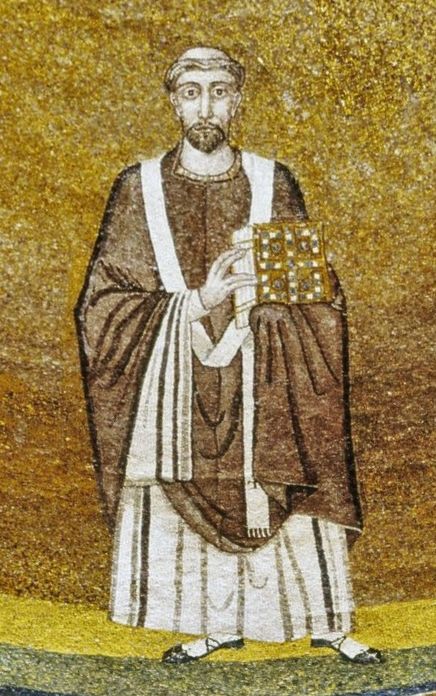
Image: Pope Symmachus – apse mosaic of Sant'Agnese fuori le mura.png · Unknown authorUnknown author · Public domain, via Wikimedia Commons

From Sabine Baring-Gould, The Lives of the Saints, new edition in 16 vols. (London: John C. Nimmo, 1897–98); text from the Internet Archive scan (OCR, lightly cleaned; errors possible). Public domain.

Image: Unknown authorUnknown author, Wikimedia Commons (Public domain)

From “Catholic Encyclopedia (1913)/Pope St. Symmachus,” The Catholic Encyclopedia (New York: Robert Appleton Company, 1907–1914), via Wikisource. Public domain. Matched by name and feast date; text unedited except for our bracketed notes in grey.

From Sabine Baring-Gould, The Lives of the Saints, new edition in 16 vols. (London: John C. Nimmo, 1897–98); text from the Internet Archive scan (OCR, lightly cleaned; errors possible). Public domain in the United States. Reproduced unedited, except for short bracketed notes in grey that we added to explain names and terms (“S.” is the old abbreviation for Saint). Some history and judgments reflect 19th-century scholarship.