Baring-Gould’s sources: Gallican and Roman Martyrologies. Also those of Usuardus and Wyon. Authority:—A life written by a contemporary, Jonas, a monk of the same abbey of Fontenelle to which S. Wulfram retired, of this there are several editions, some much interpolated. Some of these additions are gross errors. According to the life which Surius publishes, Jonas dedicated it to his abbot Bainus. But Bainus died seven years after Wulfram had undertaken his mission. Possibly Bainus is an error of the copyist for Wando, who translated the body of S. Wulfram in 742. In the prologue, moreover, Owen, or Ovus, the lad whom S. Wulfram had resuscitated after he had been hung, is quoted as the authority for much of what the bishop did in Friesland, Owen being then priest in the abbey of Fontenelle. This indicates the date of the life as being about the time of the translation.
Wulfram was born at Milly, three leagues from Fontainebleau, of a noble and wealthy family. His father, whose name was Fulbert, was held in great esteem by Dagobert I. and Clovis II. on account of the signal services he had rendered them in their wars. Although brought up, and constantly engaged in the camp, Fulbert took care that his son should receive an excellent education in letters; and as Wulfram exhibited a marked partiality for the clerical over the secular life, he suffered him to take holy orders [ordination; “orders” means the sacrament by which deacons, priests and bishops are ordained]. Wulfram was not, however, allowed to follow the bent of his wishes in every particular, for notwithstanding his desire to live a quiet secluded life of study, he was called in 670 to serve God in the court of Clothaire III. and Thierry III., kings of the Franks [the Germanic people who ruled Gaul and gave France its name], till the death of his father. About the same time, Lambert, bishop of Sens, having died, Wulfram was unanimously elected to fill his room, by clergy and people, and the royal consent having been obtained, he was consecrated to the see of Sens [a bishop’s “see” is his diocese, named from his seat (Latin sedes)], in 693. But "the Spirit breatheth where He wills, and thou canst not tell whence He cometh and whither He goeth." Moved by a divine call which could not be gainsaid, after having occupied the see for only two years and a half, Wulfram abdicted his charge in 685, probably moved by religious scruples as to the canonicity of his appointment, for S. Amæus, the rightful bishop of Sens, in the banishment to which he was sent by Thierry III. in 674, had survived the appointment of Lambert. Wulfram, freed from his charge, at once undertook a mission to Friesland. He conferred on his design with S. Ansbert, then archbishop of Rouen, after having been abbot of S. Vandrille. By his advice he retired for a while into that abbey of Fontenelle to prepare for his apostolate to the Frisians, in solitude, with prayer. After awhile he came forth refreshed, and having divested himself of his property at Milly, his native place, which he gave to the abbey of S. Vandrille, that he might go unimpeded into the battle; and having obtained from the abbot, Hilbert, some monks to accompany him and assist him in his mission, he embarked at Caudebec, in 700, spread the white sail to the breeze, and flew out into the sea.
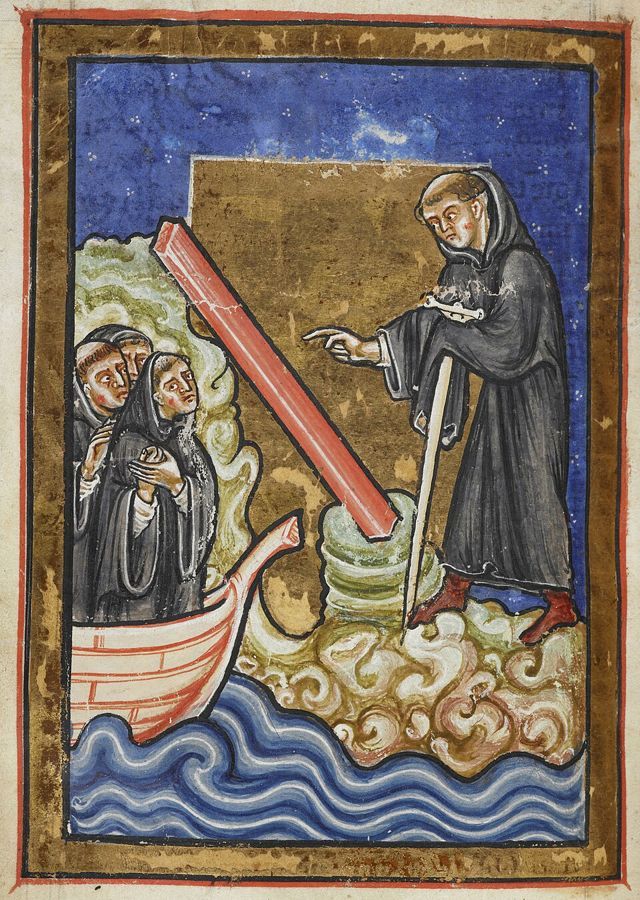
But as the deacon was wiping the paten, during mass, it slipped from his fingers, and glanced down through a green wave and was lost. Then he uttered a cry of dismay, for they had no other paten with them in the vessel. But Wulfram turning himself about from the altar in the ship's-bows, bade him thrust his hand over the side into the water. And he did so, nothing doubting, and brought up the paten, dripping with sea-water. This paten was preserved in the monastery of S. Vandrille till the year 1621, when it was stolen.
Now when they had come into Friesland, Wulfram went before the king, Radbod, and preached boldly to him the Word of God. The king listened, and allowed the missionaries to settle in the land, and to declare the Gospel of the Kingdom to his subjects, but he himself put off giving attention to what they taught till a more convenient season. And as Wulfram dwelt in the land, and saw it wholly given up to the worship of false gods, and to the performance of cruel sacrifices, his spirit was stirred within him, and he denounced the hideous offerings of children made to the false gods. It was then the custom among the Frisians to offer to Wodin their sons, by hanging them on gibbets. This method of sacrifice was common to all the Scandinavian and Teutonic peoples. One horrible instance is related, for instance, in one of the old Norse Sagas, of a mother thus sacrificing her child to Wodin to obtain from him the secret of brewing better ale than the second wife of her husband, in order that she might thus be able to attach him to herself more closely.
Wulfram preached in vain, king Radbod replied to all his remonstrances that it was the custom of the country, and that he could not, or would not alter it. And this was the way in which the victims were chosen. Lots were cast on the children of the nobles, and those who were taken, were hung on a tree or gibbet, to Wodin, or else were fastened to a post between tides, and left to drown with the rising flood, as an offering to Ran, the sea-goddess, to stay her from bringing her waves over the low, flat land, and submerging it.
Hearing that a child was about to be hung, Wulfram hasted to the spot, but was unable to prevent the perpetration of the sacrifice. Then after the boy had been hanging two hours, the rope broke, and the bishop casting himself on the body, cried to the Lord, and He heard his voice, and the child revived, and the bishop restored him to his parents. And on another occasion, he was present when two youths, sons of a widow, were being sacrificed to the sea. He saw the poor lads waiting on the wet sand, and shrieking with fear as the waves tumbled at every instant nearer to them, whilst all the people looked on, shouting to drown their cries, upon the dyke. Then Wulfram, unable to endure the spectacle, knelt down, and covered his eyes, and prayed. And when he looked up, he saw the sea was washing around the youths, but had not touched them. So he prayed more fervently, and the people standing on the dyke shouted, to drown the shrieks of the young men; and Wulfram looked, and they were up to their chins in water, battling with the angry waves. Then Radbod called to the bishop and said, "See! there be the youths, go, save them if thou canst." Then Wulfram rose, and made the sign of the cross, and cast his mantle from him, and went boldly down to the sea, and walked thereon without fear, trusting in the Lord, and he took the two children, one by each hand, and he came to the land leading them, with foot unwet.
Then the people were filled with wonder, and a great fear fell upon them, and many renounced their false gods, and came and submitted their necks to the sweet yoke of Christ. King Radbod also, convinced against his will, consented to receive baptism. But as he was stepping down into the water, he suddenly halted, with one foot in the stream, and asked, "Where are my ancestors, are they in the heaven thou promisest to me?"
"Be not deceived," answered Wulfram, "God knoweth the number of His elect. Thy ancestors have died without baptism, therefore they have certainly received the sentence of damnation." It was an injudicious answer. It is by no means certain that those who have not had an opportunity of knowing the truth, but have lived up to the light God has given them, are eternally lost. The result of this harsh answer was, that Radbod withdrew his foot from the water, saying, "I will go to hell with my ancestors, rather than be in heaven without them." It is only just to remark that this story is not to be found in the most correct and ancient copies of the life by Jonas of Fontenelle.
After about twenty years of labour in Friesland, his health failed, and he returned in haste to Fontenelle, to die amongst the brethren in the peace of a cloister. He died on March 20th, in the year 720. Nine years after, Wando, abbot of Fontenelle, took the body from its grave, and translated to the church of S. Peter. In 1058, it was taken to Notre Dame at Abbeville, and this church in course of years, assumed the name of S. Wulfram. The sacred relics [the bodily remains of a saint, or objects they used, kept with honor] remain there, enclosed in a rich shrine. An annual procession is made on this day at Abbeville with the shrine.