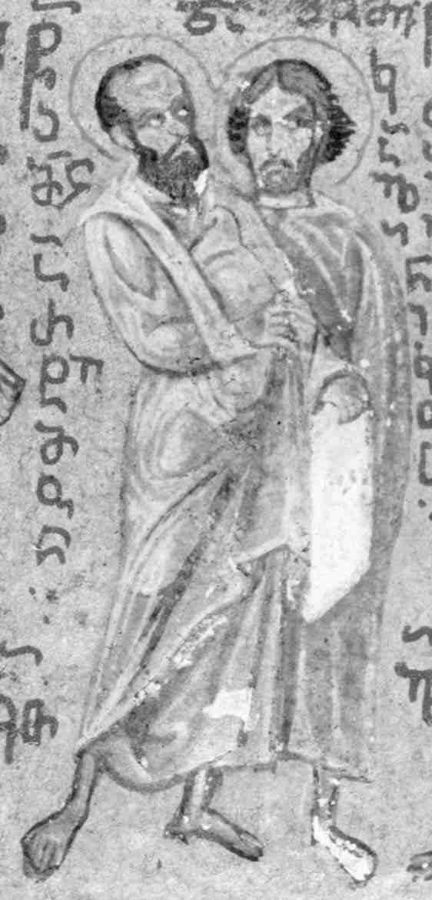
The Conversion of S. Paul is kept on January 25. Below is how Sabine Baring-Gould told it.
Read the essentials →The Conversion of S. Paul is kept on January 25. Below is how Sabine Baring-Gould told it.
January 25
Not verified yet
Feast
Thin entry · the 1914 book gives only 0 words. We have not filled the gap with invented detail.
Learn from the kind of life it was. Nobody is too far gone. The Church's worst enemy became its greatest missionary.
Keep their day. Remember them on January 25 with a short prayer, and ask for their help.
“Today we commemorate, not the whole history of St. Paul, nor his Martyrdom, but his wonderful Conversion. Every season of his life is full of wonders, and admits of a separate commemoration; which indeed we do make, whenever we read the Acts of the Apostles, or his Epistles. On this his day, however, that event is selected for remembrance, which was the beginning of his wonderful course; and we may profitably pursue (please God) the…”
“I love Rome even for this, although indeed one has other grounds for praising it, both for its greatness, and its antiquity, and its beauty, and its populousness, and for its power, and its wealth, and for its successes in war . But I let all this pass, and esteem it blessed on this account, that both in his lifetime he wrote to them, and loved them so, and talked with them whiles he was…”
Feast: January 25
One short email a day for nine days. The day's prayer, a line from The Conversion of S. Paul's story, and a nudge to keep going.
From Sabine Baring-Gould, The Lives of the Saints, new and revised edition (Edinburgh: John Grant, 1914; first edition 1872). Public domain.
John Henry Newman, “St. Paul's Conversion Viewed in reference to His Office” (Sermon 9) · Scripture: 1 Cor. xv. 9, 10; Acts xxii. 20; Isa. ix. 4; Isa. xxxvii. 28, 29
John Henry Newman, Parochial and Plain Sermons, vol. 2 (London: Rivington, 1835). Written in English; public domain. Published 1835 (before 1931): public domain in the U.S. Read the full text →
John Chrysostom, Homily 32 on Romans · Scripture: 2 Timothy 4:15; Philippians 3:19; Matthew 23:14; Deuteronomy 32:15
Trans. J. B. Morris and W. H. Simcox, rev. George B. Stevens, Nicene and Post-Nicene Fathers, NPNF I, vol. 11 (1889). Public domain. Translation published 1889 (before 1931): public domain in the U.S. Read the full text → · CCEL scan text
From Sabine Baring-Gould, The Lives of the Saints, new and revised edition (Edinburgh: John Grant, 1914; first edition 1872). Public domain in the United States. Reproduced unedited, except for short bracketed notes in grey that we added to explain names and terms (“S.” is the old abbreviation for Saint). Some history and judgments reflect 19th-century scholarship.