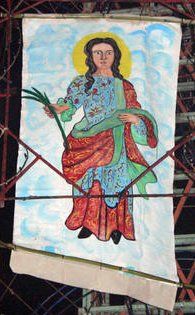
St. Prisca at Rome

Prisca was a girl of consular family.

Read the essentials →
January 18 · Virgin, Martyr

St. Prisca at Rome

St. Prisca at Rome

Prisca was a girl of consular family.

Traditional feast

January 18
1914 / pre-1969 calendar, per Baring-Gould (1914)

Current feast

January 18
Secondary source · Wikipedia

Represents

Virgin
Martyr

Their story

Adapted in modern English from Baring-Gould (1914) · original text below · little is known

Prisca was a girl of consular family. At thirteen she was accused of being a Christian, and the emperor Claudius ordered her to sacrifice to the idols. She steadfastly refused, so she was struck and thrown into prison. The next day she was pressed again, and when she would not yield she was beaten with rods and sent back to prison.

On the third day she was thrown to a lion, but it crouched at her feet and did not harm her. She was then tortured on the 'little horse' with hooks and pincers, led out of the city, and beheaded. It is said that an eagle guarded her body from the dogs until Christians came to bury it.
Early life

Selected sentences from the original account, unaltered.

Thin entry · the 1914 book gives only 123 words. We have not filled the gap with invented detail.

S. Prisca, a maiden of consular birth, being accused of Christianity, at the age of thirteen, was ordered by the Emperor Claudius to sacrifice to idols.

What they represent

How they teach us to live

Drawn from themes in the original account

Stay faithful when it costs you. This account is about holding firm under pressure.

Keep their day. Remember them on January 18 with a short prayer, and ask for their help.

Read more

The full original · 123 words

Read Baring-Gould’s full account

Baring-Gould’s sources: Roman Martyrology. She is often confounded with S. Priscilla mentioned in the Acts of the Apostles, the wife of Aquila, but called Prisca in the second epistle of Paul to Timothy. What adds to the confusion is, that S. Prisca is said in her Acts to have suffered under Claudius, but whether Claudius, who reigned from 41-54, or the second Claudius, who reigned from 263 to 270, is not stated; but it seems probable that it was under the first Claudius. [78] The Acts of S. Prisca are a forgery, and deserve no confidence. The following account is taken from the Martyrologies.

S. Prisca, a maiden of consular birth, being accused of Christianity, at the age of thirteen, was ordered by the Emperor Claudius to sacrifice to idols. On her steadfastly refusing, she was beaten with the hand and cast into prison. On the morrow she was again urged to sacrifice, but when she remained invincible, she was beaten with rods, and then taken back to prison. The third day she was exposed to a lion, which however crouched at her feet, doing her no injury. Then, having been tortured on the little horse, with hooks and pincers, she was led outside of the city, and was decapitated.

An eagle is said to have defended her body from dogs, till Christians came and buried it.

Feast days

Feast: January 18

Nine days · Free

Pray the novena
with us.

One short email a day for nine days. The day's prayer, a line from St. Prisca at Rome's story, and a nudge to keep going.

Also on January 18
P

St. Peter's Chair at Rome

January 18 · Feast
Sts. Paul and Thirty-Six Companions in Egypt

Sts. Paul and…

January 18 · Martyrs
A

Sts. Archelaa

January 18 · Virgins, Martyrs
← All 1726 saints in the library
Sources & notes

Feast-day sources

Story sources

Sources

Credits

Image: Santa prisca.jpg · ivan urbina · Public domain, via Wikimedia Commons

From Sabine Baring-Gould, The Lives of the Saints, new and revised edition (Edinburgh: John Grant, 1914; first edition 1872). Public domain.

Image: ivan urbina, Wikimedia Commons (Public domain)

From Sabine Baring-Gould, The Lives of the Saints, new and revised edition (Edinburgh: John Grant, 1914; first edition 1872). Public domain in the United States. Reproduced unedited, except for short bracketed notes in grey that we added to explain names and terms (“S.” is the old abbreviation for Saint). Some history and judgments reflect 19th-century scholarship.